Graphite Purification Methods: Processes, Advantages, Limitations, and Industrial Selection
Graphite Purification Methods: Processes, Advantages, Limitations, and Industrial Selection
Graphite purification is one of the foundations of graphite deep processing. In many industrial applications, graphite is not judged only by particle size or basic carbon content. The purity level directly influences conductivity, ash content, corrosion behavior, thermal stability, and downstream suitability for battery materials, semiconductor carbon materials, metallurgy, sealing systems, and high-temperature industrial parts. This is why graphite purification is not simply a beneficiation step. It is a key link between raw natural flake graphite and higher-value graphite products.
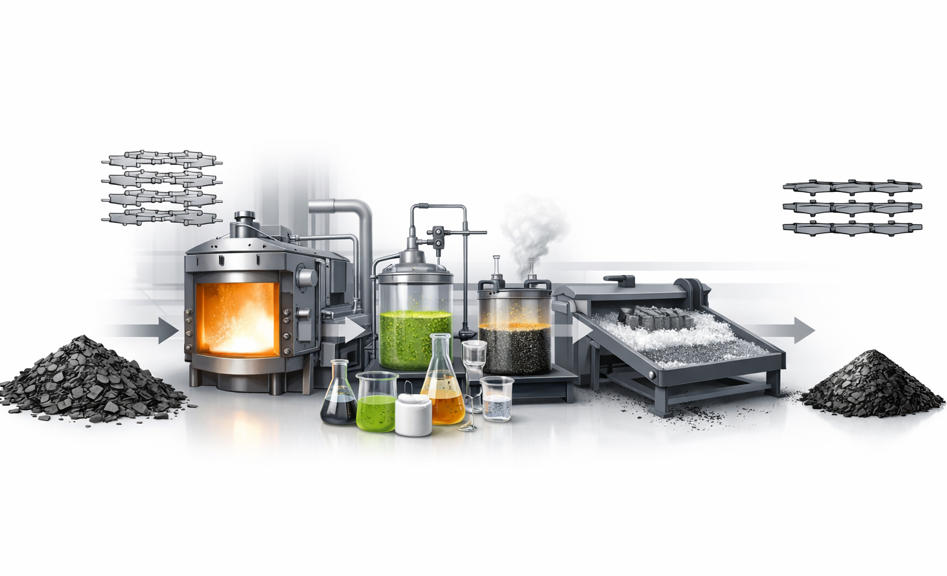
In industrial practice, graphite purification methods are usually divided into two broad categories: physical purification and chemical purification. Physical routes mainly include flotation and high-temperature purification. Chemical routes mainly include alkali-acid purification, hydrofluoric acid purification, and chlorination roasting. Each route has its own logic, cost structure, achievable purity level, environmental burden, and equipment requirement. There is no single universal method that is best in every case. The right choice depends on the target purity, raw material quality, environmental requirements, investment level, and end-use application.
Why Graphite Purification Matters
Natural graphite ore contains a range of impurities, including silicates and compounds containing silicon, aluminum, calcium, magnesium, iron, sodium, and potassium. For standard industrial uses, moderate purification may be sufficient. For higher-value applications, however, residual ash and impurity elements can significantly affect final performance. The deeper the downstream processing goes, the more important purification becomes.
For example, ordinary flotation can improve graphite grade substantially, but it is usually not enough for high-purity graphite applications above 99%. On the other hand, ultra-high-purity routes such as high-temperature purification can reach extremely high carbon content, but they come with major energy and equipment costs. This is why graphite purification should be understood as a balance among purity target, cost, safety, environmental pressure, and industrial practicality.
1. Flotation Purification
Flotation is one of the most common and important beneficiation methods in graphite processing. It relies on the natural floatability of graphite, which is difficult to wet with water and therefore separates relatively well from gangue minerals. In practice, flotation is often the first purification step for natural graphite, especially for flake graphite routes.
The main advantages of flotation are low energy consumption, relatively low reagent consumption, and mature industrial operation. Because the process can preserve flake structure better than aggressive chemical routes, it is especially important where large flake graphite value must be protected. In commercial beneficiation, flotation can often raise graphite grade to around 80% to 90%, and in some cases close to 95% fixed carbon.
Its limitation is equally clear: flotation alone usually cannot deliver ultra-high-purity graphite. Very fine silicate minerals and impurity compounds embedded within graphite flakes are difficult to remove only by grinding and flotation, especially without damaging the flake structure. For this reason, flotation is best understood as a primary enrichment method rather than a final high-purity solution.
2. Alkali-Acid Purification
Alkali-acid purification is one of the most widely used chemical purification routes for graphite. It generally includes two stages: alkali fusion and acid leaching. During alkali fusion, strong alkali reacts with acid-type impurities, especially silicon-containing minerals such as quartz, silicates, and aluminosilicates. During the acid-leaching stage, the remaining metallic oxide impurities are converted into soluble salts and washed out.
This route is widely used because it has relatively broad raw-material adaptability, mature industrial logic, and lower environmental pressure than hydrofluoric acid routes. It also places comparatively lower demands on plant conditions and initial investment, which is why it is often seen as one of the most practical industrial purification routes for high-carbon graphite.
Its disadvantages include high-temperature alkali fusion, long reaction time, and serious equipment corrosion. In most cases, the product purity is typically in the 99.0% to 99.9% range rather than the ultra-high-purity level achieved by high-temperature treatment. Even so, alkali-acid purification remains one of the most important industrial routes because it offers a workable compromise between purity, cost, and environmental manageability.
3. Hydrofluoric Acid Purification
Hydrofluoric acid purification is based on the fact that HF can react with a very wide range of mineral impurities, while graphite itself shows strong acid resistance, including resistance to hydrofluoric acid. In practice, graphite is mixed with HF so that impurity minerals react and are then removed by washing and drying. To deal with precipitated compounds formed with calcium, magnesium, iron, and similar elements, additional acids such as hydrochloric acid or nitric acid may also be introduced.
The main advantages of this route are relatively low energy consumption, simple process flow, high purification efficiency, and high product carbon content. It can produce high-grade purified graphite without requiring the extreme temperatures of thermal purification. In addition, it generally has limited negative impact on the graphite structure itself.
The major weakness is safety and environmental burden. Hydrofluoric acid is highly toxic and strongly corrosive. Wastewater treatment is difficult, and environmental compliance cost is high. Because of these issues, HF purification may be technically effective, but its industrial use is constrained by strict safety requirements, corrosion-resistant equipment, and wastewater management obligations.
4. Chlorination Roasting Purification
Chlorination roasting purifies graphite by converting impurity oxides into lower-melting or lower-boiling chlorides under high temperature and a controlled atmosphere. In simplified terms, impurity oxides such as silica, alumina, iron oxide, calcium oxide, and magnesium oxide can react with chlorine under suitable conditions, producing chlorides that volatilize and separate from graphite.
This method has several advantages. It can achieve relatively high purification efficiency, good recovery, and in some cases lower energy demand than ultra-high-temperature treatment. However, the disadvantages are serious: chlorine is toxic, the process is highly corrosive, and environmental pressure is significant. In addition, process stability and product consistency can be difficult to control, which has limited the broader industrial use of this route.
As a result, chlorination roasting is important in the technical history of graphite purification, but it is not the most commonly preferred industrial route today for routine graphite production.
5. High-Temperature Purification
High-temperature purification takes advantage of the fact that graphite has an extremely high sublimation or melting-related temperature compared with most impurity minerals. Under vacuum or oxygen-free conditions, graphite can be heated to around 2500°C or even 2700°C and above, allowing impurity species to vaporize and escape while the graphite remains. This route is capable of producing very high-purity graphite, often above 99.99%.
The strength of this method is product quality. For ultra-high-purity graphite required in defense, aerospace, nuclear, semiconductor, and other high-specification sectors, thermal purification is one of the most effective routes. Its weakness is cost. The furnace system must tolerate extreme temperatures, investment is high, power consumption is very high, and the raw material itself usually needs to be relatively clean before treatment in order to achieve the best economic result.
That is why high-temperature purification is generally reserved for small-batch or high-value production rather than standard large-volume industrial graphite grades.
6. Comparative View of the Main Purification Routes
| Method | Typical Purity Level | Main Advantages | Main Limitations | Typical Industrial Role |
|---|---|---|---|---|
| Flotation | Usually up to about 95% | Low cost, low energy use, mature, helps preserve flake structure | Usually insufficient for high-purity graphite above 99% | Primary enrichment and beneficiation |
| Alkali-Acid | About 99.0% to 99.9% | Broad adaptability, practical industrial route, lower environmental burden than HF | Long process, equipment corrosion, usually not ultra-high purity | Mainstream chemical purification |
| Hydrofluoric Acid | High purity | Simple flow, low energy demand, strong impurity removal | High toxicity, high corrosion, difficult wastewater treatment | High-purity route with environmental constraints |
| Chlorination Roasting | Relatively high | Good purification efficiency and recovery | Toxic chlorine, severe corrosion, environmental pressure, process instability | Specialized technical route with limited industrial adoption |
| High-Temperature | 99.99% and above | Very high purity, suitable for advanced applications | Very high investment and energy consumption | Ultra-high-purity graphite production |
7. Industrial Selection Logic
In real production, graphite purification is rarely selected by purity alone. A practical industrial route is usually decided by several questions: What purity is actually required? How much capital equipment can the plant support? What level of environmental burden can be managed? Is the target product a standard industrial graphite or a high-end graphite material for battery, semiconductor, or thermal-field use?
Under that logic, flotation is usually the starting point for natural graphite beneficiation. Alkali-acid treatment often serves as a practical high-purity route when the target is around 99% or slightly above. Hydrofluoric acid treatment may be attractive where process simplicity and purity matter, but environmental and safety requirements allow it. High-temperature purification becomes the preferred route only when ultra-high purity justifies its cost. Chlorination roasting remains technically important, but its use is narrower because of toxicity and process control issues.
8. Future Trends in Graphite Purification
The future of graphite purification is not likely to be defined by a single method. Several development trends are already clear. The first is continued improvement of existing methods, especially in process flow, energy efficiency, corrosion control, and wastewater treatment. The second is combined purification, because single routes often struggle to balance recovery, purity, cost, and environmental performance at the same time. In many practical cases, flotation plus chemical purification, or flotation plus alkali-acid plus thermal treatment, may offer better overall results than one method used alone.
A third trend is the development of new routes such as hydrothermal methods, plasma purification, and other lower-pollution or higher-efficiency techniques. These methods are promising, but for most of them the mechanism, process stability, and industrial scale-up still require deeper work before they can replace mainstream purification routes.
Conclusion
Graphite purification is a core step in moving from natural graphite resources to higher-value graphite materials. Flotation is the foundation for initial beneficiation. Alkali-acid purification is one of the most practical industrial routes for high-carbon graphite. Hydrofluoric acid purification offers strong impurity removal but brings major safety and environmental pressure. Chlorination roasting has high efficiency but limited large-scale adoption because of toxicity and process stability concerns. High-temperature purification remains the premium route for ultra-high-purity graphite, especially in advanced sectors where cost is secondary to material quality.
There is no single best graphite purification method for every project. The right route depends on the raw material, target purity, investment level, environmental requirements, and end-use industry. As high-purity graphite becomes increasingly important to advanced manufacturing, energy materials, and other technical sectors, purification technology will remain one of the key factors shaping the future value of graphite resources.