Table of Contents
- Abstract
- I. Global Graphite Supply and Demand: Growth with Different Qualification Paths
- II. Demand Tracks: Different Materials, Tests, and Approval Cycles
- III. Manufacturing Priorities: Consistency before Capacity Claims
- IV. Industry Risks: Technical, Operational, and Policy Boundaries
- V. 2026–2030 Planning Themes
- Conclusion
Abstract
Graphite serves several markets that do not share the same material form or approval process. Natural flake graphite, synthetic graphite, battery anode material, fine-grain specialty graphite, flexible graphite sheet, powder, and machined components each move through different purification, forming, conversion, testing, and customer-qualification routes. A global demand forecast can therefore indicate pressure on the broader supply chain without proving demand, price, margin, or qualification success for every graphite product.
The 2026 evidence points to three simultaneous conditions. First, demand remains strong across energy and high-technology scenarios. Second, refining and downstream capacity remain highly concentrated, while announced mining projects do not by themselves create qualified material at the point of use. Third, buyers increasingly need evidence that connects origin, transformation, grade identity, drawing revision, inspection, packaging, and delivery. These sourced market observations are considered separately from a 2026–2030 analytical planning framework. It does not treat a planning horizon as an official forecast, and it does not present project examples as universal graphite-industry specifications.
2026 Evidence Snapshot: Source, Date, Metric, and Scope
The following table contains published evidence only. The last column explains what the evidence can support in a graphite-manufacturing discussion. It does not convert a global mineral projection into a promise for one product category.
| Source and publication date | Original metric or finding | Scope | Permitted manufacturing interpretation |
|---|---|---|---|
| IEA, Global Critical Minerals Outlook 2026 — Outlook 16 July 2026 |
Graphite demand grows about 50%–90% to 2040 across cited IEA scenarios. | Energy-related graphite demand across scenarios; supply includes natural flake and synthetic graphite in the graphite balance. | Use a scenario range for capacity and qualification planning. Do not convert it into one annual growth rate, product revenue forecast, or margin claim. |
| UN Trade and Development, Global Trade Update June 2026 |
Projected graphite-demand increase of 131% between 2024 and 2040. | Critical-minerals trade and demand context. | Supports a long planning horizon, but not a conclusion that every graphite segment or supplier grows at the same rate. |
| IEA, 2026 Market Overview 16 July 2026 |
Almost all graphite supply growth from 2023 to 2025 originated from the leading supplier; refining concentration reached new highs across energy minerals. | Recent supply growth and refining concentration. | Supplier diversification must be assessed at refining, anode processing, forming, machining, and qualification stages—not from mine capacity alone. |
| IEA, 2026 Outlook 16 July 2026 |
The top graphite refiner accounts for more than 90% of global supply in the IEA risk framework; downstream diversification lags upstream project growth. | Refining concentration, announced projects, and strategic risk. | A new source requires process, property, and application qualification before it can replace an approved route. |
| IEA/OECD, Critical Mineral Traceability 22 April 2026 |
Survey of more than 80 companies across six minerals, including graphite, conducted from October to December 2025; five policy actions identified. | Origin, custody, transformation, interoperability, cost, and information continuity. | Supports the need for traceability design. It does not prove that a particular supplier already has complete chain-of-custody coverage. |
| USGS, Mineral Commodity Summaries 2026 First posted 6 February; revised 27 May 2026 |
Annual official baseline covering world production, reserves, resources, trade, trends, and government programmes. | Natural graphite statistics and mineral-market context. | Use for natural-graphite market baselines; do not use it as a specification for synthetic, flexible, or machined graphite products. |
The figures also use different denominators. The IEA scenario range covers graphite demand associated with energy transitions and reports natural flake and synthetic graphite together in parts of the supply balance. The UN Trade and Development projection is a trade-and-demand indicator for critical minerals. The USGS publication is a natural-mineral statistical baseline. None of those sources measures the addressable market for a specific machined component, flexible-graphite roll, furnace grade, or EDM electrode. A responsible commercial review therefore keeps the original unit, base year, scenario, and product scope visible when data is transferred into an internal plan.
Analytical planning frame: 2026–2030 is used as a five-year review window for capacity, qualification, machining, energy, documentation, and resilience. That window is an analytical choice, not a figure attributed to the official sources above.
I. Global Graphite Supply and Demand: Growth with Different Qualification Paths
1. Demand Growth Is Strong, but Not Uniform
The IEA and UN Trade and Development both support strong long-term graphite demand, but they use different models and scopes. The IEA reports a 50%–90% increase to 2040 across scenarios, while UN Trade and Development reports a 131% increase from 2024 to 2040. Those figures are useful for risk and capacity planning. They do not establish a single market-size number for natural flake, synthetic graphite, specialty blocks, flexible sheet, powder, or machined parts.
Battery applications create high-volume demand for natural and synthetic anode materials. Semiconductor, furnace, EDM, nuclear, aerospace, and other high-temperature applications create lower-volume but qualification-intensive demand for specialty graphite. Sealing products and thermal-management sheets follow still different thickness, reinforcement, compression, oxidation, and conversion requirements. A buyer should connect every market statement to a product form and an approval path.
- Natural graphite: mine concentrate, purification, spheroidization, coating, refractory, lubricant, powder, and expandable-graphite routes have different quality variables.
- Synthetic graphite: coke selection, forming, baking, graphitization, milling, morphology, and electrochemical qualification determine suitability.
- Specialty graphite: forming route, grain structure, density, strength, resistivity, ash, anisotropy, large-block uniformity, and repeat-lot evidence matter.
- Flexible graphite: thickness, density, reinforcement, compression response, oxidation environment, roll uniformity, and conversion quality control the final application.
- Machined parts: material selection must remain connected to datum, tolerance, wall thickness, holes, surface condition, cleaning, packaging, and inspection.
For the product-level distinction, compare battery-grade anode materials, graphite block, and custom machined parts. The graphite block industrial-use guide and natural flake graphite technical guide provide more application-specific context.
2. Concentration Must Be Described by Value-Chain Stage
A binary statement that one region controls low-end production while other regions control high-end technology is too broad to be reliable. Concentration changes by stage. Natural-graphite mining, chemical purification, thermal purification, synthetic-graphite production, spherical graphite, anode coating, molded or isostatic forming, precision machining, cleaning, and customer qualification may be located in different countries and may diversify at different speeds.
The IEA reports that the leading graphite refiner accounts for more than 90% of supply in its risk framework, and that almost all recent graphite supply growth came from the dominant supplier. It also reports that announced mining projects outside the leading refining country are not matched by equivalent midstream and downstream capacity. The practical implication is stage-specific: a new mine may improve raw-material availability while leaving purification equipment, anode processing, forming capacity, skilled machining, or approved customer routes concentrated.
Diversification also has a time dimension. A plant can be mechanically complete before its material has passed customer qualification. Sampling plans, repeated production lots, equipment capability, process stability, test reproducibility, and customer change approval may take longer than construction. For a supply-risk model, “announced,” “commissioning,” “producing,” and “approved for the intended application” should remain separate statuses. This distinction prevents a project pipeline from being counted as immediately interchangeable qualified capacity.
Regional supply analysis should ask separate questions. Where is the material mined? Where is it purified or graphitized? Where is it formed into a block, powder, foil, or anode material? Where is it machined, cleaned, coated, tested, and packed? Which site and process route are approved by the customer? What change-notification evidence is required before a source, furnace, purification route, or machining site changes?
The Five-Layer Graphite Supply and Qualification Framework
The following framework is an RFQ and control map. Its fields must be adjusted to the approved drawing, specification, risk class, and inspection plan. It does not prescribe one purity level, source count, hole size, wall thickness, or label-check percentage for every graphite order.
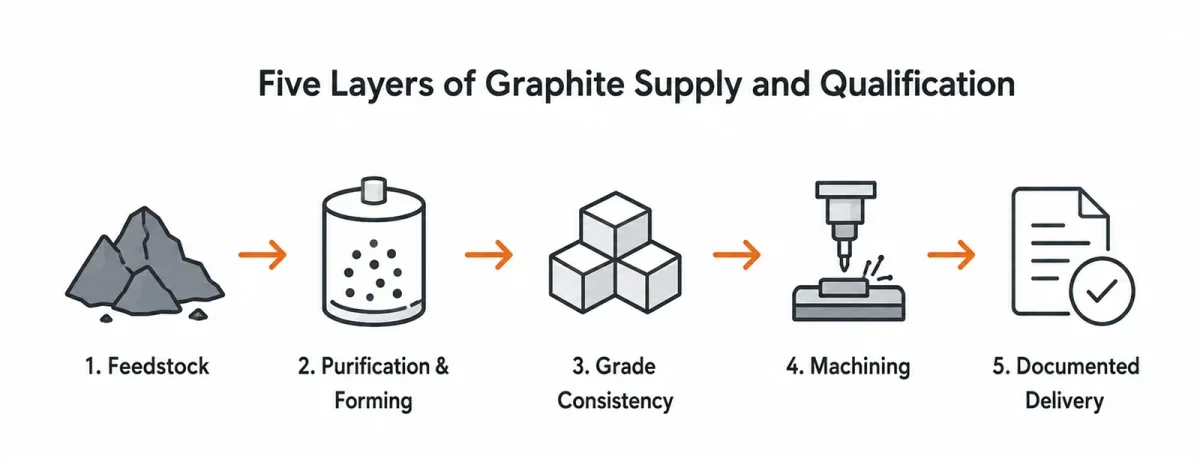
| Layer | Project inputs to request | Control variables | Typical evidence or deliverable |
|---|---|---|---|
| 1. Feedstock | Material route, origin information required by the project, flake or coke basis, initial carbon basis, moisture, sulphur, ash, and critical elements. | Source identity, lot definition, sampling plan, test method, impurity list, and agreed change-notification trigger. | Supplier certificate, laboratory report, lot record, and origin or custody documents when contractually required. |
| 2. Purification & Forming | Purification route, binder or impregnation information where relevant, forming route, density target, orientation, heat-treatment basis, and required property tests. | Carbon-content method, ash method, element-specific methods, porosity, density, strength, resistivity, and directional properties. | Process route identification, material data sheet, test report, and approved grade designation. |
| 3. Grade Consistency | Approved property window, lot size, sampling positions, repeat-lot requirements, and permitted process or source changes. | Within-block distribution, lot-to-lot variation, trace elements, orientation, thermal expansion, resistivity, strength, and dimensional stock allowance. | Lot traceability, trend data where required, approved deviation record, and change notice. |
| 4. Machining | Current drawing revision, datum scheme, critical dimensions, tolerance, geometric controls, thin features, holes, surface requirements, cleaning, and handling restrictions. | Fixturing, tool path, edge support, breakout risk, dust control, inspection access, surface integrity, contamination, and protected packaging. | Dimensional report, surface report when specified, visual record, first-article or sample approval where required. |
| 5. Documented Delivery | Packaging method, orientation, moisture barrier, cleanliness level, labels, quantity, document set, route, destination, and compliance requirements. | Package integrity, part protection, label-to-document consistency, revision status, lot identity, and shipment release. | Packing list, inspection report, material certificate, labels, photos when agreed, and transaction-specific export documents. |
II. Demand Tracks: Different Materials, Tests, and Approval Cycles
Graphite demand is not a single technical market. The following table replaces mixed “volume or horizon” numbers with comparable questions: what the market context is, what the project must provide, what acceptance variable controls release, and where manufacturing usually becomes difficult.
| Graphite segment | Market or qualification context | Required project inputs | Acceptance variables | Manufacturing bottleneck |
|---|---|---|---|---|
| Battery-grade natural graphite | Long-term energy-storage demand with cell-specific validation. | Flake route, purification, spheroidization, coating, particle specification, impurity limits, and electrochemical protocol. | Particle distribution, morphology, tap density, surface area, moisture, magnetic impurities, first-cycle efficiency, rate, and cycle performance. | Consistent purification, morphology, coating, and cell performance across lots. |
| Battery-grade synthetic graphite | Energy-intensive processing with chemistry- and cell-design-specific qualification. | Coke route, graphitization basis, particle design, coating, blending, and electrochemical test conditions. | Morphology, crystallinity, expansion, rate capability, cycle retention, and lot consistency. | Energy cost, thermal-process control, particle engineering, and repeated cell results. |
| Specialty graphite block | Qualification-intensive furnace, semiconductor, EDM, nuclear, and equipment applications. | Forming route, grain structure, block dimensions, orientation, purity basis, property requirements, and service atmosphere. | Density, strength, resistivity, ash, critical elements, thermal expansion, and within-block distribution. | Stable properties across large blocks, orientations, and repeat lots. |
| Machined graphite parts | Drawing-controlled conversion with application-specific cleanliness and release requirements. | Approved grade, drawing, datums, tolerance, surface condition, cleaning, inspection, and packaging. | Critical dimensions, geometry, edge condition, surface, contamination, and document-to-part identity. | Brittleness, abrasion, dust, feature breakout, inspection access, and contamination control. |
| Flexible graphite paper or sheet | Thermal, sealing, and conversion applications with thickness- and structure-specific behaviour. | Thickness, density, reinforcement, laminate, width, roll length, compression or thermal requirement, and atmosphere. | Thickness uniformity, density, tensile or handling performance, compression behaviour, surface, and roll condition. | Long-roll consistency, conversion yield, handling damage, and packaging. |
| Graphite powder | Distribution- and chemistry-controlled feedstock for multiple downstream routes. | Particle method, carbon basis, ash method, critical elements, moisture, sulphur, morphology, and sampling plan. | Particle-size distribution, chemistry, moisture, morphology, contamination, and lot homogeneity. | Stable distribution and contamination control after milling, classification, blending, and packing. |
1. Batteries and Energy Storage
Batteries remain the principal volume-growth route in the official critical-minerals outlook. However, “graphite demand” includes multiple natural and synthetic routes, and cell performance is not determined by carbon percentage alone. Particle morphology, crystallinity, surface area, coating, porosity, moisture, magnetic impurities, expansion, first-cycle efficiency, rate capability, and cycle life must be tested under a defined cell protocol.
Fast-charging, high-rate, high-energy-density, and blended-anode designs can change the required particle and surface design. Silicon-containing anodes, hard-carbon systems, and alternative battery chemistries also change the graphite share and qualification route. The correct commercial response is not to claim one inevitable material transition. It is to obtain the cell manufacturer’s current particle, impurity, coating, and electrochemical specification.
For related product scope, see battery and energy-storage materials and battery-grade graphite anode materials.
2. Semiconductors and High-Temperature Equipment
Semiconductor and high-temperature equipment applications often use specialty graphite because it combines machinability, thermal stability, electrical properties, and the ability to be produced in controlled grades. That does not make every high-purity block interchangeable. The project must define the forming route, grain structure, density, strength, resistivity, ash, critical elements, orientation, dimensions, surface, cleaning, packaging, and service atmosphere.
A purity figure such as 99.9995% may appear in a demanding project, but the figure is incomplete without its calculation basis and test method. Carbon by difference, ash residue, and element-specific impurities are separate measurements. Surface contamination can also change after machining, cleaning, handling, or packaging. Qualification therefore links material and conversion processes rather than approving a headline purity number in isolation.
EDM electrode selection also remains application-specific. Graphite has not simply replaced copper in every EDM operation. Workpiece material, machine settings, flushing, electrode geometry, wear target, removal rate, surface finish, and fabrication cost determine whether graphite, copper, or a copper-infiltrated graphite grade is appropriate. Entegris POCO’s technical material describes grade selection and machine parameters as application-dependent, which is consistent with treating grain size as one variable rather than a universal roughing-versus-finishing rule.
Related pages include semiconductor graphite components, graphite drawing and tolerance review, and the precision graphite machining guide. The thin-wall and small-hole review explains why feature geometry must remain tied to grade, depth, edge distance, tool path, fixturing, and inspection.
3. Photovoltaics, Fuel Cells, and Process Systems
Crystal-growth and high-temperature processing equipment can use graphite heaters, crucibles, guide cylinders, shields, insulation hardware, carriers, and structural parts. The qualification questions are concrete: maximum and cycling temperature, atmosphere, oxygen or moisture exposure, deposition, chemical contact, load, thermal gradient, expansion allowance, dimensional stability, cleaning, and replacement criteria.
Fuel-cell bipolar plates should not be described as one mainstream graphite route. The U.S. Department of Energy states that bipolar plates may be made of metal, carbon, or composites. Each route balances conductivity, corrosion, strength, mass, manufacturability, cost, sealing, and flow-field production differently. Flexible graphite, molded carbon composites, coated metals, and other designs can all be relevant in defined systems.
Water electrolysis and hydrogen-process equipment also use multiple electrode, separator, seal, and construction materials. A graphite component is only one possible design choice. Gas composition, pressure, temperature, electrolyte, current, sealing medium, and inspection basis must be provided before material form is selected.
For material-form comparisons, see rigid machined graphite parts, flexible graphite sheet, and graphite sealing materials.
4. Nuclear and Aerospace Applications
Nuclear graphite is a specialised qualification field. High-temperature gas-cooled reactors use graphite as moderator and in core structures, but not every nuclear reactor or every Generation IV concept uses graphite in the same role. The International Atomic Energy Agency identifies HTGRs as graphite-moderated and helium-cooled, while other reactor classes use different moderators, coolants, and structural materials.
Nuclear qualification can include raw-material control, forming route, density and strength distribution, thermal properties, irradiation behaviour, oxidation, dimensional change, inspection, and long-term records. These requirements are not transferable from an industrial furnace block without a dedicated nuclear-grade programme.
Aerospace and high-temperature propulsion systems may use graphite or carbon-based components in nozzles, thermal structures, fixtures, and test hardware. The material route depends on temperature, atmosphere, erosion, ablation, load, thermal shock, coating, and validation. The article therefore treats aerospace and nuclear markets as technically demanding application families, not as guaranteed volume opportunities for every supplier.
III. Manufacturing Priorities: Consistency before Capacity Claims
1. Specialty Graphite Requires Repeat-Lot Evidence
One acceptable sample does not establish a stable grade. A specialty-graphite approval should identify the forming route, block orientation, sampling locations, test methods, property window, critical impurities, and change triggers. Large blocks can show property variation across the section, and anisotropy can change thermal, electrical, and mechanical behaviour by direction.
Localisation or alternative sourcing becomes meaningful when a replacement route reproduces the required application evidence. A supplier may have sufficient nominal density and still fail because of trace elements, thermal expansion, edge strength, coating interaction, cleaning residue, or variation between lots. Capacity announcements should be separated from approved capacity.
2. Machining Is a Controlled Conversion Process
Graphite is brittle and abrasive. Thin walls, narrow ribs, small holes, deep holes, sharp corners, and interrupted sections increase risk, but no single dimension creates a universal manufacturability limit. The outcome depends on grade strength, grain structure, feature depth, edge distance, tool geometry, tool wear, fixturing, cutting strategy, inspection access, and handling.
A useful machining review also distinguishes dimensional tolerance from process capability. A drawing may contain a tight value that is achievable on one short, supported feature but unstable on a long wall, deep bore, or large plate. Inspection temperature, datum access, instrument resolution, sampling frequency, and the condition of the part during measurement must be defined. When those controls are absent, a nominal tolerance can create disputes without improving function.
The current drawing controls the release. Datum references, geometric tolerances, critical surfaces, cleaning, marking, and packaging must remain aligned with the approved grade. A source or grade change can alter stock allowance, tool wear, edge behaviour, surface condition, and thermal response even when the nominal drawing remains unchanged.
3. Battery-Anode Qualification Extends beyond Carbon Percentage
Battery anode material is a designed particle system. Purification removes unwanted material, but milling, spheroidization, classification, coating, blending, and heat treatment shape the final electrochemical behaviour. A certificate that reports carbon, ash, moisture, and particle distribution is necessary but not sufficient for cell approval.
The test plan should specify the sample preparation and cell protocol used for first-cycle efficiency, capacity, rate, expansion, and cycle retention. Results from different electrode recipes, binders, electrolytes, loadings, or test temperatures should not be compared as though they came from one method.
4. Recycled Graphite Is a Feedstock Route, Not a Universal Substitute
Recycled graphite is moving through research, pilot, and commercial-development programmes, but its status depends on the source stream and target application. Battery scrap, recovered anode material, machining dust, used furnace parts, and flexible-graphite trim contain different binders, coatings, metals, salts, oils, oxidation products, and particle structures.
U.S. Department of Energy projects are evaluating natural and recycled synthetic graphite for battery-grade anode production and methods to recover or regenerate anode material. That evidence supports technical development and pilot-scale validation; it does not prove that every recycled stream is already interchangeable with primary material at full scale. Qualification should cover feedstock identity, decontamination, morphology restoration, electrochemical performance, yield, and repeated production.
IV. Industry Risks: Technical, Operational, and Policy Boundaries
1. Consistency and Change Control
High-end barriers frequently appear as consistency barriers. The approved condition may depend on a particular mine or coke route, purification process, furnace, impregnation cycle, block orientation, machining site, cleaning agent, coating, packaging material, or inspection method. A technically small change can therefore trigger customer review.
Traceability can help, but it should not be claimed without evidence. The IEA/OECD report shows that companies face cost, interoperability, and information-continuity barriers. A practical project should state which fields are required—origin, supplier lot, transformation stage, grade, test report, drawing revision, machining record, package, or shipment—and how those fields remain linked.
2. Feedstock and Energy Exposure
Natural and synthetic routes face different input risks. Natural graphite depends on mine quality, recovery, flake distribution, purification, logistics, and environmental conditions. Synthetic graphite depends on coke and binder availability, forming, repeated heat treatment, graphitization energy, furnace utilisation, and yield. Flexible graphite and specialty components then add conversion, machining, and packaging exposure.
A buyer should distinguish price volatility from technical availability. A low-price source that has not passed qualification is not available capacity for the approved product. A high-capacity source that cannot provide the required impurity, property, or change-control evidence may still represent a supply interruption risk.
3. Environmental and Process-Efficiency Requirements
Roasting, graphitization, purification, milling, dust extraction, water treatment, and thermal processing can carry substantial energy or environmental requirements. The exact impact depends on process route, power source, reagent system, yield, emissions controls, and local regulation. It is therefore inaccurate to claim one universal “green threshold” or that all small capacity will be removed.
Commercial pressure can still increase demand for energy data, waste handling, emissions information, recycled content, and process efficiency. Suppliers should report only measured or contractually supported information. Carbon, water, energy, or recycling claims require a defined boundary and method.
4. Trade Remedies, Import Rules, Financing, and Export Controls
Trade measures need jurisdiction, product scope, date, and legal status. Anti-dumping or countervailing investigations are import-side trade remedies applied to defined products. Local-content rules and public financing influence where capacity is built. Export controls restrict specified exports or technologies from the controlling jurisdiction. These mechanisms should not be combined into one sentence as though they were the same policy.
The IEA’s 2026 executive summary reports that China announced export controls in October 2025 covering graphite anode materials and related battery supply-chain chokepoints. It also notes other mineral-related trade restrictions in producing countries, including graphite restrictions in Mozambique. Compliance conclusions should be based on the current product list, licensing rule, implementation date, and transaction.
The United States, European Union, and other jurisdictions also use grants, loans, procurement rules, tax incentives, partnerships, and trade-remedy procedures to develop local or diversified supply. Those measures should be described under their actual programme or case, not as a general claim that these regions impose graphite export controls.
International orders connect product description, specification, origin, destination, end use, classification, packing, and documents. The graphite export documentation guide outlines the transaction-specific information that may be required.
5. Competing Materials Must Be Compared by Function
Graphite competes with metals, ceramics, polymers, carbon composites, and other materials according to the function. A fuel-cell bipolar plate may use metal, carbon, or composite construction. An EDM electrode may use graphite, copper, or copper-infiltrated graphite. Furnace hardware may use graphite, carbon-carbon, ceramic, refractory metal, or coated systems depending on atmosphere, load, contamination, and temperature.
Substitution is therefore not a single threat to the graphite category. It is a design decision at the component level. The correct comparison includes conductivity, thermal expansion, strength, oxidation, corrosion, erosion, mass, machining, surface, contamination, cost, and validation.
V. 2026–2030 Planning Themes
Planning should also separate volume resilience from specification resilience. A buyer may have several nominal sources for graphite powder but only one source approved for a critical impurity profile. Conversely, a machined part may have several capable machining sites but depend on one qualified block grade. Mapping these dependencies by material, process, test, and document exposes the actual single points of failure more clearly than a supplier count alone.
The following themes are conditional planning considerations, not guaranteed forecasts or investment returns. Their value depends on customer qualification, process capability, energy and trade conditions, and the evidence available for each product.
1. Qualification Depth
Specialty and customized products can create value where a supplier controls the link between material grade, part design, process, inspection, cleaning, and delivery. That value is not automatic and should not be described as profitability that will exceed an industry average. It depends on solving a documented application problem and repeating the result.
2. Measurable Vertical Integration
Vertical integration can reduce some interfaces, but it can also hide variation if stages are not measured independently. An integrated route still needs input specifications, process identification, property tests, lot control, drawing release, inspection, and change notification. The commercial benefit must be demonstrated through yield, lead time, stability, or risk reduction rather than assumed from ownership alone.
3. Energy Efficiency and Circularity
Energy-efficient graphitization, improved furnace utilisation, heat recovery, lower-loss purification, water and reagent recovery, and qualified recycled feedstocks may improve cost or environmental performance. Adoption will vary by route and site. Recycled graphite can move from research to pilot and commercial use in selected applications, but it should not be described as a completed closed loop for the whole industry.
Diversified regional capacity can reduce route or geopolitical exposure only when the new site can reproduce the required material and application evidence. Common grade names do not guarantee equivalence across furnaces, sources, machining sites, cleaning processes, or packaging systems. Shared qualification data, controlled revisions, and agreed change rules are therefore as important as physical capacity.
5. Emerging Applications with Limited Addressable Scope
Advanced semiconductors, high-temperature reactors, aerospace systems, fusion research, and next-generation energy equipment can raise the technical ceiling for graphite. Each field has a narrow material form, validation route, and supplier base. These applications can justify focused development, but they should not be converted into a general claim of unprecedented opportunity for every graphite producer.
The five-layer framework applies across graphite blocks, graphite paper, and natural flake graphite: define the feedstock, transformation, grade consistency, conversion, and documented delivery required by the specific order.
Frequently Asked Questions
Does the 2026 evidence show continued graphite-demand growth?
Yes, within the cited scenarios and projections. The IEA reports 50%–90% graphite-demand growth to 2040 across its scenarios, while UN Trade and Development projects a 131% increase from 2024 to 2040. These are global critical-mineral indicators, not a guaranteed growth rate for every product.
Why does refining concentration matter if new mines are being developed?
Mine output is only the first step. Purification, spheroidization, coating, synthetic production, specialty forming, machining, cleaning, and customer qualification can remain concentrated. The IEA reports that downstream diversification is lagging upstream project growth.
What does high-purity graphite mean in an RFQ?
It means a defined carbon basis and method, ash method, critical element list, detection limits, sampling location, surface-cleanliness requirement, and packaging condition. Carbon by difference, ash, and trace elements are not interchangeable measurements.
Can recycled graphite replace primary graphite?
Only after application-specific qualification. The source stream, contamination, particle or structural condition, purification, yield, and required performance determine whether a recycled route is suitable.
What should a buyer request from an alternative supplier?
Request the current grade definition, material route, test methods, sampling, property window, critical impurities, lot traceability, drawing and inspection controls, cleaning, packaging, and change-notification rules. A national capacity figure does not replace those records.
How should trade-policy risk be reviewed?
Identify the jurisdiction, product classification, measure type, date, legal status, destination, end use, and licence or document requirement. Recheck the transaction at the time of shipment because policy scope can change.
References and Sources
- International Energy Agency — Global Critical Minerals Outlook 2026: report publication, market, outlook, concentration, project-pipeline, and policy context.
- IEA — 2026 Executive Summary: recent refining concentration, graphite supply growth, and October 2025 graphite-anode export-control context.
- UN Trade and Development — Global Trade Update, June 2026: 2024–2040 graphite-demand projection and critical-minerals trade context.
- IEA/OECD — Critical Mineral Traceability for Energy and Economic Security: survey scope, traceability barriers, and five policy actions.
- U.S. Geological Survey — Mineral Commodity Summaries 2026: official annual natural-mineral statistics baseline.
- U.S. Department of Energy — Parts of a Fuel Cell: bipolar plates may use metal, carbon, or composite materials.
- International Atomic Energy Agency — PRIS Glossary: reactor classes and graphite-moderated HTGR context.
- U.S. Department of Energy — Graphite Anode Pilot-Plant Project: development of battery-grade anode material from mined and recycled graphite routes.
Conclusion
The 2026 graphite outlook is best understood as a combination of demand growth, concentrated refining, uneven downstream diversification, and higher qualification requirements. The official evidence supports long-term demand and supply-security concerns. It does not support a universal “golden cycle,” guaranteed margins, or the assumption that every announced source can immediately replace a qualified route.
A practical graphite strategy starts with the application and then works backward through documented delivery, machining, grade consistency, purification and forming, and feedstock. For buyers, this structure clarifies what must be specified and verified. For suppliers, it identifies where capability must be demonstrated rather than advertised. The result is a more useful industry outlook: one that separates market scenarios from product approval and treats resilience as a measurable technical and documentation problem.