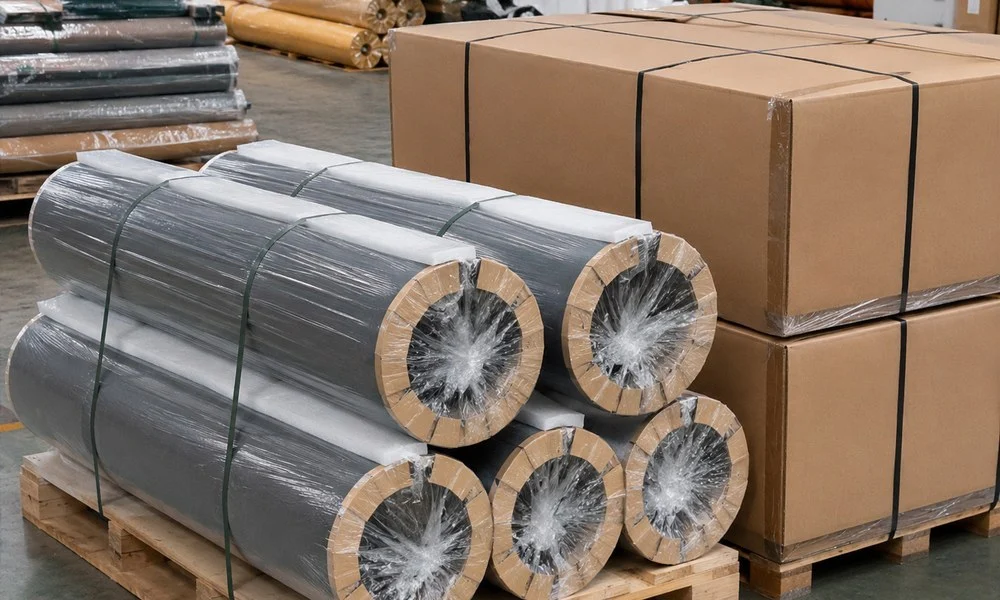
Export packaging is the last controlled process applied to graphite paper before the customer receives it. A roll can leave production at the ordered thickness, density and width yet arrive oval, telescoped, moisture-exposed or crushed at the edge. Flat sheets can arrive with folded corners, pressure marks or warped support boards. These are not merely cosmetic defects when the material will later be slit, laminated or die-cut: they can reduce usable width, disturb feeding, contaminate adhesive surfaces and invalidate a planned nesting layout.
The package must therefore be designed around the real transport chain: factory movement, truck collection, terminal handling, customs inspection, air or sea carriage, destination warehousing and final unpacking. The broader graphite packaging and logistics article covers shipment management. This guide focuses on how the product, core or support boards, inner barrier, blocking, outer container and pallet work together as one protection system.
Wood packaging also has destination-specific compliance requirements. For the United States, the current USDA APHIS wood-packaging requirements require regulated wood packaging material to meet applicable ISPM 15 treatment and marking rules. That mark confirms phytosanitary treatment; it does not prove pallet strength, timber moisture, carton performance or protection of the graphite. Those properties must be specified and verified separately for the actual load and route.
The Six-Layer Export Packaging Protection Chain
A reliable package is easier to review when each layer has one clear function. The graphite product establishes the dimensions and damage sensitivity. The core or rigid boards carry shape. The inner barrier manages dust and moisture exposure. Blocks or cushioning prevent movement without pressing directly on a fragile edge. The carton or crate resists handling and stacking loads. The pallet and restraint connect the package to forklifts, hoists and the cargo transport unit. A stronger outer box cannot compensate for a weak core, an open barrier or uncontrolled internal movement.
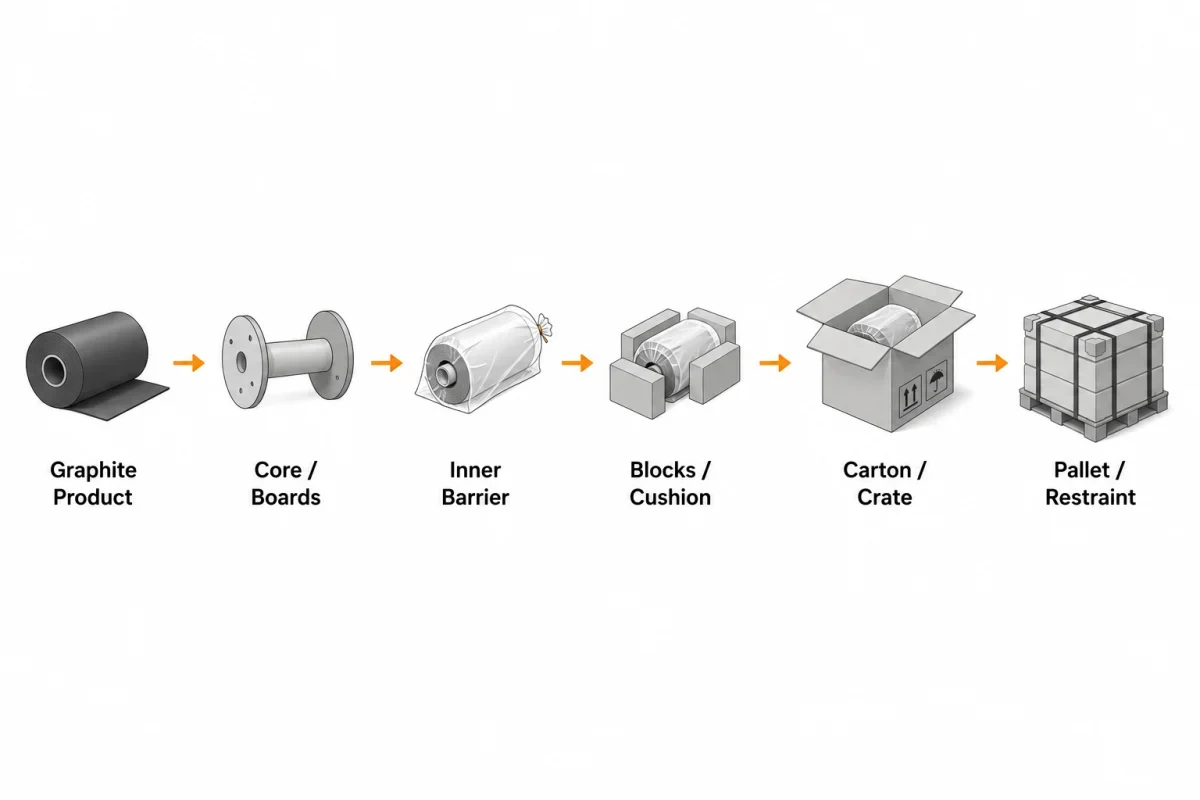
| Protection layer | Primary purpose | Project inputs | Approval evidence |
|---|---|---|---|
| Graphite product | Define roll or sheet geometry, usable width, surface sensitivity and lot identity. | Grade, thickness, density, roll/sheet dimensions, winding direction and quantity. | Released material and traceable packing list. |
| Core / boards | Maintain roundness or flatness and provide a handling interface. | Core ID and strength, end discs, board size, board stiffness and overhang protection. | Approved drawing and incoming dimensional check. |
| Inner barrier | Control dust transfer, moisture entry and document separation. | Barrier material, bag dimensions, seal method, desiccant and humidity indicator plan. | Seal inspection and route-specific moisture plan. |
| Blocks / cushion | Limit axial, radial and lateral movement without loading the graphite edge. | Clearance, block position, contact surface and expected acceleration. | Fit check and package trial. |
| Carton / crate | Resist puncture, compression and handling damage. | Board or crate construction, loaded dimensions, gross weight and stack plan. | Compression, stacking and distribution test evidence. |
| Pallet / restraint | Provide forklift/hoist access and restrain the load in the transport unit. | Pallet footprint, capacity, fork entry, strap direction, blocking and CTU loading plan. | Pallet compliance, loading photographs and restraint record. |
What a Damaged Roll Looks Like on Arrival
A damaged roll often signals its condition before the inner wrapping is removed. The carton may bow, one end may sit lower than the other, the core may be visibly oval or a carbon mark may appear where the edge has rubbed through the bag. When shifted layers form a cone, the package should be isolated before it is placed on an unwinder.
A recommended receiving-evidence checklist starts with photographs of all carton faces, the pallet, carton and pallet numbers, labels, seals and any shock or tilt indicator. Record the time, delivery condition and gross weight before moving the package. A 3 kg difference on a nominal 25 kg roll, four angular roundness measurements and inspection of the first 1–2 m are practical examples. These values are useful examples, but the actual investigation trigger, measurement method and permitted opening sequence must follow the purchase specification, carrier rules, insurance terms and the receiving site’s procedure.
Unwinding should not be the first action. A compressed roll can spring, shed damaged edges or create new evidence when tension is applied. Open the carton on a clean, supported surface; preserve seals, damaged wrapping and indicators; measure the affected area; and place the roll on hold. The incoming quality-check procedure for graphite paper can then continue with thickness, surface, edge and trial-conversion checks after the arrival record is complete.
A claim record should connect the damage to a specific package and time. “Roll unusable” is weak evidence. “Carton 3 of 8, core ovality 7 mm, right edge crushed 12 mm over 430 mm circumference, photographed before unloading from the pallet” is an illustrative record that identifies the physical condition. Notification deadlines, whether the package may be opened, and who retains the evidence must be confirmed from the governing Incoterm, carrier contract and cargo-insurance policy.
| Evidence item | Recommended record | Project-defined field | Disposition link |
|---|---|---|---|
| Outer package | All faces, pallet, labels, seals and visible impact marks. | Photo sequence, timestamp and required carrier notation. | Receive, isolate or reject delivery before opening. |
| Mass and identity | Gross weight, carton number, pallet number and lot/batch. | Permitted variance and scale method. | Mismatch investigation. |
| Core and edges | Roundness, axial shift, crushed depth and damaged circumference. | Datums, tools, sample points and limits. | Hold, expanded inspection or concession. |
| Opening sequence | Barrier, blocks, end discs, indicators and first exposed material. | Who may open and how much material may be unwound. | Preserve claim evidence and avoid creating new damage. |
| Communication | Supplier, carrier, insurer and customer notification. | Required deadline and document set. | Claim, replacement, rework or accepted deviation. |
Illustrative Packaging Options—Not Universal Tiers
Core diameters, roll weights, carton grades and pallet footprints are useful quotation inputs, but they should not be presented as universal low, medium and high packaging tiers. A 76 mm core may be suitable for one compact sample roll, while another thin material or wide roll may require a larger or stronger core to protect the inner wraps and match the customer’s unwinder. The same gross weight can create different loads when the roll width, outside diameter, centre of gravity or support geometry changes.
The following table converts practical packaging examples into RFQ options. QDZRT Graphite can review these inputs together with production and delivery planning. Each row must be confirmed against the actual roll or sheet, unloading method, stack duration, humidity exposure and transport route. Package design should also follow the principles in the IMO/ILO/UNECE CTU Code, which treats blocking, bracing and securing as part of the complete cargo transport unit rather than as an isolated carton decision.
| Illustrative format | Illustrative packaging inputs | Must be confirmed before quotation | Required unloading / restraint record |
|---|---|---|---|
| Courier sample roll | 76 mm core; 5–15 kg; 200 psi burst input; 800 × 600 mm pallet option. | Roll width/OD, core strength, carrier size rules, edge protection, whether a pallet is required and drop exposure. | Site-approved manual or mechanical handling method. |
| Compact production roll | 76 mm core; 15–25 kg; 275 psi burst input; 1200 × 800 mm pallet option. | Unwinder interface, carton construction, support blocks, gross weight and stacking evidence. | Package weight, centre of gravity and receiving-site approval. |
| Assisted production roll | 152 mm core; 25–50 kg; 275–350 psi burst input; 1200 × 1000 mm pallet option. | Core/cradle geometry, forklift or hoist interface, loaded carton compression and securing. | Defined lifting points and equipment. |
| Heavy production roll | 152 mm core; 50–100 kg; 350 psi burst input; 1140 × 1140 mm pallet option. | Pallet capacity, roll cradle, strap path, CTU blocking and no-clamp conditions. | Mechanical unloading plan and restraint photographs. |
| Flat sheet carton | 10–20 kg; 200–275 psi burst input; 1200 × 800 mm pallet option. | Board stiffness, sheet overhang, flatness support, top load and moisture barrier. | Flat handling and no-point-load instructions. |
| Reinforced sheet crate | 20–40 kg; 350 psi liner-carton input; 1200 × 1000 mm pallet option. | Crate construction, top/side clearance, fork entry, stack test and destination rules. | Mechanical unloading and crate-opening procedure. |
Crushing, Core Collapse and Carton Performance
Core collapse begins when radial or point loading exceeds the support available inside the roll. A smaller core keeps a package compact but increases curvature in the inner wraps. A larger core can reduce curvature and provide a stronger shaft interface, but it adds core cost and package volume. The approved core therefore depends on roll width, outside diameter, finished weight, winding tension, customer unwinder and transport support—not on weight alone.
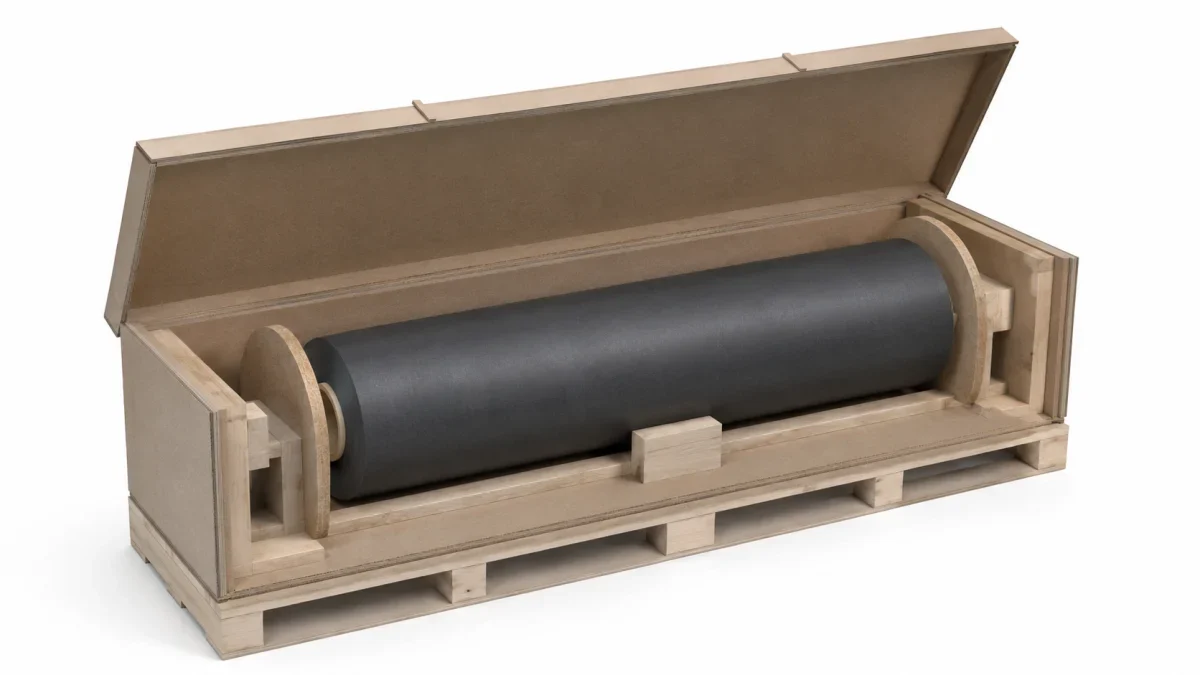
End discs spread load away from the graphite edge, and side blocks prevent the roll from accelerating into the carton wall. A 1000 mm-wide-roll example compares 5 mm clearance, 20–40 mm controlled clearance and an empty 100 mm gap. Those figures illustrate the design principle: a small uncontrolled gap may disappear when the carton flexes, while a large empty gap allows impact velocity to build. The final clearance and block stiffness require a package drawing and a physical trial.
Mullen burst ratings such as 200, 275 and 350 psi can remain on an RFQ as paperboard inputs, but they do not by themselves prove loaded-box compression or long-duration stacking. ASTM D4727/D4727M addresses corrugated and solid fibreboard sheet material; ASTM D642 evaluates compression resistance of shipping containers or unit loads; and ASTM D4169 provides a distribution-cycle framework. Where vibration is a major risk, ASTM D4728 can be considered for random-vibration evaluation of loaded shipping containers. The applicable sequence, assurance level, conditioning and pass criteria must be selected for the actual package and route.
Package weight must be visible in the quotation, but “one-person,” “two-person” and “mechanical” should not be treated as universal safety categories. Lifting risk also depends on frequency, reach, asymmetry, vertical travel, grip and worker conditions. The receiving site should approve the unloading method using its ergonomic programme and, where applicable, the NIOSH Revised Lifting Equation. The quotation should state package gross weight, centre of gravity, lifting points, fork entry and any no-clamp requirement without promising that a given weight is safe for manual lifting.
Edge Damage, Telescoping and Usable Width
Edge damage begins with direct contact. A rough end board, a strap bearing on the roll, a core from an adjacent roll or a knife used during opening can remove usable width before the outer carton shows a puncture. Edge guards should load a protective disc or support member, not the graphite edge. When multiple rolls share a package, separators must prevent one core or flange from cutting into the neighbouring wrap.
Telescoping is axial layer movement. It can begin during winding, but transport vibration and inadequate restraint can turn a small offset into a cone. A 2 mm dispatch shift and a 10–20 mm post-vibration shift are useful illustrations, not a prediction. Excessive side compression is not a general cure because it can crush the edge. Stable winding, flat end support and controlled axial movement need to be verified together.
The usable-width calculation directly connects packaging damage to conversion cost. A nominal 500 mm roll with 8 mm damage on one edge and 4 mm on the other leaves 488 mm before any additional trim. If the converter planned four 120 mm lanes plus 20 mm trim, the planned 500 mm layout no longer fits. The heat-spreading pad conversion chain should receive the measured usable width, not only the purchase-order width.
Moisture, Condensation and Barrier-System Validation
Graphite itself does not behave like paperboard, but the package around it changes with moisture. Corrugated strength can fall, release liners can curl, labels can detach and steel components can corrode. Condensation is more severe than steady humidity because liquid water may collect between a barrier and a cold roll or drip from the roof of a cargo transport unit.
A 30 °C-to-5 °C route example illustrates a temperature drop that can cross the dew point, but it is not a universal sea-freight profile. Likewise, carton moisture at 12%, pallet timber at 20%, a 50 mm bag overlap, 100 mm desiccant separation and 30/40/50% humidity indicators are retained only as illustrative design inputs. The approved package must identify route, season, expected duration, barrier material, seal method, initial material moisture, desiccant calculation, indicator position and validation evidence.
The CTU Code guidance on mechanisms of condensation and loss-prevention measures supports the principle that cargo, packaging, dunnage, ventilation and temperature history interact. Desiccant cannot correct a wet pallet, an open bag or excessive moisture already loaded into the transport unit. Stretch film should not by itself be treated as a vapour barrier because overlaps and fork openings can admit air.
Labels and the primary commercial documents should normally remain outside the sealed barrier, while a duplicate lot card may be placed in a protected pouch if the project requires internal traceability. The graphite export documentation guide covers commercial identity and document alignment; the barrier plan protects the physical link between those records and the material.
Project Packaging Inspection Plan
The inspection table is valuable because it names the failure modes, but its numerical green and escalation limits should not be copied as universal acceptance criteria. The table below lists every check while leaving the formal decision to a project-approved method. Each characteristic needs a datum, instrument, sample plan, acceptance limit, measurement uncertainty and disposition rule.
| Inspection characteristic | Illustrative inspection values | Project method to define | Disposition |
|---|---|---|---|
| Core roundness difference | ≤2 mm example; >4 mm escalation; four diameters per roll. | Reference diameter, angular positions, tool, loaded/unloaded condition and lot sampling. | Accept, hold for unwinder fit review or reject. |
| Axial layer shift | ≤3 mm example; >8 mm escalation; both ends. | Datum plane, roll support, allowable usable-width loss and winding history. | Accept, trim/concession or reject. |
| Edge crush depth | ≤2 mm example; >5 mm escalation; eight points per edge. | Measurement direction, circumference mapping, functional zone and conversion layout. | Accept, map/trim, expanded inspection or reject. |
| Carton moisture | ≤12% example; >15% escalation; three panels. | Meter type, conditioning, board grade, route and timing of measurement. | Dry/hold, repack or reject package. |
| Pallet timber moisture | ≤20% example; >25% escalation; five points. | Species, instrument, structural specification and destination requirements. | Supplier review, dry/replace or reject pallet. |
| Inner-barrier seal | ≥50 mm overlap example; <25 mm escalation. | Barrier type, heat-seal or tape method, seal width, continuity and leak check. | Reseal, replace or hold. |
| Desiccant separation | ≥100 mm example; <50 mm escalation. | Desiccant type, packaging, quantity, attachment and no-contact zones. | Reposition or repack. |
| Sheet-pack flatness | ≤3 mm/1000 mm example; >6 mm/1000 mm escalation. | Support condition, direction, gauge and sheet-stack acceptance limit. | Accept, flattening review or reject. |
| Label text height | ≥4 mm example; <2 mm escalation. | Customer, carrier and customs legibility requirements; barcode verification if used. | Relabel before release. |
Sheet Packing: Bending, Point Loads and Cleanliness
Sheet packs fail under bending, local pressure and unsupported overhang. A roll can redistribute some movement through its supports; a thin sheet stack can retain every pressure mark. A corner extending 30 mm beyond a support board may take a permanent set when another carton is placed above it. The approved board should be larger than the sheet and stiff enough to bridge the real pallet deck and handling points.
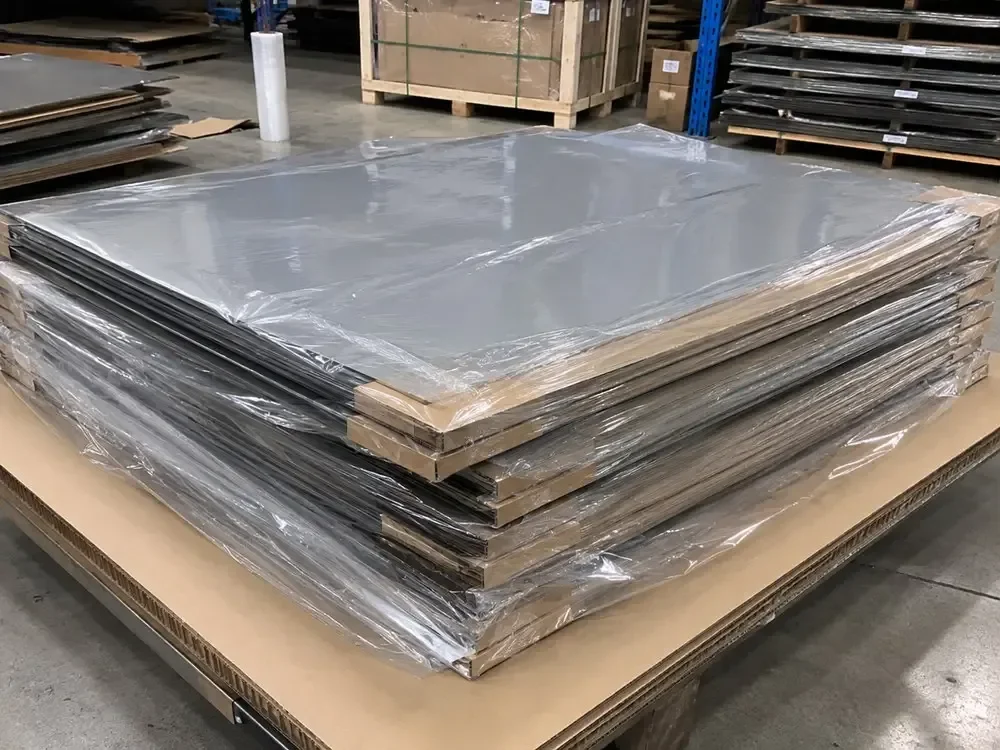
For 1000 × 1000 mm sheets, a 1020 × 1020 mm board gives 10 mm protection per side, while a 1060 × 1060 mm board gives 30 mm. The larger board can tolerate more side contact but increases chargeable volume. The decision should be based on sheet fragility, edge-damage cost, pallet deck, crate clearance and transport route rather than a single preferred overhang. The thickness and density selection article provides the material inputs that should be transferred into the packaging review.
Stacking performance must be demonstrated for the loaded pack. Four 15 kg flat cartons may work when the pallet deck is fully supported and the box system has been conditioned and tested. The same cartons can bow when they bridge between pallet runners. A top cap, corner posts or a rigid crate can transfer vertical load around the sheet stack, but the contact path must not create point loading on the graphite.
Surface cleanliness also matters. Carbon transfer can mark protective film, adhesive liner or inspection paper. The NIOSH natural graphite entry provides general U.S. industrial-hygiene information; it does not define a universal packing-room SOP. Cleaning, dust control and personal protection should follow the material SDS, site exposure assessment and local requirements. The package should open without sweeping loose particles across the sheets.
Labels, Marks and Destination Requirements
The product label connects the physical package to the purchase order. It should identify our team, product name, approved grade or code, thickness, density, roll or sheet dimensions, net and gross weight, lot or batch number, carton number and pallet number. Handling marks such as “Keep Dry,” “Do Not Clamp” and “This Side Up” should be used only when the approved package and handling plan depend on them.
Commercial documents and labels need the same product description and unit. When an invoice states 12 rolls and the packing list states 600 kg, carton labels should show the roll count and net weight needed to reconcile the totals. Country-of-origin and customer-specific marks must be confirmed before printing. The export documentation page and global communication article help keep descriptions, revisions and responsible parties aligned.
An ISPM 15 mark should remain visible for inspection when regulated wood packaging is used, but the required location and destination rule must be checked for the shipment. Phytosanitary compliance, pallet structural approval and product-protection performance remain separate release gates.
How Packaging Cost Appears in the Quotation
Packaging cost should be visible through components and measurable inputs rather than appearing later as an unexplained surcharge. The package can change material cost, labour, testing, chargeable volume, pallet count and freight handling. A 500 mm roll in a 560 mm carton occupies less space than the same roll placed in a 700 mm universal carton, even when net weight is identical. A larger core can reduce inner-wrap curvature but increase package volume. These trade-offs belong in the quoted packaging line.
| Cost item | Charging basis | Quotation input | Typical change trigger |
|---|---|---|---|
| Core and end support | Per roll or set. | Core ID/strength, roll width, OD, end discs and blocks. | Roll dimensions, weight or unwinder interface changes. |
| Rigid boards / sheet support | Per sheet pack or board area. | Sheet size, board overhang, stiffness and top/bottom configuration. | Sheet dimensions, stack load or pallet deck changes. |
| Inner barrier and desiccant | Per pack, barrier area or route design. | Bag dimensions, barrier grade, seal method, duration and climate. | Route, season, transit time or moisture requirement changes. |
| Carton or crate | Per unit. | Loaded dimensions, board/crate construction and gross weight. | Stack plan, carrier limit or damage risk changes. |
| Pallet and restraint | Per pallet / load. | Footprint, capacity, fork entry, straps, blocks and destination compliance. | Pallet count, destination, loading or CTU layout changes. |
| Packing labour | Per roll, carton or pallet. | Number of protection and inspection steps. | Special cleaning, sealing, indicators or documentation added. |
| Package testing | Per design or validation sequence. | Conditioning, compression, vibration, shock and inspection plan. | New design, new route, higher load or recurring failure. |
| Freight volume and handling | m³, chargeable weight or carrier tariff. | Packed dimensions, gross weight, pallet count and handling class. | Core/carton size, air/sea mode or special handling changes. |
Sample and bulk packaging should be compared separately. A courier sample might use one compact roll and no pallet when the carrier and product risk allow it. A multi-roll sea shipment may require larger cores, stronger support, a treated pallet, two strap directions and a moisture-control system. Those are project options, not fixed package levels. Air freight may penalise excess volume; sea freight exposes the pack to a longer climate and handling cycle.
Our team can quote graphite paper rolls and sheets with the approved core, maximum package weight, support method, barrier, outer container and pallet scope stated in the order. Related material forms are listed in the graphite products category, while practical handling context is available in the stable supply warehouse video and graphite paper production video. Specific packaging, testing, freight and destination-compliance costs remain subject to confirmed project scope.
For a comparable quotation, send the destination country, Incoterm, transport mode, roll or sheet dimensions, quantity, maximum package weight, unloading equipment, stacking restrictions, moisture-control requirement, wood-packaging preference and any customer label format through the contact page. QDZRT Graphite can then separate product, packaging and optional validation costs while the carrier confirms freight charges and the consignee confirms unloading and site-safety requirements.