Graphite paper thickness and density must be selected as one material system, not as two independent catalogue values. Thickness controls available space, bending, die-cut depth, compressed stack height, and the distance heat travels through the sheet. Density changes theoretical areal mass, handling response, surface contact, compression behavior, roll stability, and conversion yield. Two materials sold under the same general product name can therefore behave differently when one is thin and dense and the other is thicker and less dense.
QDZRT Graphite lists a broad graphite paper range of 0.1–2.0 mm in thickness and approximately 1.0–1.7 g/cm³ in density. These are catalogue-level boundaries across more than one grade and supply configuration. They do not prove that every thickness is available at every density, and they are not instructions to choose the lowest thickness or the highest density. The exact combination, width, roll length, laminate, adhesive, reinforcement, surface, and converted form must be confirmed for the selected grade.
A practical graphite-paper specification links thickness, density and areal mass instead of treating any one value as sufficient. Those three measurements then connect to the final function, material family and construction, measurement method, conversion process, approved sample and delivery condition. The result is a specification that can be quoted, inspected and repeated without leaving the construction ambiguous.
The worked numbers below show how the relationships are calculated. Product availability and performance still need to be checked against the named grade, supplier data, approved sample and the buyer’s functional test.
Define the Material Family and Construction Before Selecting Thickness and Density
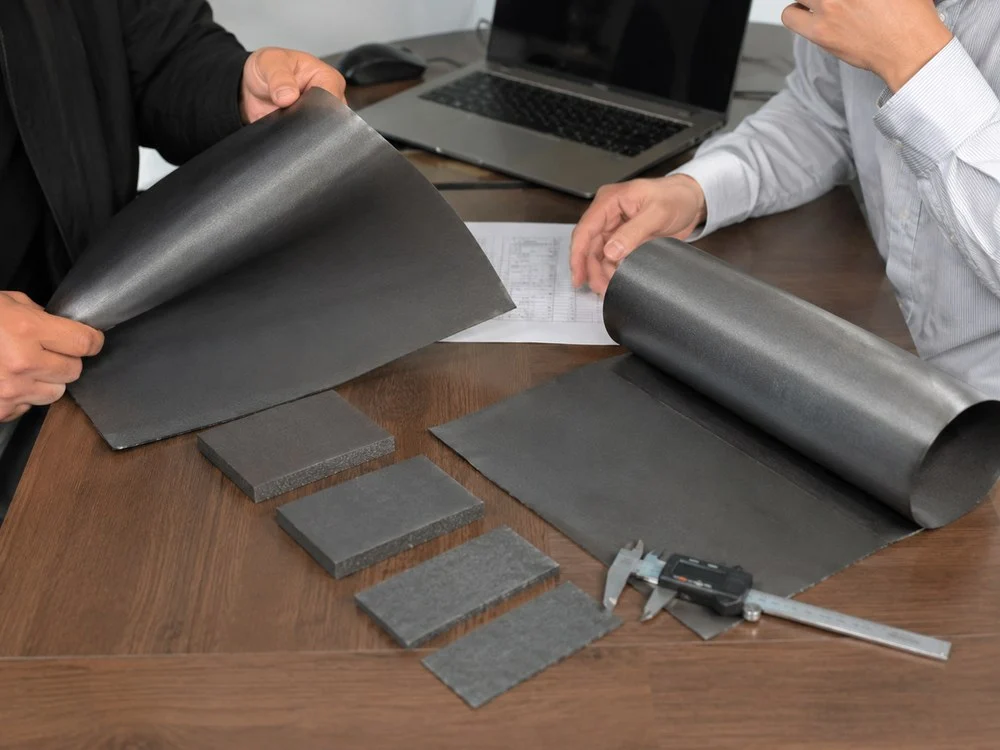
“Graphite paper,” “graphite foil,” “flexible graphite sheet,” and “thermal graphite sheet” are overlapping market terms, but they are not always technically interchangeable. Our paper product discussed here is primarily an expanded-natural-graphite material made by expansion, rolling, compression, and sheet forming. It may be supplied as thin sheets, master rolls, slit rolls, laminates, adhesive-backed stock, or converted parts.
High-conductivity synthetic or pyrolytic thermal graphite sheet is another material family used in selected electronic heat-spreading designs. Its manufacturing process, directional conductivity, thickness range, mechanical behavior, surface treatment, and laminate requirements can differ substantially from expanded natural graphite. The flexible graphite foil versus thermal graphite sheet comparison explains why the buyer should identify the material family and construction before comparing thermal data.
For sealing, gasket, cushioning, and industrial interface work, expanded natural graphite is usually discussed with compressibility, recovery, oxidation environment, chemical exposure, reinforcement, and installed thickness. For compact electronic heat spreading, the buyer may instead emphasize in-plane heat transport, insulation films, adhesives, bending, puncture resistance, and total stack height. A thickness–density table cannot replace this first material-family and construction decision.
| Specification layer | What it means | What can be stated now | What must be confirmed |
|---|---|---|---|
| Catalogue range | The outer range presented across the product family. | Graphite paper is listed at 0.1–2.0 mm and about 1.0–1.7 g/cm³. | The exact grade, thickness–density pairing, width, length, surface, and supply form. |
| Grade-specific availability | Combinations produced within one named material family and construction. | A supplier may offer several standard or project-based combinations. | A current data sheet, quotation, sample label, and approved construction. |
| Calculated example | A pair used to demonstrate areal-mass arithmetic. | Thickness × density gives theoretical mass per area. | It does not prove the combination is commercially available. |
| Project specification | The buyer-approved description of the ordered material. | Function, drawing, target range, format, and inspection can be stated. | Final limits, method, sampling, concessions, packaging, and acceptance authority. |
Use the Thickness–Density–Areal Mass Triangle
Areal mass is a useful cross-check because it links nominal thickness and density to the theoretical mass of one square metre. When thickness is expressed in millimetres and density in grams per cubic centimetre, the convenient relationship is:
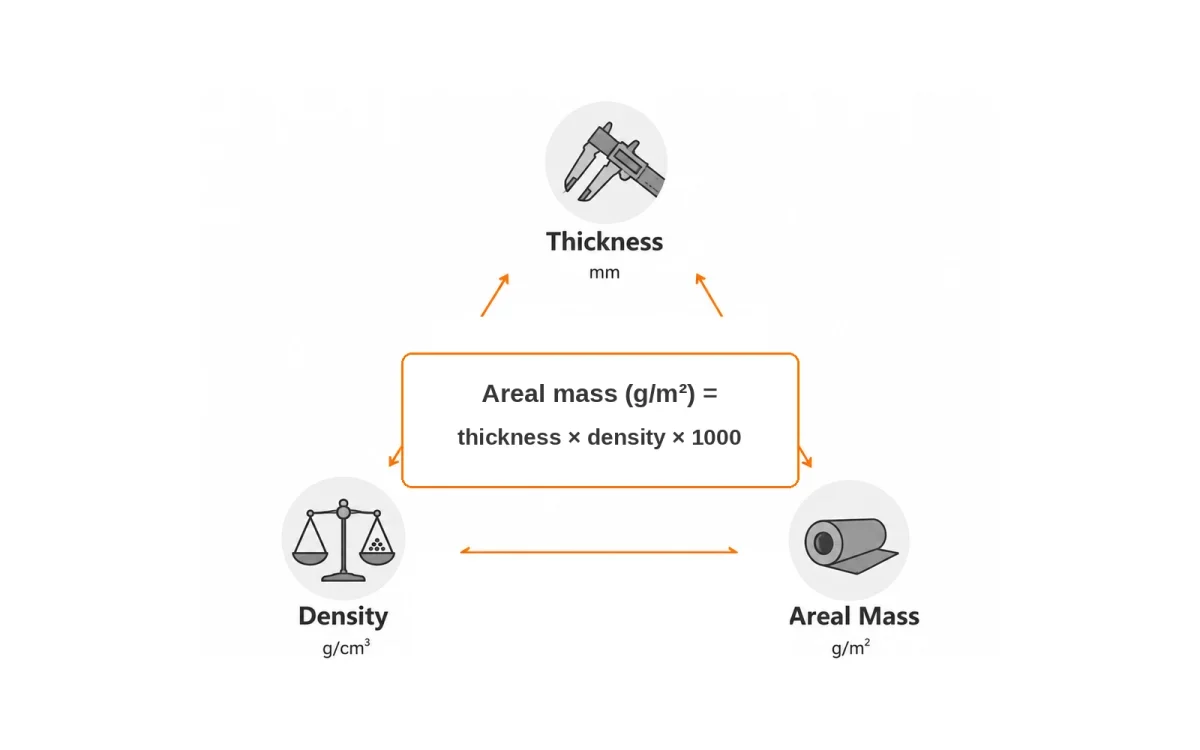
Theoretical areal mass (g/m²) = thickness (mm) × density (g/cm³) × 1000
For example, 0.20 mm at 1.0 g/cm³ gives 200 g/m². The same 0.20 mm at 1.3 g/cm³ gives 260 g/m². A 1.00 mm sheet at 1.7 g/cm³ gives 1700 g/m². These calculations are correct dimensional conversions. They help identify a labelling or measurement mismatch, estimate roll mass, compare candidate structures, and review whether a reported thickness and density are mutually plausible.
Areal mass is useful as a consistency check, but it does not measure compressibility, thermal conductivity, purity, surface condition, strength, oxidation resistance or conversion yield. It also cannot compensate for a thickness reading taken with the wrong contact pressure.
| Nominal thickness | Density example | Theoretical areal mass | What the number helps review | What it does not establish |
|---|---|---|---|---|
| 0.10 mm | 1.0 g/cm³ | 100 g/m² | Thickness profile, adhesive stack, slit edge, and sample mass. | A fixed grade from us unless confirmed in the quotation. |
| 0.20 mm | 1.0 g/cm³ | 200 g/m² | Reference point for roll, sheet, and die-cut comparison. | Compression, recovery, or sealing stress. |
| 0.20 mm | 1.3 g/cm³ | 260 g/m² | Effect of higher density at unchanged nominal thickness. | Automatic improvement in contact or heat transfer. |
| 0.30 mm | 1.2 g/cm³ | 360 g/m² | Roll weight, bending, stack height, and conversion planning. | A standard production combination without grade confirmation. |
| 0.50 mm | 1.3 g/cm³ | 650 g/m² | Handling body, compressed-state planning, and packaging. | Suitability for a particular flange or device. |
| 1.00 mm | 1.7 g/cm³ | 1700 g/m² | Heavy flexible construction and sheet-versus-roll review. | Proof that this pairing is available in every width and length. |
Start with the Function of the Finished Part
The first engineering question is not “Which density is best?” It is “What must the graphite layer do after conversion and assembly?” A heat-spreading layer moves heat mainly along the plane of the sheet. A sealing layer conforms to mating surfaces and changes thickness under load. A protective separator creates a thin carbon interface between components. A converter-stock roll must feed, slit, laminate, punch, rewind, and pack without unacceptable wrinkles, edge splits, dust, or surface damage.
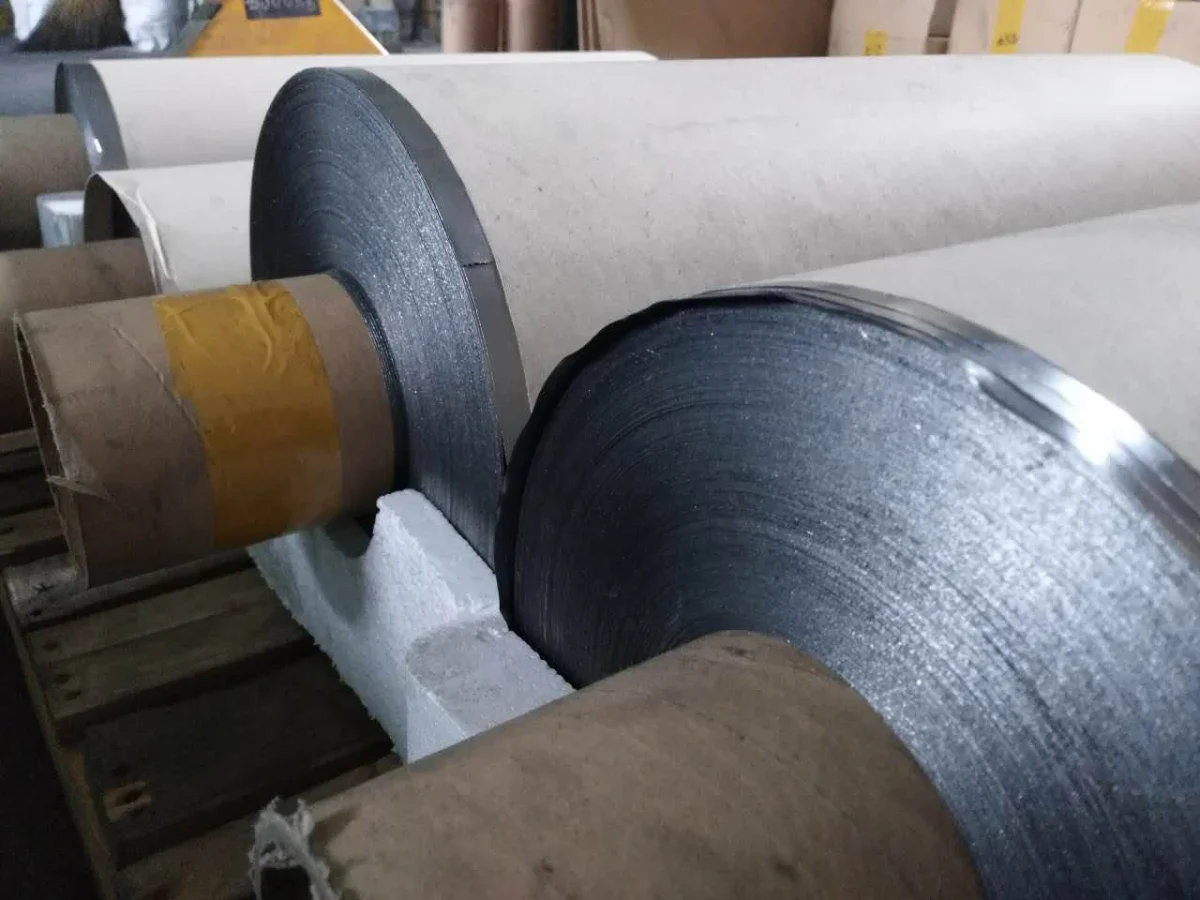
For thermal management, low profile may be valuable because the assembly has limited space. The construction still needs enough handling stability for lamination and die cutting, and the designer must distinguish in-plane spreading from through-plane interface resistance. Adhesive, insulation film, protective film, surface contact, pressure, heat-source size, chassis path, and final heat rejection can matter as much as the graphite layer itself.
For sealing or gasket-related use, nominal thickness and density are reviewed with the installed compressed state, flange condition, media, temperature, oxidation environment, reinforcement, bolt load, and leakage requirement. A thicker or less-dense structure may provide more available compression volume in one grade family, while a denser structure may change surface response and handling. Neither choice is automatically superior.
For converter stock, process stability can be as important as a laboratory property. Thin paper may require a carrier or release liner. A soft roll may need controlled tension, core support, and end protection. A denser or thicker construction may handle differently at sharp bends, small punched holes, narrow bridges, or tight rewind diameters. Final part size, web direction, minimum bridge, hole diameter, adhesive, liner, splice rule, and package orientation belong in the same review.
How Thickness Changes Practical Performance
Thickness affects available space, bending, converted edge quality, assembled stack height, compression volume, and the length of the through-thickness path. Very thin graphite paper can fit compact structures but becomes more sensitive to wrinkles, particles, puncture, local stretching, and handling damage. Medium thickness often gives converters more body for sampling and cutting. Thicker flexible graphite can provide greater physical volume, but bend radius, roll diameter, sheet flatness, cut detail, and packing method require separate review.
At 0.10 mm or 0.20 mm, a small surface particle or instrument indentation can represent a large percentage of the nominal value. Manual handling can also introduce a crease that is insignificant on a thicker sheet but critical in a thin laminate. A backing film, carrier, release liner, or temporary support can stabilise the material; however, every added layer changes total stack height, thermal interfaces, electrical behavior, peel response, and conversion cost.
The purchasing specification should therefore state both the graphite-layer thickness and, when relevant, the total laminate thickness. It should identify whether the tolerance applies before lamination, after lamination, in an uncompressed condition, or at an agreed test pressure. Where the installed compressed thickness matters, nominal free thickness alone is insufficient.
| Thickness candidate | Possible project reason | Risks to review | Evidence before approval |
|---|---|---|---|
| Very thin candidate | Low stack height, compact laminate, small mass, or thin interface. | Wrinkle, particle sensitivity, puncture, curl, measurement force, liner dependence. | Exact-grade sample, approved measurement method, lamination and feeding trial. |
| Thin-to-medium candidate | Balance of flexibility, handling body, and conversion practicality. | Thickness profile, slit edge, adhesive stack, roll flatness, cut detail. | Cross-web profile, converted first article, surface and roll inspection. |
| Thicker flexible candidate | Greater body, compression volume, sheet handling, or industrial layer. | Bend path, roll diameter, compressed state, packing deformation, small-feature quality. | Grade-specific compression data, installation trial, drawing and package review. |
Interpret Density as a Grade-Family Trend
Density describes mass per unit volume, but the same number does not guarantee the same behavior across different raw materials, calendering routes, purity levels, thicknesses, reinforcements, laminates, or surface treatments. Statements such as “lower density is softer” and “higher density is firmer” can be useful starting trends only when comparing constructions inside one named material family.
Within one grade family, increasing density at the same nominal thickness increases theoretical areal mass. It may also change handling body, surface response, compression behavior, edge quality, and roll weight. The direction and magnitude of those changes must be demonstrated by the supplier’s grade data or by samples. Higher density does not automatically mean better heat spreading, better sealing, greater strength, or easier die cutting.
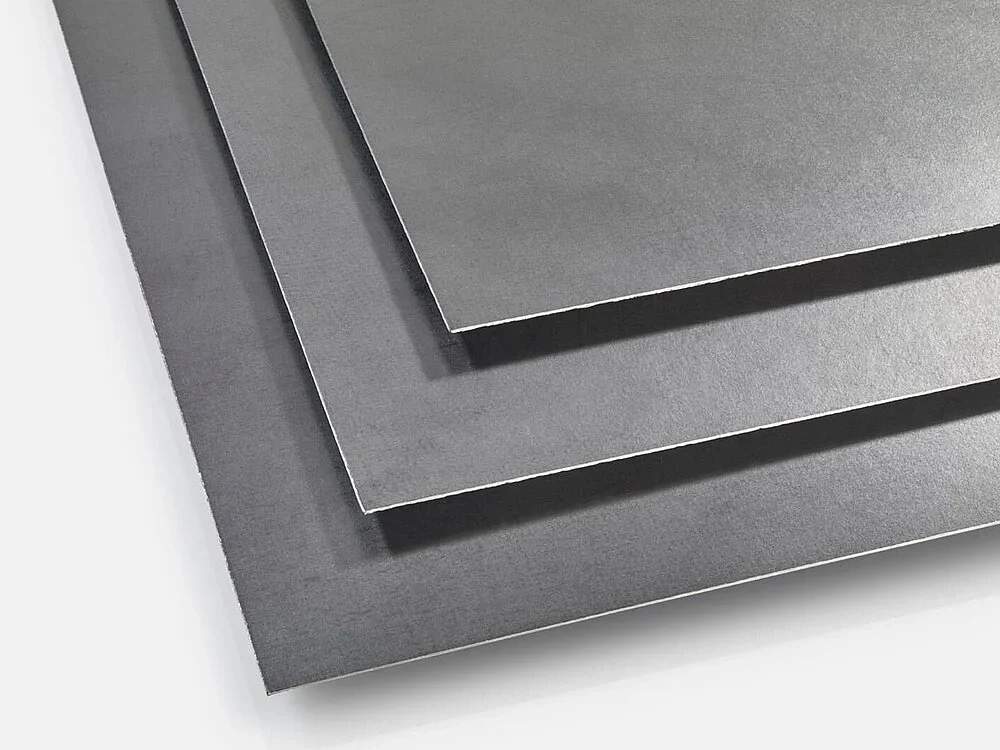
For a thermal layer, the buyer should compare directional thermal data, total interface construction, pressure, adhesive, insulation, bend path, and heat-spreading area. For sealing, compare compressibility, recovery, creep relaxation, oxidation resistance, purity, reinforcement, and the joint design. For converting, compare feeding, slitting, dust, edge integrity, wrinkle, liner, lamination, and yield.
Named products on the market also show that flexible graphite foils can span different density and structure ranges. Such data are useful as product-specific examples, not as a universal classification for products from us or other suppliers. The buyer should use the exact quoted grade and the approved sample, then keep the same grade identity on repeat orders.
| Density comparison | What may change | Questions for the function | Questions for conversion and packing | Required evidence |
|---|---|---|---|---|
| Lower-density candidate within the same family | Areal mass, conformability, compression response, roll body. | Does it conform under the actual assembly load and retain the needed function? | Does the roll need more core support, end protection, liner, or flat-sheet packing? | Grade data, thickness profile, mass/area, compression or bend test, converted sample. |
| Intermediate-density candidate | Balance among areal mass, handling and contact behavior. | Does it meet function without unnecessary mass or stiffness? | Can the selected width and length rewind without telescoping or creasing? | Representative roll sample, surface record, slit edge, first article. |
| Higher-density candidate within the same family | Higher mass at equal thickness and potentially firmer handling. | Is the higher density linked to a measured project benefit? | Does the part crack, crease, dust, or resist tight bends and small features? | Application test at stated pressure, temperature, laminate and geometry. |
| Tight density tolerance request | Potentially narrower repeat-lot variation. | Is the tighter band functionally necessary and measurable? | Can sample size and measurement uncertainty support the limit? | Approved method, sample positions, average and individual limits, disposition rule. |
Choose Thickness and Density Together
A common sourcing error is to freeze thickness first and treat density as a later commercial detail. In production the two values interact. A thin, dense sheet can have the same or greater areal mass than a thicker, lower-density sheet; the two can differ in bending, compression, surface contact, roll response, and die-cut yield. Samples should therefore use the exact thickness–density family intended for production.
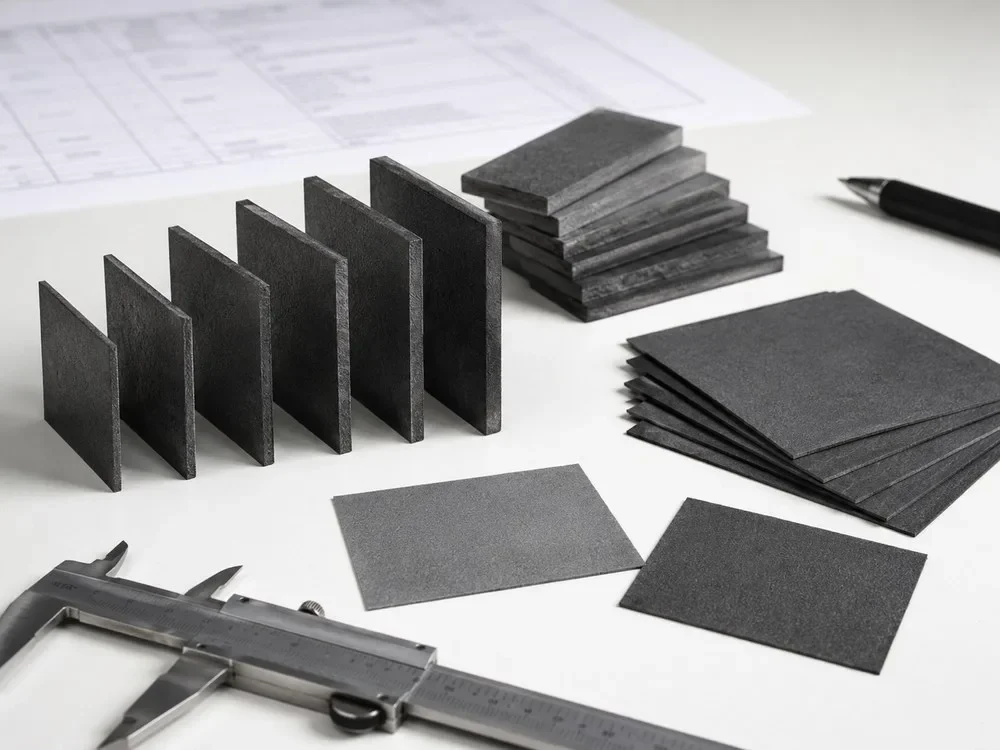
The first trial does not need every catalogue option. A more efficient plan selects one or two thickness candidates and one or two grade-specific density candidates that fit the function and process. The buyer then compares the complete construction, including adhesive, film, reinforcement, liner, and converted geometry. This reduces false conclusions caused by testing one graphite sheet but ordering another.
Where a theoretical pair is used for costing or roll-mass estimation, label it clearly as calculated. Where a pair is offered for sale, identify the grade, width, length, roll or sheet format, surface, and batch. Where the buyer approves performance, preserve the sample reference and test conditions so the result can be reproduced on repeat orders.
Measurement Method and Tolerance Control
A tolerance without a measurement method can create disagreement even when the physical material has not changed. Flexible graphite can compress under a contact foot, and results can vary with contact area, pressure, dwell time, support surface, temperature, humidity, surface texture, sample conditioning, and operator technique. Display resolution alone does not establish measurement capability.
Thickness Requires Defined Contact Conditions
The inspection plan should identify the instrument, foot or anvil geometry, contact force or pressure, support, dwell time, zero check, calibration status, sample conditioning, and measurement locations. For laminates, it should state whether the value applies to the graphite layer, adhesive-backed construction, release-liner construction, or total finished stack.
The linked NIST dimensional metrology publication concerns dimensional metrology for micro- and meso-scale manufacturing. It is used here only for the general principles that a measurement process needs defined conditions, traceability, and uncertainty. It is not a graphite-paper test method and does not prescribe a universal contact force, foot diameter, tolerance, or sample count.
Our team can record an agreed project method and compare it with the converter’s incoming-inspection method when this is included in the order. The approved document should state who owns the method, which instruments are acceptable, how disagreements are investigated, and whether an average limit, individual-point limit, or both control the lot.
Density Needs Representative Samples
Density calculated from one small coupon may not represent an entire roll. The record should include sample area, mass, thickness result, formula, instrument, locations, and lot. A buyer can sample across the width and along the length when long-roll uniformity matters, but the number and positions must come from an approved risk-based plan rather than an automatic thickness ladder.
Theoretical density can also be distorted by an unrepresentative thickness reading, trapped liner, adhesive, surface particles, edge damage, or an inaccurate sample area. For a finished laminate, define whether density refers only to the graphite core or to the entire construction. Where density is stated as a lot average, the acceptance plan should also define whether individual results may fall outside the nominal band.
Move Example Tolerances Out of the Purchasing Specification
Sample tolerances such as ±5% or ±10% thickness, ±0.05 or ±0.10 g/cm³ density, and a five-by-three measurement map show how a control plan can be structured. A purchasing specification should replace those examples with the approved nominal value, individual-point and average limits, sample plan, measurement uncertainty, review authority and disposition rule for the actual product.
For example, a trial roll could be checked at five positions across the width at the start, middle and end, producing fifteen readings. Production sampling may use fewer or more points according to width, roll length, lot size, historical capability, criticality and converter risk.
Control Surface, Roll Geometry, and Conversion Separately
Thickness and density cannot describe wrinkles, punctures, scratches, contamination, edge splits, telescoping, core damage, splices, permanent creases, or liner defects. These characteristics need separate visual or dimensional acceptance criteria. The buyer should identify the usable web width, excluded edge zone, surface class, splice rule, roll-end offset, core condition, winding direction, label, and package orientation.
The graphite paper export packaging guide and the graphite packaging and logistics process describe related controls for core support, edge protection, moisture protection, labels, and arrival inspection. Packing is part of the product definition because a correct grade can still become unusable after telescoping, edge impact, puncture, or permanent deformation.
Conversion trials should use the actual tool, liner, adhesive, release system, web direction, pressure, speed window, minimum bridge, hole geometry, and packing method where possible. A hand-cut sheet can confirm basic material identity and function, but it does not validate long-roll feeding, unwind tension, splice handling, waste stripping, rewind quality, or production yield.
For die-cut work, the graphite paper pad conversion guide and the roll quality and die-cutting checks provide complementary process detail. Thickness and density remain key inputs, but the approved converted part must also satisfy the drawing and the process window.
Validate the Delivered Form, Not Only a Small Coupon
Sample approval must identify the exact material tested. The record should include grade, thickness, density, roll or sheet format, width, length, surface, laminate, adhesive, liner, lot, measurement method, packaging, and the functional trial. If the order will be supplied as rolls, at least one representative roll-format trial is preferable before repeat bulk supply.
Inspection can include thickness profile, mass per area or density samples, width, roll length, end-face offset, core condition, surface, slit edge, converted dimensions, laminate adhesion, and package condition. The plan should be proportionate to risk. A critical laminated thermal component may require point thickness, first-article dimensions, and functional thermal validation; a general separator may use a simpler dimensional and visual plan.
For thermal applications, total interface resistance can be represented conceptually as contact resistance plus the bulk layer term, often written R = Rc + BLT/k. That relationship shows why neither sheet thickness nor a conductivity number determines assembly performance on its own. Contact surfaces, pressure, direction, adhesive, voids, insulation and the rest of the heat path remain relevant.
The DOE APEEM report includes tests on a named GrafTech graphite sheet sample and other thermal-interface materials using a particular apparatus and pressure range. It supports the limited point that measured interface behavior depends on the tested material and setup. It does not establish a universal thermal-resistance law for every expanded-graphite paper or every grade supplied by our team.
The older DOE fuel-cell cost analysis discusses a specific PEM fuel-cell bipolar-plate manufacturing route using flexible graphite, resin impregnation, embossing, and curing. It can be retained as an industrial example of expanded-graphite web and roll processing in that cost model. It does not define general graphite-paper density, tolerance, purity, or production practice.
USGS graphite statistics and information is used only for broad graphite material and market background. Specific paper performance still depends on product form, direction, thickness, density, grade, laminate, and assembly.
A Practical Selection Workflow for Buyers
Begin with the final function and the material family and construction. Next, define the available stack height, finished part size, pressure or contact condition, thermal direction, media and temperature where relevant, and whether the part is laminated or adhesive-backed. Then select a limited number of grade-specific thickness and density candidates rather than requesting every combination.
Review theoretical areal mass to check the candidate description and estimate roll weight. Define the measurement method and the lot sampling plan. Perform handling, bending, cutting, lamination, compression, sealing, or thermal testing appropriate to the application. Finally, approve the exact construction and record the roll or sheet format, packaging, inspection, and change-control requirements.
| Step | Question to answer | Information to send or approve | Release evidence |
|---|---|---|---|
| Application | What must the graphite layer do in the finished assembly? | Heat spreading, sealing, gasket layer, separator, converter stock, or custom part. | Functional requirement and acceptance owner. |
| Material family / construction | Is the project expanded natural graphite, flexible graphite sheet, or another thermal graphite family or construction? | Product family, grade identity, reinforcement, film, adhesive, and purity needs. | Current grade data and labelled sample. |
| Dimensions | Which thickness, width, length, outline, holes, and installed state matter? | Drawing, roll or sheet format, orientation, total laminate stack. | Approved drawing and dimensional method. |
| Conversion | How will the material be slit, laminated, die-cut, punched, rewound, assembled, and packed? | Tool, liner, adhesive, web direction, minimum features, package orientation. | Representative process and first-article trial. |
| Performance | Which result controls acceptance? | Thermal path, sealing response, compression, surface, yield, or handling. | Application-specific test and acceptance criteria. |
| Repeat supply | How will lots be compared and changes controlled? | Sampling, average and individual limits, lot label, retained sample, change notification. | Approved inspection plan and repeat-order record. |
Write the RFQ as a Controlled Specification
An effective RFQ states the application, material family and construction, target thickness candidates, preferred density range, width, length, roll or sheet form, drawing, laminate, adhesive, liner, thermal direction, pressure, temperature, media, conversion process, quantity, inspection, packaging, and destination. Some fields can remain provisional at the first inquiry, but the missing items should be identified rather than silently assumed.
For example: “We need expanded-natural-graphite paper for die-cut heat-spreading parts. Trial graphite-layer thicknesses are 0.10 mm and 0.20 mm. Please identify the available grade and density for each thickness, not merely the catalogue density range. Finished parts are 40 mm × 60 mm with small holes and adhesive lamination. Supply should be roll form for converter trials. Please state the measurement method, roll width, length, core, splice rule, packaging, and sample identification.”
For sealing, the RFQ should instead include the flange or interface, installed thickness, temperature, pressure, media, oxidation environment, reinforcement, compression requirement, and validation responsibility. For a general converter-stock purchase, the emphasis may be roll geometry, surface class, slit edge, tension, core, splices, usable width, and process yield.
Our team can review sheets, master rolls, slit rolls, laminated material, adhesive-backed stock, and converted parts. Related product forms include graphite paper, flexible graphite sheet, and graphite sealing materials. The quotation should identify the exact form so that “paper,” “foil,” and “sheet” do not hide a specification mismatch.
The custom graphite paper sourcing guide provides the broader sourcing and communication workflow. For material background, the graphite paper properties and uses guide covers structure, anisotropy, and industrial forms. This page remains focused on thickness, density, areal mass, measurement, and approval.
Connect the Specification to the Application Context
For electronic thermal management, review the complete heat path rather than one graphite value. The thermal management and high-temperature processing solution, graphite paper in electronic thermal management, and graphite thermal-management overview explain the broader design context. Expanded-natural-graphite paper and synthetic or pyrolytic thermal graphite sheet should remain clearly identified throughout the project.
For sealing or gasket service, thickness and density must be evaluated with pressure, media, temperature, flange condition, reinforcement, oxidation environment, bolt load, and compressed state. The graphite sealing materials page and the industrial gasket and sealing solution show the wider product and application context.
A project may legitimately use the same nominal thickness for different functions, but the required grade and evidence will differ. A 0.20 mm heat-spreading layer may be judged by laminate integrity and assembly temperature distribution. A 0.20 mm sealing insert may be judged by compression, media compatibility, leakage, and installation. A 0.20 mm converter roll may be judged by feed, surface, edge, and yield. The nominal thickness is only one field in each definition.
Frequently Asked Questions
What graphite paper thickness is best for thermal pads?
There is no single best thickness. Thin candidates such as 0.10 mm or 0.20 mm may fit compact assemblies, but the correct value depends on the material family and construction, available stack height, heat-spreading area, through-plane interfaces, adhesive, insulation film, bending, puncture resistance, and converter handling. Test the exact grade, density, and laminate intended for production.
Does higher graphite paper density always improve thermal performance?
No. Density changes theoretical areal mass and may influence structure, contact, handling, and compression inside a named grade family. Assembly thermal performance also depends on direction, pressure, interfaces, adhesive, voids, temperature, and test method. A higher-density candidate should be linked to a measured project benefit rather than selected by number alone.
How are thickness, density, and areal mass connected?
At a defined density, increasing thickness increases theoretical areal mass in direct proportion. At the same thickness, increasing density also increases areal mass. The practical formula is areal mass in g/m² = thickness in mm × density in g/cm³ × 1000. The result checks consistency and roll mass but does not prove functional performance.
Why can two thickness measurements disagree?
Flexible graphite can compress under the contact foot. Results may change with instrument type, force, contact area, support, dwell time, surface, conditioning, location, and operator. The specification should record the method and use approved positions. A single unqualified reading is not enough for a tight tolerance or a long roll.
Can a sheet sample approve a full roll order?
A sheet can confirm material identity, basic thickness, density, surface, cutting, lamination, and function. It does not validate winding tension, telescoping, core condition, splices, long-length uniformity, converter feeding, rewind, or export packing. A representative roll trial is preferable when production supply will be rolls.
Can every catalogue thickness be supplied at every catalogue density?
Not necessarily. A product-family page can show the outer thickness and density range without establishing all possible pairings. Ask the supplier to identify the available grade, density, width, length, and form for each requested thickness, and approve the labelled construction through sample and quotation.
Do you supply die-cut or laminated graphite paper?
Our team can review master rolls, slit rolls, sheets, laminates, adhesive-backed material, and die-cut parts. The quotation should define the graphite layer, carrier, adhesive, release liner, total stack, converted outline, inspection, label, and package orientation.
What information is needed for a graphite paper quotation?
Provide the function, material family and construction, thickness candidates, density range, width, length, roll or sheet format, drawing, holes, laminate, adhesive, liner, thermal direction, pressure or media where relevant, tolerance, inspection, quantity, packing, and destination. Provisional fields can be refined through samples and first-article approval.
Final Purchasing Advice
Select graphite paper from the finished function backward. First identify the material family and construction. Then connect thickness, density, and theoretical areal mass to the actual conversion and assembly. Confirm that the requested thickness–density combination exists in the named grade and supply form. Define how thickness and density will be measured, how the lot will be sampled, and how deviations will be reviewed.
Before a tolerance, sample map or density band enters a purchase order, confirm that it is necessary, measurable and supported by the process. Preserve the approved sample, grade identity, drawing, method, inspection result and packaging definition so a repeat order matches the construction that actually passed.
Start the inquiry through the QDZRT Graphite contact page with the application, material family and construction, target thickness, density range, width, length, laminate, conversion process, quantity, inspection needs, and destination. After we reply, send the controlled drawing and other project files by email or another agreed secure channel. The review can then propose a practical trial plan tied to the finished function rather than treating thickness or density as an isolated catalogue choice.
References and Sources
- NIST Dimensional Metrology for Micro/Meso-Scale Manufacturing — general dimensional-metrology context only; not a graphite-paper test method.
- U.S. Department of Energy 2005 Fuel Cell Cost Analysis — specific flexible-graphite bipolar-plate manufacturing and cost-model example.
- U.S. Department of Energy 2008 APEEM Report — named thermal-interface samples and a particular test setup; not universal graphite-paper performance.
- USGS Graphite Statistics and Information — general graphite background.