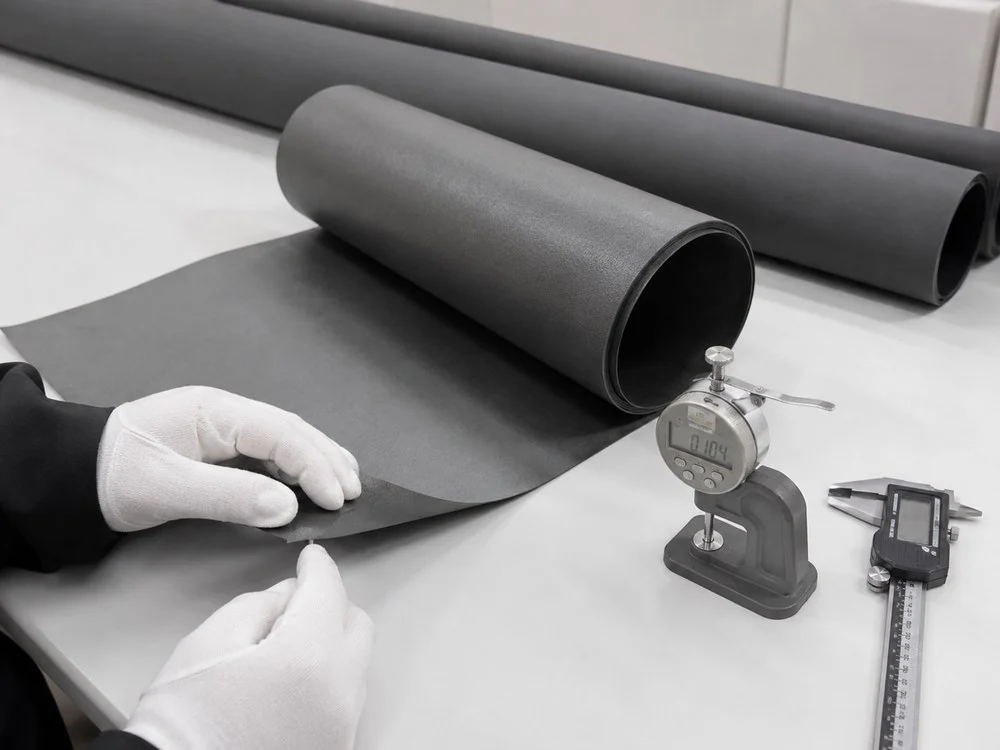
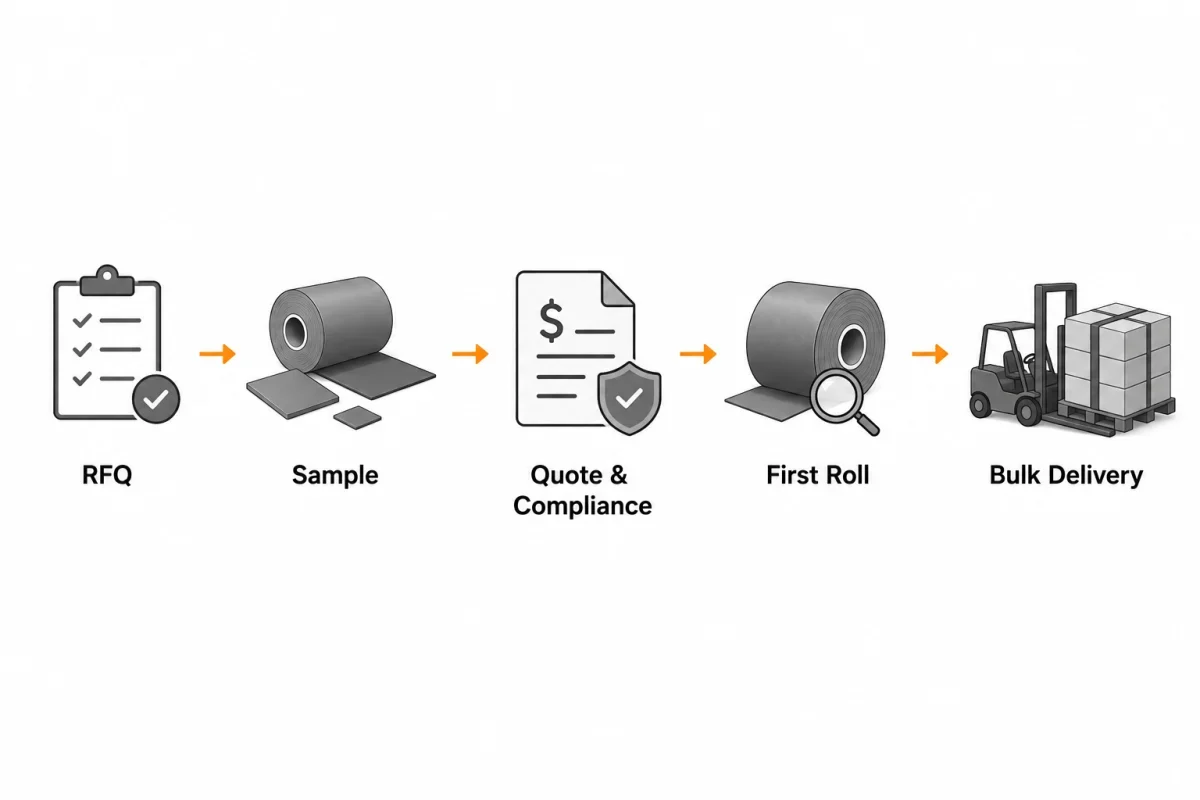
QDZRT Graphite manufactures and supplies custom graphite paper for export projects through five controlled stages: confirm the technical requirement, prepare a process-matched sample, align the quotation and compliance documents, approve the first production roll, and release bulk delivery against the frozen specification. This factory-direct process keeps material, converting, inspection, packing, and delivery responsibilities traceable from inquiry to repeat order.
This guide focuses on technical definition, sample validation, quotation normalization, export-control review, first-roll approval, and repeatable bulk supply. China has suppliers focused on raw graphite, solid graphite blocks, sealing products, or flexible sheet materials. A project involving graphite paper needs thickness, density, roll handling, lamination, cutting, and export protection. The overview of graphite paper properties and industrial uses explains the material family, while the graphite products range shows why thin paper, thicker flexible sheet, sealing stock, and machined graphite are not interchangeable. For commodity background, the USGS graphite statistics and information page provides an official mineral-market reference; it does not define a specific graphite-paper grade.
For each export order, the contract, pro forma invoice, commercial invoice, bank beneficiary, and declared exporter must be consistent. If an authorised export entity or approved external process is involved, we disclose the relationship and payment instructions before remittance. Customers can verify capability through the approved sample, named material and process records, lot traceability, inspection evidence, and documented corrective response.
QDZRT Graphite supplies flexible graphite paper directly for export projects. We state which production, converting, inspection, and packing steps are completed by our team and disclose any approved external process before quotation or sample approval. Material grade, inspection records, batch traceability, and change notification remain defined in the project specification.
Before technical approval or payment, verify the Chinese legal entity that will sign the contract and receive funds. Search the supplier’s legal name and unified social credit code in the National Enterprise Credit Information Publicity System, and compare the registered status, address and disclosed business information with the licence and quotation. A business licence confirms registration; it does not by itself prove that the company operates the claimed graphite-paper production or conversion process.
QDZRT Graphite Pre-Order Project Verification
Our Five-Stage Order Control Process
Keep each approval tied to a specific output: the RFQ defines open and fixed requirements; the sample records process-matched test results; quotation and compliance review set the commercial and shipment basis; the first production roll proves roll-scale behavior; and bulk release uses the same frozen references for lot release, packing, and repeat orders.
Step 1 — Build an RFQ That Separates Requirements from Examples
The application comes first. Heat spreading, die-cut gasket layers, converter stock, thermal pads, industrial insulation layers, friction-related parts, and laminated assemblies do not require the same graphite paper. A project for thermal management and high-temperature processing should state the heat-source area, contact surfaces, available assembly height, attachment method, and whether electrical insulation is required. A project linked to industrial gasket and sealing service should state temperature, pressure, medium exposure, compression condition, flange geometry, and whether the material is only an intermediate layer or the finished sealing element.
QDZRT Graphite lists expanded-natural-graphite paper within a broad thickness range around 0.1–2.0 mm and density options around 1.0–1.7 g/cm³. Those are product-family ranges, not proof that every thickness can be supplied at every density. Sheets suit hand trials and small cutting runs; master rolls suit continuous processing; slit rolls reduce trim; laminated formats may add adhesive, release liner, film, or another handling layer. A thicker flexible graphite sheet belongs in a different specification when the job needs sealing thickness, reinforcement, or a construction beyond thin paper.
Use status labels instead of hiding unknowns. Mark each field as Required, Target, Open, Supplier Proposal, or Approved Method. “Density open; the material must survive rotary die cutting without edge breakup” gives more engineering direction than a copied density value with no test condition. Apply the same discipline to purity, ash, moisture, sulfur, chloride, surface condition, adhesive, liner, insulation film, and roll geometry.
| RFQ field | Illustrative entries | What must be stated for the project | Approval basis |
|---|---|---|---|
| Material family / construction | Expanded natural graphite paper; laminated paper; finished die-cut part | Raw graphite layer, adhesive, release liner, film, reinforcement, and any excluded material | Drawing, stack description, supplier grade, and sample record |
| Thickness | 0.10, 0.20, 0.50, 1.0, or 2.0 mm | Nominal value, individual-point limit, average limit, test method, contact force, and conditioning | Application height, compression behavior, conversion trial, and approved measurement procedure |
| Density | 1.0, 1.2, 1.5, or 1.7 g/cm³ | Grade-specific target and tolerance; whether calculated from actual thickness and specimen mass | Handling, compressibility, mass per area, surface condition, and process-matched sample |
| Chemistry | Purity, ash, sulfur, chloride, moisture | Which values are mandatory, the analytical method, reporting unit, lot frequency, and certificate fields | Application exposure, customer specification, and agreed COA format |
| Roll format | 100, 300, 500, or 1000 mm width; 76 or 152 mm core | Gross and usable width, core inside diameter, maximum roll outside diameter, winding direction, splice rule, and edge allowance | Machine fit, unwind trial, nesting yield, packing, and unloading method |
| Sheet format | 210 × 297, 300 × 500, or 500 × 1000 mm | Cut dimensions, squareness, flatness, interleaving, protective boards, usable area, and count | Trial layout, storage, receiving inspection, and converted-part yield |
| Trial quantity | Two thicknesses × two densities × three pieces, or one short trial roll | Why each option is included, identification code, retained reference quantity, and test sequence | Approved trial plan rather than a default sample count |
For finished parts, identify the drawing revision in the inquiry and send the controlled drawing after our reply by email or another agreed secure channel. For roll stock, include maximum roll diameter, core size, winding direction, splice rules, minimum usable width, and whether the leading or trailing section may be non-usable. State the destination country, importer, final user, final use, route, trial quantity, future volume, and packing form because those details can affect technical classification, export documents, packing, and lead time. A request involving graphite sealing materials should also state whether the requirement is raw paper, reinforced sheet, gasket stock, or finished cut pieces.
Step 2 — Clarify the Requirement and Design the Sample Round
Our technical team confirms the open requirements that affect material construction, tolerances, conversion, packing and acceptance before preparing the sample. For repeat orders, we check changes against the approved specification. We document our response, sample results and any corrections so the customer can follow the manufacturing decisions.
The first clarification normally separates function from preference. Is 0.10 mm fixed by an assembly gap, or is it only the current sample thickness? Is 1.2 g/cm³ a tested requirement, or an estimate? Does “graphite thermal sheet” mean flexible graphite paper, a synthetic thermal film, or a laminated stack? The comparison of flexible graphite foil versus thermal graphite sheet shows why terminology must be settled before quotation.
Conversion questions come next. A roll that looks smooth by hand may behave differently on a slitter, laminator, rotary die cutter, flat-bed press, or manual knife. Name the process. For finished-part drawings, give the smallest hole, narrowest bridge, tightest inside corner, critical dimensions, preferred orientation, and whether the cut is through-cut or kiss-cut. Our team can then discuss raw roll, slit roll, laminated stock, or finished parts as a project-specific supply form.
A hand sample and a roll trial answer different questions. A 100 × 100 mm piece can confirm appearance, rough thickness, and basic handling. It cannot prove roll tracking, winding tension, core fit, splice behavior, flatness, brittleness, liner tracking, or edge stability over production length. The graphite paper thickness and density guide helps define the first comparison, but the approved sample must still match the customer’s actual process.
Choose one controlled comparison. Two thicknesses at one density, or one thickness at two densities, can isolate a meaningful variable. Six unrelated samples usually cannot. Test the material in the intended stack and on the intended equipment. A thermal pad trial needs the real adhesive, liner, mating surfaces, pressure, and heat-source geometry. A die-cut trial needs the tool type, cutting direction, stripping method, and part geometry. A sealing trial needs the working surfaces, compression condition, temperature, pressure, and medium. The article on graphite paper for heat-spreading pad conversion explains why the graphite layer cannot be judged separately from the converted assembly.
Record the result instead of only writing “pass.” Measure thickness at defined positions using the approved method. Record edge quality, dust, wrinkles, liner release, adhesive effect, curling, cracking around narrow bridges, and distortion after cutting. Keep one unprocessed reference piece from each option. For future roll supply, test a short roll because sheets do not reveal unwind behavior.
Graphite dust belongs in the trial review when slitting, punching, or die cutting. The NIOSH Pocket Guide entry for natural graphite and the OSHA natural graphite chemical-data page provide United States occupational-health references. They do not replace the plant’s SDS review, exposure assessment, ventilation design, PPE selection, or local legal requirements.
Turn the approved sample into a controlled reference. Record the sample code, supplier grade, thickness, density, format, dimensions, laminate stack, liner, test method, test result, and retained reference location. “Same as sample” is too weak when the sample has no code or frozen written specification. The graphite paper roll quality checks for die cutting article provides additional inspection points when the project moves from hand samples to continuous converting.
Step 3 — Read the Quote Together with Compliance and Delivery Terms
A quotation is useful only when each price is tied to defined material, quantity, inspection, packing, and delivery terms. Match the quoted item against the approved sample: grade, material family and construction, thickness, density, chemistry, width, length, core, surface, lamination, liner, winding, splice rule, and packing. Treat an absent field as open rather than assuming it matches the sample.
Gross width is not usable width. A 500 mm roll with 5 mm edge trim on both sides provides 490 mm of usable material. That difference changes nesting yield and finished-part count. The same principle applies to damaged edges, liner overhang, splice length, leading and trailing sections, or non-usable winding.
Normalize units before comparing price. For bare graphite paper, a theoretical cross-check is:
Theoretical areal mass (kg/m²) = Thickness (mm) × Density (g/cm³)
For example, 0.10 mm × 1.2 g/cm³ = 0.12 kg/m². A quoted price per kilogram can therefore be converted to a theoretical material cost per square metre only after thickness and density align. This calculation does not include adhesive, liner, film, reinforcement, trim loss, splices, process scrap, or tolerance variation. A price per roll still needs usable width, usable length, and nominal mass. Minimum order quantity needs a unit: kilograms, square metres, sheets, rolls, or one production batch.
The following values are hypothetical examples only. They are not our team prices, standard lead times, standard packing, or default inspection quantities.
| Quotation line | Hypothetical value | What to normalize or confirm | Change trigger |
|---|---|---|---|
| Material basis | 0.10 mm, 1.2 g/cm³, ±10% | Approved grade, actual test method, chemistry, laminate stack, and COA fields | Grade, process, chemistry, adhesive, liner, or method changes |
| Usable roll width | 500 mm gross, 5 mm trim per side, 490 mm usable, 76 mm core | Whether price, yield, and minimum length use gross or usable material | Width, edge allowance, core, maximum roll diameter, or splice policy changes |
| Quantity basis | One trial roll; ten bulk rolls; 50 kg per roll; 500 kg total | Overrun, underrun, partial rolls, minimum usable length, and batch definition | Order volume, production minimum, or packaging unit changes |
| Schedule basis | Seven days for sample, twenty for production, three for packing | Clock start, sample approval, export-control review, production, inspection, packing, and document release | Specification revision, license requirement, raw material, route, or packing changes |
| Packing basis | One roll per carton, two end supports, four corner guards, ten cartons per pallet | Core support, moisture barrier, label, pallet, packed dimensions, gross weight, and unloading method | Roll weight, route, transport mode, destination, or stacking requirement changes |
| Inspection basis | Five thickness points per roll, two edge checks, one roll label, one batch reference | Approved method, sample size, individual and average limits, document fields, hold and concession rules | Lot size, risk, process capability, customer specification, or method changes |
| Landed-cost basis | Material + packing + bank charges + freight + insurance + destination costs | Chargeable weight or volume, license-related cost, customs, duties, taxes, terminal, broker, and delivery charges | Incoterm, route, currency, packed volume, destination, or regulatory status changes |
The article on export packaging for graphite paper rolls and sheets explains why packing details change both cost and receiving condition. Separate sample preparation from bulk production, packing from transport, and technical approval from document release. “Delivery in 30 days” remains unclear until the start event and delivery endpoint are defined.
Run export-control classification before promising shipment
Graphite paper made from expanded natural graphite can require export-control review in China. The 2026 Catalogue of Dual-Use Items and Technologies Subject to Import and Export License Administration took effect on 1 January 2026 and includes control entry 1C108.c for natural flake graphite and its products, including expanded graphite. The exporter should classify the actual product against the current official list using its material source, composition, technical parameters, processing route, and intended use. This article is a workflow guide, not a legal classification or a promise that a license will be granted.
Before confirming a courier sample or bulk lead time, collect the importer, consignee, final user, final use, final destination, route, contract information, and accurate product description. The MOFCOM graphite dual-use FAQ explains that end-use descriptions should be specific and consistent across application materials. For graphite dual-use items destined for the United States, paragraph 2 of MOFCOM Announcement No. 46 of 2024 provides for stricter end-user and end-use review; however, MOFCOM Announcement No. 72 of 2025 suspends paragraph 2 through November 27, 2026. Product classification, destination, end user, end use, and any other applicable controls still need to be reviewed before shipment timing is represented as firm. Re-check the official status for shipments on or after that date.
Write the exact Incoterms rule and named place
Do not write only “FOB,” “CIF,” or “door delivery.” The quotation and purchase order should state the exact rule, place or port, and version, for example FCA Qingdao, China, Incoterms® 2020 or CIP [named place], Incoterms® 2020. The ICC Incoterms® 2020 guidance allocates buyer and seller tasks, costs, and risks, but it does not define product specifications, payment triggers, ownership transfer, acceptance criteria, export-license approval, or remedies for nonconforming goods.
Confirm pickup, export clearance, main carriage, insurance, import clearance, duties and taxes, terminal charges, unloading, and the risk-transfer point. Also confirm whether the carrier is nominated by the buyer or seller, who supplies the courier account, which documents release payment, and whether packed dimensions or chargeable weight can change the freight quotation.
Documents need the same control. Confirm the commercial invoice, packing list, product description, quantity unit, batch reference, certificate fields, country-of-origin request, customer labels, consignee, final user, and any license references. The graphite products export documentation guide explains the difference between technical product selection and shipment paperwork. A technically acceptable roll can still be delayed when invoice wording, quantity units, end-use information, or consignee details do not match the approved file.
Step 4 — Approve the First Production Roll Against a Frozen Specification
The first production roll is not only a larger sample. Roll length introduces winding pressure, edge alignment, telescoping risk, core fit, cumulative variation, splice behavior, and transport load. Lamination adds web tension and liner tracking. Slitting adds blade condition and edge consistency across the full length.
Freeze the approved reference before production. The controlled package should include the specification revision, our team or supplier grade, supplier item code, nominal thickness and density, chemistry requirements, laminate stack, adhesive and liner, roll geometry, test method, sample code, drawing revision, approved deviations, and packing plan. The production-line view in the graphite paper custom production-line video helps procurement and engineering teams discuss physical roll format instead of treating a roll as an enlarged sheet.
Then define what exists only at roll scale: gross and usable width, core inside diameter, maximum outside diameter, winding direction, splice policy, roll mass, leading and trailing allowance, edge protection, label position, and pallet orientation. Decide before shipment where thickness will be checked, how much material will be unwound, which converted parts will be measured, and what result places the roll on hold.
The first-roll release record should identify the roll and lot, specification revision, sample reference, inspection method, measured results, converted-part result, retained sample, packing photos, deviations, and approval authority. Keep the first run small enough to investigate a problem without exposing the complete demand; the actual quantity depends on the equipment, minimum manufacturing lot, and project risk.
Packing is part of first-roll approval. A local transfer and a long export shipment do not load cores and edges in the same way. Confirm orientation marks, roll identification, wrapping, inner barrier, end support, carton or crate, pallet restraint, moisture protection, packed dimensions, gross weight, and unloading method. The article on graphite packaging and logistics for delivery provides the broader shipment context. A roll has not fully passed when it converts correctly but arrives with edge compression that reduces usable width.
When the first roll fails, preserve specific evidence. “Roll quality poor” gives no correction path. “Left edge shows 8 mm of compression after unpacking; the first 12 m tracks toward the operator side” identifies location, magnitude, and effect. Photos, measured values, roll label, remaining material, packing condition, and machine settings help separate production variation from transport damage or process setup.
Step 5 — Release Bulk Delivery by Lot and Control Changes
Bulk supply shifts control from one sample to multiple rolls, cartons, pallets, batches, shipping documents, and repeat-order records. The approved sample remains the visual and functional reference, while lot identity, packing, and logistics need their own release checks.
Define lot release before production. Record the supplier lot, roll numbers, specification revision, quantity, COA fields, incoming or pre-shipment sample plan, measurement positions, individual and average limits, label format, retained sample, and disposition route for an out-of-range result. Use an approved method rather than an unsupported quality-system claim. A 0.10 mm target measured with different contact force, instruments, conditioning, or positions can produce conflicting results.
Quantity tolerance also becomes important. Define accepted overrun or underrun, partial-roll handling, minimum usable length, splice allowance, and whether price follows gross mass, usable area, or finished-part yield. For die-cut conversion, usable area after trim and splices may matter more than gross mass. For sheets, count, dimensions, flatness, interleaving, and protective boards may matter more than weight.
Changes require written notification and approval. The supplier should not silently change the graphite grade, raw-material route, compaction, adhesive, liner, film, core, winding direction, splice policy, subcontract converter, test method, label, or packing construction. The agreed change-control clause should define which changes require notice, the notice period, the evidence required, whether a new sample or first roll is needed, and who may approve a deviation or concession.
Packaging scales differently in bulk. Ten cartons do not behave like one courier box. Pallet height, load distribution, core support, stacking direction, humidity protection, container restraint, warehouse handling, and unloading equipment need review. For long rolls, packed outside diameter may determine carton size and chargeable volume. For wide sheets, pallet footprint and overhang affect edge protection. Our team can discuss sheets, rolls, slit rolls, laminated options, and finished conversion as confirmed project formats; each format needs its own packing description and release evidence.
For repeat orders, keep the frozen specification, approved sample code, first-roll record, quotation revision, purchase-order description, Incoterm and named place, label wording, accepted deviations, licence or classification record where applicable, and final packing plan together. Changes to width, liner, quantity, route, consignee, final user, final use, or packing trigger a fresh review; material approval alone does not approve a new logistics or compliance plan.
What Goes Wrong When a Stage Is Skipped
Skipping the application definition produces a technically real product that serves the wrong function. A 0.10 mm paper may arrive when the assembly needed an adhesive laminate, electrical insulation layer, or thicker reinforced sheet. The material is not necessarily defective; the RFQ did not define the required function.
Skipping process-matched sampling produces the wrong evidence. A hand sample looks smooth, yet the material cracks at a narrow bridge during die cutting. Raw paper passes, but the adhesive laminate curls. A small sheet passes, but the production roll wanders during unwind. The sample was not false; it answered a different question.
Skipping line-by-line quotation review creates commercial disputes. One quotation uses kilograms, another square metres, and neither states usable width. Packing, bank fees, compliance work, labels, insurance, or export documents appear later as added costs. The lowest price wins only because the quotations were not normalized.
Skipping export-control review can stop a sample or bulk shipment after the commercial schedule has already been promised. The project then waits for technical classification, final-user and final-use documents, route information, or license review. Compliance must be treated as a gate, not as a packing-room task.
Skipping first-roll approval exposes the full order to roll-scale problems. Telescoping, edge compression, winding direction, splice handling, liner tracking, or cumulative thickness variation may appear only after multiple rolls are produced. A controlled first production run creates a place to detect those issues before repeat volume.
Skipping change control breaks continuity. The second order may be called “same material” even though width, liner, raw-material route, freight method, consignee, or pallet loading changed. The approved sample controls a defined material and process reference; it does not freeze every future commercial and logistics condition automatically.
Send our team the application, target thickness or density, required format, dimensions, processing method, trial quantity, destination, final use, and packing needs through the QDZRT Graphite contact page. The project can then be discussed as sheet, master roll, slit roll, laminated material, or finished converted part, with the sample, quotation, compliance, first-roll, and bulk-release stages documented separately.