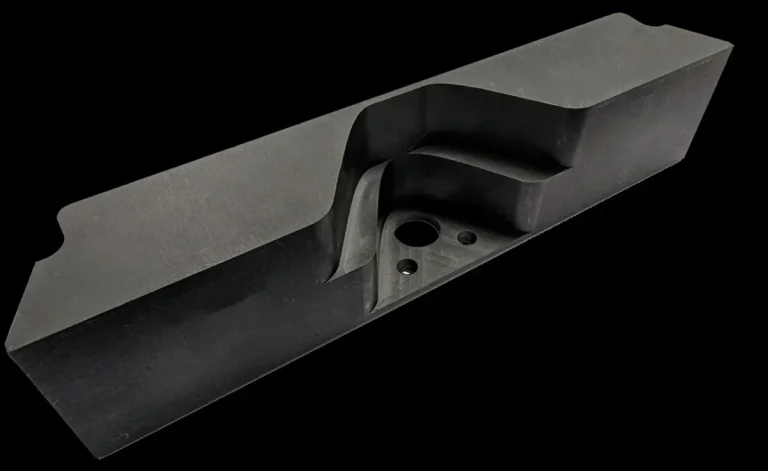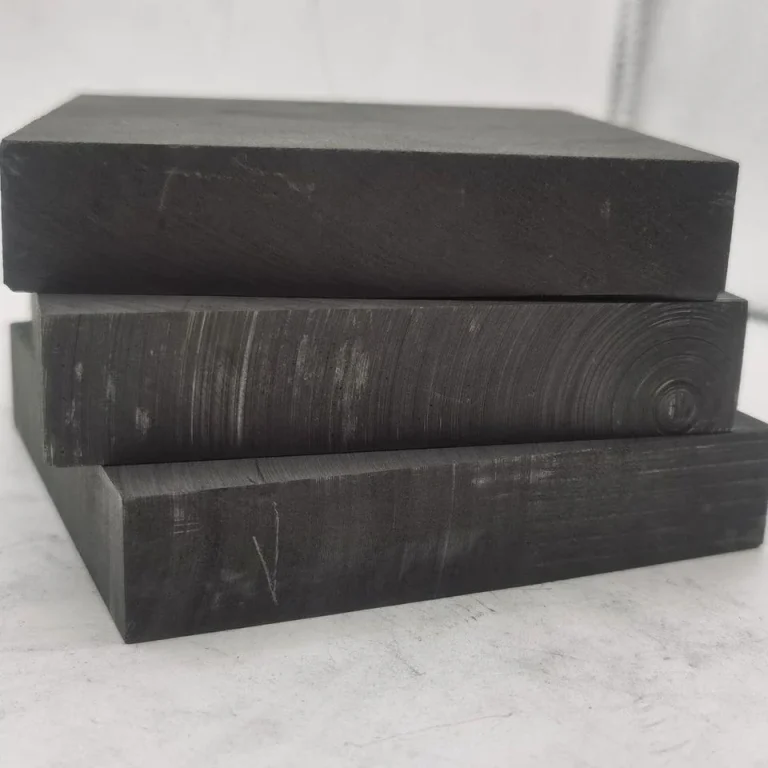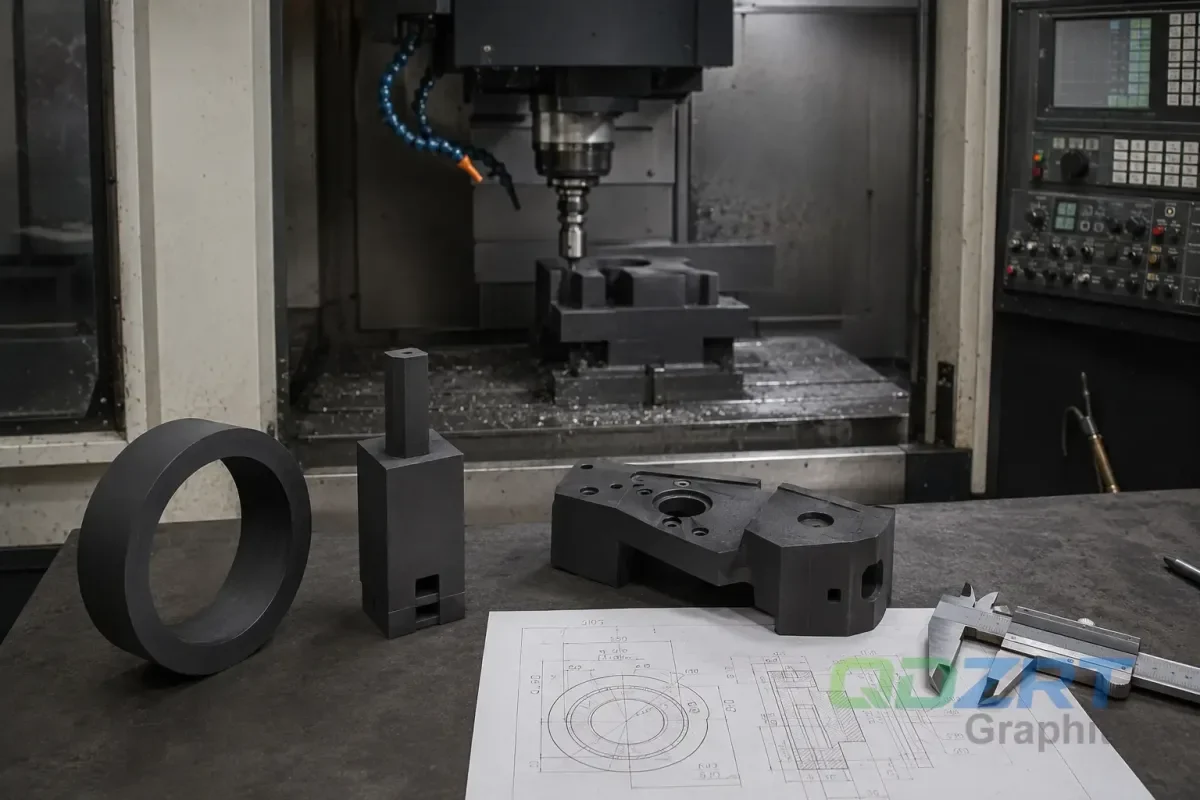
Choosing graphite block for EDM electrodes starts with the electrode duty, cavity geometry, expected surface, wear strategy, and the way the electrode will be machined and inspected. A block selected only by outside dimensions may be too coarse for a narrow finishing rib, unnecessarily expensive for a large open roughing electrode, or inconsistent with the datum and allowance plan used by the mold shop.
QDZRT Graphite can supply molded, extruded, isostatic, fine-grain and machining-ready graphite blocks. Different electrode programs need different balances of structure, available size, machinability, consistency and cost, so grade selection starts with the electrode duty and geometry rather than one preferred material family.
Use the numerical bands below for screening and RFQ discussion. Final EDM behavior is set by the named grade together with the machine, workpiece, dielectric, polarity, current, pulse settings, flushing, spark gap, electrode geometry, and operator strategy.
A Six-Step EDM Electrode Selection Process
A repeatable purchase follows six connected controls. The first two define the electrode job and geometry. The next two identify a suitable graphite grade or forming route and blank condition. The last two verify that the material can be machined, inspected, burned, and approved under the buyer’s actual process.
| Stage | Question to close | Required evidence |
|---|---|---|
| 1. Electrode duty | Roughing, semi-finishing, finishing, detail-critical, or mixed duty? | Cavity purpose, wear strategy, surface objective, number of electrodes. |
| 2. Geometry | Which ribs, slots, corners, holes, unsupported lengths, and deep features control risk? | Current drawing, minimum features, datum plan, tool-access review. |
| 3. Grade and forming route | Which named grade and forming route are being quoted? | Grade data sheet, typical or guaranteed values, forming route, supply size. |
| 4. Blank and orientation | How will the block be cut, oriented, identified, and supplied? | Blank dimensions, allowance, cut direction, lot and block ID, orientation mark. |
| 5. Machining and inspection | Can the electrode be produced without unacceptable chipping, distortion, or datum loss? | Toolpath, first-off results, feature measurements, visual and edge inspection. |
| 6. EDM trial and approval | Does the electrode perform acceptably in the buyer’s real cavity program? | Machine and program record, wear, cavity dimensions, surface result, approval decision. |
Start with Electrode Duty, Not Only Block Size
A large roughing electrode with open geometry does not necessarily need the grade selected for a thin-rib finishing electrode. The same mold package may use several graphite levels because each electrode has a different purpose. Grouping by duty prevents the purchasing specification from forcing the highest-cost material onto every block while also preventing a general grade from being used where edge stability and detail transfer are critical.
The five duty levels below work as an RFQ triage tool. They help separate open roughing electrodes from finishing work with narrow ribs or other detail-sensitive features. Unsupported length, corner radius, tool access, electrode mounting, spark gap, flushing, workpiece material and the EDM program still decide whether a particular grade is suitable.
| Duty level | Illustrative geometry trigger | Material emphasis | Validation emphasis |
|---|---|---|---|
| 1. Open roughing | Broad cavity and large stock removal; minimum features may be above about 5 mm. | Stable general EDM route with practical blank utilization. | Grade identity, rough-machining response, mounting and repeatability. |
| 2. Controlled roughing | Stepped cavity or moderate wear sensitivity; features may be around 3–5 mm. | General-to-fine structure with consistent blank condition. | Squareness, datum faces, allowance and orientation. |
| 3. Semi-finishing | Intermediate surface and dimensional transfer; features may be around 2–3 mm. | Fine-grain screening and balanced machinability. | Edge inspection, sample feedback and controlled packing. |
| 4. Finishing | Narrow slots, final surface duty, or ribs around 1.5–2.0 mm. | Fine or ultrafine named grade where justified by the design. | Feature-specific inspection, batch identity and cavity trial. |
| 5. Detail-critical finishing | Features below about 1.5 mm, sharp transitions, or long unsupported details. | Highest justified uniformity and edge stability for the actual feature. | Prototype validation, individual protection and repeat-order lock. |
A depth greater than six times a tool diameter or groove width deserves closer review. The ratio is only one part of the geometry: a deep feature with a generous corner radius, short overhang and open evacuation path may be easier than a shallower feature with a thin unsupported wall.
Further background appears in the EDM graphite electrode machining basics and the EDM and precision tooling solution.
Use Named Grades and Forming Routes
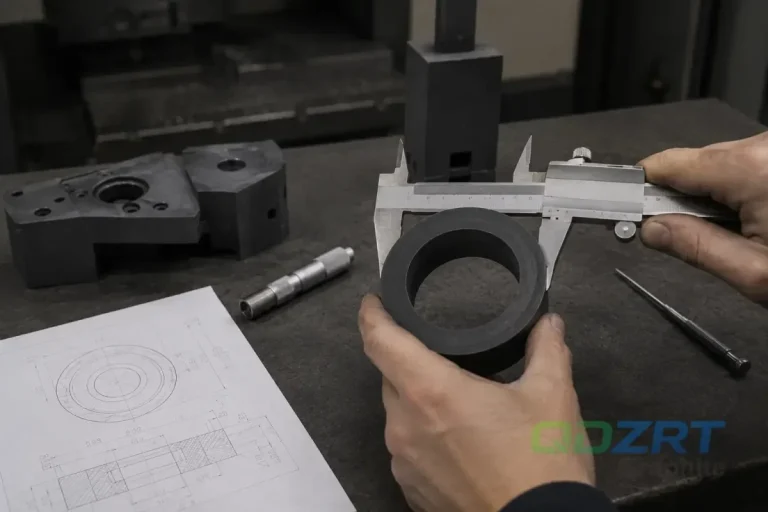
“EDM graphite” is a product category, not one universal material. Our team supplies graphite blocks through molded, extruded, isostatic, fine-grain, and high-purity routes. The current Graphite Block range lists density, electrical resistivity and ash as product-family reference ranges. The 1–20 µm particle-size range applies only to selected fine-grain / isostatic grades; molded, extruded and other coarser routes must be confirmed against the selected grade/TDS.
For selected fine-grain / isostatic EDM-oriented grades, a narrower particle-size band such as 5–20 µm can frame preliminary EDM screening; density around 1.70–1.80 g/cm³ and resistivity around 10–15 µΩ·m remain grade-dependent reference values. These must not be presented as guaranteed specifications for every grade, forming route, size, or lot we supply. The quotation should name the grade, separate typical references from contractual limits, state the test method, and clarify whether the COA reports actual lot results.
| Property or control | Why it matters | What the RFQ should record |
|---|---|---|
| Particle or grain size | Helps screen detail capability and structural uniformity, but does not independently predict wear or finish. | Named grade, manufacturer terminology, value basis, and test method. |
| Bulk density | Supports grade comparison and can relate to structure and surface behavior. | Typical or guaranteed range, test direction, lot result if required. |
| Electrical resistivity | Relevant to discharge behavior, but the EDM program remains decisive. | Units, test temperature, test direction, typical or guaranteed status. |
| Flexural strength | Useful when ribs, narrow walls, and handling loads create fracture risk. | Test method, direction, specimen basis, and applicable limit. |
| Hardness | Can affect machining behavior and grade comparison, but is not a complete machinability index. | Hardness scale, method, typical or guaranteed value. |
| Ash or purity | Controls cleanliness for selected applications; does not alone predict electrode wear. | Carbon or ash requirement, test method, selected-grade limit. |
| Forming route and orientation | Molded, extruded, and isostatic routes may differ in structure, available size, and directional behavior. | Forming route, isotropy or orientation, cut direction, test direction, block ID. |
Manufacturer terminology is not interchangeable. One supplier may call a 5 µm grade fine-grain, another micro-grain, and another ultrafine. Toyo Tanso, Mersen, and SGL Carbon each publish their own EDM families and typical values. Those sources support the principle that EDM graphite is offered through multiple named grades, but their classifications should not be copied onto a quotation from us as if the grades were equivalent.
For initial screening, buyers may use grain-size bands such as below about 5 µm, 5–10 µm and 10–20 µm. The supplier’s named grade and its actual data remain more important than the label attached to the band. A practical verification sequence is:
Named Grade Datasheet → Electrode Sample Trial → Cavity Record
Control Forming Route, Orientation, and Blank Condition
For a simple raw block order, the buyer may only need a named grade and cut size. For thin, long, matched, or repeat electrodes, that is often insufficient. The RFQ should state whether the quoted material is molded, extruded, isostatic, or another approved route. It should also state whether orientation is controlled, not controlled, or not applicable.
Extruded graphite may show stronger directional behavior than an isostatic route, while isostatic grades are often selected for greater structural uniformity. That does not make extruded material unsuitable for EDM or guarantee the best cavity result from an isostatic grade; feature geometry, block size, grade availability, machining plan, and validated burn results still decide the choice.
The blank condition must also be explicit:
- Raw block: supplied with mill or saw condition and buyer-managed squaring.
- Cut block: sawn to a nominal blank size with stated allowance.
- Squared blank: datum faces prepared to a stated squareness and parallelism plan.
- Rough-machined electrode blank: major stock removed with controlled finishing allowance.
- Finished electrode: drawing-based machining, feature inspection, identification, and protective packing.
Machining allowance depends on the incoming blank and who performs the final machining. A rough allowance of 0.5–2.0 mm per side and finishing stock of 0.1–0.3 mm can be useful starting examples, then adjusted for incoming flatness, squaring method, datum strategy, part size, toolpath and inspection method.
The RFQ should record the lot or block ID, blank cut direction, property test direction, and orientation mark where applicable. Matched electrode sets should keep these records together so a replacement can be traced to the same approved material and drawing revision.
RFQ Fields That Prevent a Wrong Quote
A useful RFQ separates mandatory requirements, target values, open questions, supplier proposals, and the approved method. This keeps general targets from turning into accidental guarantees and gives the supplier room to explain when another grade or blank format could reduce cost or risk.
| RFQ field | Buyer input | Supplier response | Approval record |
|---|---|---|---|
| Electrode duty | Roughing, semi-finishing, finishing, detail-critical, mixed. | Recommended grade and reason. | Approved duty-grade mapping. |
| Geometry | Minimum rib, slot, hole, unsupported length, corner radius, deep features. | Machinability risks and proposed design or toolpath questions. | Drawing revision and closed questions. |
| Grade and forming route | Required or open. | Named grade, forming route, typical and guaranteed properties. | Approved specification revision. |
| Blank condition | Raw, cut, squared, rough-machined, or finished. | Machining scope, allowance, datum faces, edge protection. | Approved drawing and inspection plan. |
| Orientation | Controlled, not controlled, or not applicable. | Cut direction, test direction, marking method. | Lot and orientation traceability. |
| Machining evidence | Critical dimensions and surfaces. | First-off inspection, instrument and sampling proposal. | Approved inspection report. |
| EDM validation | Workpiece, machine, dielectric, polarity, program and acceptance. | Sample quantity and material traceability. | Cavity trial and release decision. |
| Packing and repeat supply | Edge protection, matched-set identification, storage and delivery limits. | Package plan, labels, retained record and change notification. | Repeat-order control record. |
Useful follow-up project files include the current electrode drawing, cavity or mold context, electrode grouping list, planned machining method, electrode holder interface, and any previous cavity result; send controlled files after the initial inquiry by email or another agreed secure channel. When the buyer only knows the required cavity performance, the supplier should state which questions remain open rather than converting assumptions into a final material promise.
Machining and Inspection Before the EDM Trial
Graphite is commonly machined dry where the approved process uses effective dust collection. Dry machining avoids many metal-style coolant assumptions, but it should not be written as an absolute ban on every wet or dedicated process. The machining method, collection system, cleaning procedure, PPE, and exposure monitoring must follow the material SDS, machine design, workplace assessment, and local regulations.
The machining plan should consider:
- Tool material and geometry suitable for abrasive graphite.
- Tool projection and stiffness for deep or narrow features.
- Supported entry and exit paths around thin edges.
- Corner radii that match the functional cavity requirement.
- Roughing and finishing stock assigned to controlled surfaces.
- Datum preservation from blank preparation through final inspection.
- Dust extraction at the cutting zone and controlled cleanup.
- Handling and packing that protect fragile ribs and corners after inspection.
Our team can discuss raw blocks, squared blanks, rough-machined blanks, and custom graphite machined parts. The quotation should identify which operations are included and which remain the buyer’s responsibility. A finished-electrode quotation should also identify the drawing revision, critical dimensions, surface callouts, datum system, inspection method, and any features that require concession or design review.
Related process guidance appears in the successful graphite machining guide, the shop-floor graphite cutting comparison, the common graphite machining mistakes, and the precision graphite machining guide.
Convert a Material Trial into a Cavity Record
A material trial should produce a record that can be compared with the approved baseline. The example below is hypothetical. It demonstrates the fields and arithmetic structure; it is not a default acceptance standard used by our team and it is not an industry-wide EDM recipe.
| Record field | Illustrative entry | Control note |
|---|---|---|
| Material | Named Grade A, Lot 2408-01 | Record manufacturer, grade, lot, block ID and orientation. |
| Electrode duty | Finishing trial | Link to cavity and electrode drawing revision. |
| Electrode machining target | Ra 1.6 µm; edge breakout below 0.10 mm | Illustrative only; record instrument, filter, location and method. |
| EDM machine and program | Machine ID E-02; Program FIN-17 | Record firmware or parameter revision where controlled. |
| Workpiece and dielectric | Tool steel; approved hydrocarbon dielectric | Record grade, hardness, dielectric condition and flushing method. |
| Polarity and settings | Positive electrode; 6–12 A; 20–80 µs pulse band | Hypothetical program values, not a universal recommendation. |
| Measured corner wear | 0.08 mm | Define measurement location, baseline geometry and uncertainty. |
| Cavity dimensional deviation | 0.02 mm at controlled feature | Separate electrode dimensions, spark gap and cavity result. |
| Cavity surface | Ra 3.2 µm at defined location | Do not compare without the same method and measurement location. |
| Decision | Approve for this cavity program | Approval applies to the recorded material, geometry and process window. |
The trial should compare the candidate grade with a baseline whenever possible. A result such as 0.08 mm corner wear is only meaningful when the original corner geometry, measurement method, cavity program, and baseline material are known. Likewise, an electrode-machining surface of Ra 1.6 µm is different from a cavity surface of Ra 3.2 µm and must be recorded separately.
Once approved, the project record should connect the named grade, material lot, block ID, orientation, electrode drawing, machining program, inspection report, EDM program, workpiece, cavity result, and buyer approval. That record turns a one-time trial into evidence for repeat supply.
Repeat Orders Need Change Control
“Same as last time” is not a complete repeat-order instruction. A reliable repeat order identifies the previous approved specification and then checks whether anything has changed. The supplier and buyer should review:
- Named graphite grade and manufacturer.
- Forming route and orientation control.
- Lot, block, or batch identity.
- Drawing and electrode-program revision.
- Blank dimensions, allowance, datum preparation, and marking.
- Machining and inspection scope.
- EDM machine, program, workpiece, and cavity acceptance record.
- Packing method and matched-set identification.
- Any raw-material, manufacturing, machining, or subcontractor change.
For two or more electrode sets, each set should be identifiable without exposing fragile edges to unnecessary labels or handling. A replacement electrode should be linked to the same approved material and geometry record. If a named grade becomes unavailable, the substitute should return to the sample and cavity-validation stage rather than being approved by density or grain size alone.
The common graphite block buying mistakes article provides additional examples of incomplete grade and repeat-order control. The graphite tolerance confirmation guide explains how drawing and inspection decisions should be closed before production.
Packing and Delivery for EDM Blocks and Electrodes
A raw block, squared blank, and finished electrode do not need the same protection. Raw blocks require stable restraint against movement and impact. Squared blanks also need datum-face protection. Finished electrodes may require individual cavities, edge clearances, orientation labels, and matched-set identification.
The package should prevent graphite surfaces from rubbing against each other, keep thin features away from carton walls, and maintain the inspection state until receipt. Large blocks need a practical lifting and unloading plan. Fragile finished electrodes should not carry straps or blocking loads through the functional geometry.
Photographs, package numbers, grade and lot labels, and quantity records support receiving inspection. The graphite packaging and logistics guide explains the general product-protection approach. The buyer should still confirm site-specific unloading, storage, and quarantine procedures.
Worked Example: One Mold Package, Several Electrode Groups
Consider a mold package containing twelve electrodes. Four are large open roughing electrodes, three are stepped semi-finishing electrodes, three are finishing electrodes with narrow ribs, and two are replacement electrodes for the same critical cavity. A single purchase line such as “EDM graphite block, fine grain, twelve pieces” hides important differences. It does not show which parts justify the fine-grade cost, which blanks need orientation control, or which two electrodes must remain matched to the same cavity program.
A more useful grouping record could be organized as follows:
| Group | Quantity and duty | Material and blank decision | Evidence before release |
|---|---|---|---|
| A | 4 open roughing electrodes | General EDM named grade; cut or squared blanks; practical allowance. | Grade identity, blank size, datum faces, rough-machining response. |
| B | 3 semi-finishing electrodes | Fine-grain screening; controlled orientation where applicable. | First-off dimensions, edge condition, machining record. |
| C | 3 finishing electrodes with narrow ribs | Named fine or ultrafine grade justified by geometry. | Feature measurements, protected packing, cavity trial. |
| D | 2 matched replacement electrodes | Same approved grade and controlled material record. | Drawing and program revision, block ID, set marking, repeat approval. |
This structure does not force four different grades. After review, Groups B and C may use the same named grade, or Groups A and B may share one route. The value of the grouping is that the decision is visible. The supplier can quote alternatives, the mold shop can explain which features control risk, and the final order can preserve the approved mapping.
The same example also shows why price per kilogram is not enough. A higher-cost material may reduce machining time, rework, electrode replacement, or cavity polishing on a detail-critical group, while providing little benefit to a large open roughing block. The economic comparison should therefore include blank utilization, machining time, tool wear, rejected electrodes, number of replacement electrodes, EDM time, cavity correction, and the cost of interrupting the mold program.
For this reason, the quotation should not claim that a smaller particle size automatically lowers total cost. It should explain the selected grade, the included blank or machining scope, the evidence that will be supplied, and any sample or cavity validation that remains the buyer’s responsibility.
EDM Electrode Allowance, Datum, and Matched-Set Control
Electrode performance begins before the EDM machine. If the blank is not large enough to establish stable datums, or if a thin finishing feature is used to absorb the final squaring error, a suitable grade may still produce a poor electrode. The allowance plan should identify where material will be removed and which surfaces become the machining and inspection references.
A practical drawing review separates:
- Mounting interface: the holder, threaded feature, clamp face, or reference surface that controls electrode installation.
- Primary datum: the face or axis used to establish the electrode coordinate system.
- Functional geometry: ribs, slots, corners, cavity-forming surfaces, and discharge faces.
- Nonfunctional stock: material that can be used for clamping, probing, and stable machining.
- Protected features: thin edges, sharp corners, and finished surfaces that must not carry packing loads.
Where the supplier provides a squared blank, the quotation should state the blank tolerance and which faces are prepared as datums. Where the supplier provides a finished electrode, the drawing should identify the datum system, critical dimensions, surface requirements, and any dimensions that are reference-only. The inspection report must use the same revision and datum interpretation.
Matched sets require another layer of control. Two electrodes with the same outside dimensions may still differ in orientation, program compensation, holder reference, or cavity assignment. Each electrode should carry a non-damaging identifier that connects it to the set, drawing, program, and material record. The identifier should not be placed on a fragile rib or discharge surface.
When a replacement electrode is made later, the buyer should confirm whether the original cavity program and spark-gap strategy are unchanged. A replacement based on the old drawing but used with a revised program may not reproduce the previous result. Repeatability therefore includes both the physical electrode and the controlled digital record.
Practical Approval Path from RFQ to Bulk Supply
A controlled EDM graphite order can move through the following sequence:
- RFQ review: confirm duty, drawing, minimum features, blank condition, forming route, quantity, and open questions.
- Supplier proposal: identify the named grade, typical and guaranteed properties, supply size, machining scope, inspection evidence, packing, and lead-time assumptions.
- Technical clarification: close geometry, orientation, allowance, datum, measurement, and sample questions before the purchase order freezes the wrong assumption.
- Sample or first-off preparation: maintain grade, lot, block, orientation, drawing, and machining traceability.
- Electrode inspection: record the required dimensions, edge condition, surface method, and any approved deviation.
- EDM trial: run the approved machine and cavity program and record wear, dimensions, surface, stability, and operator observations.
- Approval or correction: approve the specific grade and process, adjust the design or program, or test another material. Do not convert a single favorable result into a claim for every cavity.
- Repeat-order lock: freeze the specification revision, change-notification rules, packing, and evidence required for future lots.
Each stage closes a different risk. The RFQ closes ambiguity. The grade proposal closes material identity. The first-off closes machining feasibility. The cavity trial closes application performance. The repeat-order record closes uncontrolled substitution. Skipping one stage may appear faster, but it transfers the uncertainty to a later and more expensive point in the mold program.
For lower-risk open roughing electrodes, the sequence can be proportionate: a named grade, clear blank condition, and documented first-off may be sufficient. For detail-critical electrodes, the buyer may require a dedicated cavity trial, retained sample, more detailed measurements, and stricter change notification. The control level should match the consequence of failure rather than applying the same paperwork to every block.
Common EDM Graphite Sourcing Mistakes
Buying one grade for every electrode
This can increase cost for open roughing electrodes and still fail to protect detail-critical finishing features. Group the electrodes by duty and geometry before asking for a grade.
Comparing only density or grain size
Density and particle size are useful screening inputs, but neither is a complete EDM performance measure. Compare the named grade, forming route, strength, hardness, resistivity, structure, machining response, and validated cavity result.
Using a competitor grade name as a complete specification
Competitor names may help communicate a previous reference, but they do not prove equivalence. Request the required functions and compare named-grade data, sample machining, and cavity performance.
Ignoring blank condition and orientation
A quote for a raw saw-cut block is not equivalent to a squared or rough-machined blank. Repeat sets may also require direction and lot control.
Mistake: Turning Trial Values Into Acceptance Limits
Current, pulse width, wear, roughness, and dimensional results depend on the entire EDM system. Keep example values clearly separated from the buyer-approved program.
Skipping the first-off electrode and cavity record
Without a controlled first-off record, later quality discussions rely on memory. Record the material, machining, inspection, EDM program, and cavity result together.
FAQ for EDM Graphite Block Buyers
Is the smallest grain size always the best choice?
No. A smaller and more uniform structure may support fine details and finishing work, but the highest-cost grade is not automatically necessary for a large open roughing electrode. Select the grade against the electrode duty, geometry, machining route, and validated result.
Can density predict electrode wear?
Density can help compare material families, but it does not independently predict wear. Resistivity, structure, strength, polarity, settings, flushing, workpiece, and geometry also affect the result.
Should every EDM electrode use isostatic graphite?
No. Isostatic graphite is often selected for uniformity and precision, but molded or extruded routes may be suitable for other sizes and duties. The RFQ should identify the actual route and the reason for selecting it.
Do you provide finished graphite electrodes?
Our team can discuss raw blocks, cut blocks, squared blanks, rough-machined blanks, and drawing-based custom graphite parts. The quotation must define the included machining, inspection, marking, and packing scope.
How much machining allowance should be ordered?
There is no universal allowance. Block condition, size, squaring method, datum plan, toolpath, flatness, and final inspection all affect the required stock. Example allowances should be replaced by the project-approved value.
Does dry machining mean coolant is never allowed?
No. Dry machining is commonly suitable where effective dust collection is used, but dedicated processes may differ. The approved machine, material, collection, cleaning, and safety procedure govern the method.
What should be supplied for a repeat order?
Reference the approved specification, named grade, forming route, orientation status, drawing revision, machining and inspection scope, cavity record, packing plan, and change-notification requirements.
References and Source Scope
- Graphite Block — product families offered by our team, supply forms, and typical graphite-block parameter ranges.
- OSTI: CNC Electrical Discharge Machining Centers — general EDM equipment and process background, not a graphite-grade guarantee.
- OSTI: Meso-scale Machining Capabilities and Issues — meso-scale and micro-EDM capability background; it does not establish the graphite grade thresholds in this guide.
- NIST Surface Finish Metrology Tutorial — surface measurement terminology and method control.
- NIST Dimensional Metrology for Micro and Mesoscale Manufacturing — dimensional measurement, sampling, and uncertainty context.
Request an EDM Graphite Block Quotation
Start the inquiry through the contact page with the electrode duty, minimum features, planned blank condition, preferred graphite grade or forming method, quantity, inspection requirements, and delivery point. After we reply, send the controlled drawing revision by email or another agreed secure channel. QDZRT Graphite can then separate raw-block supply, machining-ready blanks, and drawing-based electrode machining in the quotation.
For a new or detail-critical program, include the planned sample and cavity-validation method. For a repeat order, include the previous approved grade, specification revision, drawing, lot or block reference, and any change that could affect the material or machining route. This gives the supplier a controlled basis for recommendation without converting general property ranges into an unsupported performance guarantee.