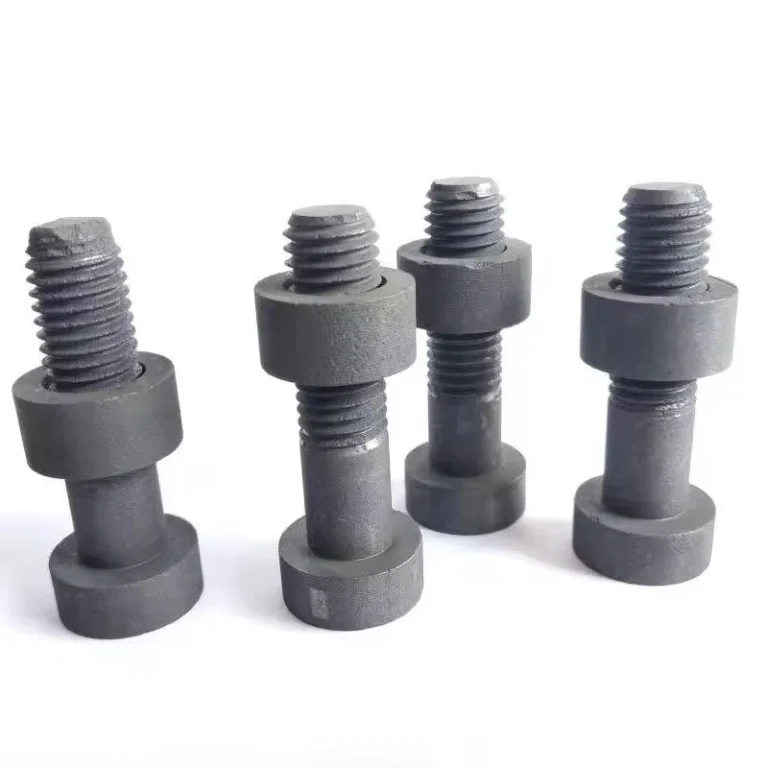
Write graphite machining challenges as specific failure events rather than a generic list of material problems. A useful risk register records the failure mode, affected feature, required check, decision owner, and release condition.
| Risk category | Typical register trigger | Evidence required before release |
|---|---|---|
| Material and grade | The exact grade is not named, an equivalent is proposed, or application requirements are incomplete. | Approved grade data, batch identity, forming route, orientation where relevant, and the customer-approved substitution basis. |
| Geometry and edge integrity | A wall, rib, hole exit, sealing land, or unsupported feature may lose strength during machining or handling. | Marked drawing, feature-control map, support concept, allowable edge condition, and inspection access. |
| Tooling and process stability | A wear-sensitive feature, long run, deep tool engagement, or fine detail may drift before the defect is visible. | First-off result, tool condition, trend feature, change or offset rule, and responsible operator or process owner. |
| Dust and cleanliness | Dust can remain in holes, pockets, datums, packaging, or contamination-sensitive surfaces. | Extraction check, cleaning method, inspection condition, packaging requirement, and any workplace exposure assessment required by the facility. |
| Workholding and measurement | Clamp force, support condition, gauge contact, or free-state definition may alter the part or the recorded result. | Fixture or support sketch, permitted contact surfaces, datum plan, measurement method, and acceptance condition. |
Use the register to flag conditions that need review before production and to record what closes each item. The approved drawing, named material, and inspection plan provide the acceptance criteria.
The most useful risk statement links four elements: the cause, the event, the stage, and the effect. For example, an unsupported hole exit may break during drilling or cleaning and damage a nearby sealing land. That statement is more actionable than writing only “small hole risk.”
Tie each graphite-specific concern to a process stage, an owner, a check, and a release condition before production starts.
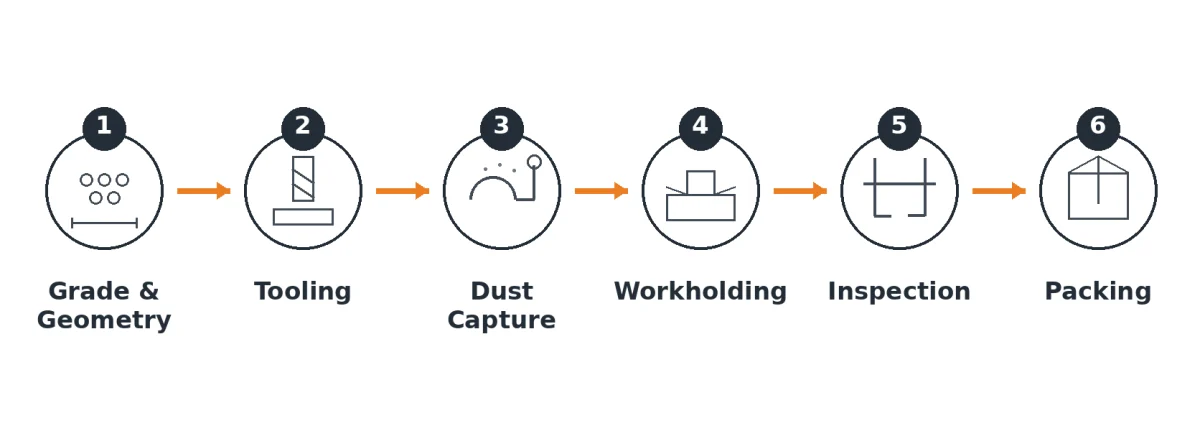
The six categories used here are grade and geometry, tooling, dust capture, workholding, inspection, and packing. A project may add other categories, but every line still needs a named owner and a documented close-out decision.
1. Define the Risk Event, Not Just the Feature
A thin wall, sharp edge, deep hole or narrow slot becomes a project risk when a specific process stage can damage it and the effect matters to function, inspection, assembly or delivery.
Write the risk as a cause-and-effect statement. State the feature or condition, the stage where failure may occur, the visible or hidden event, and the functional consequence.
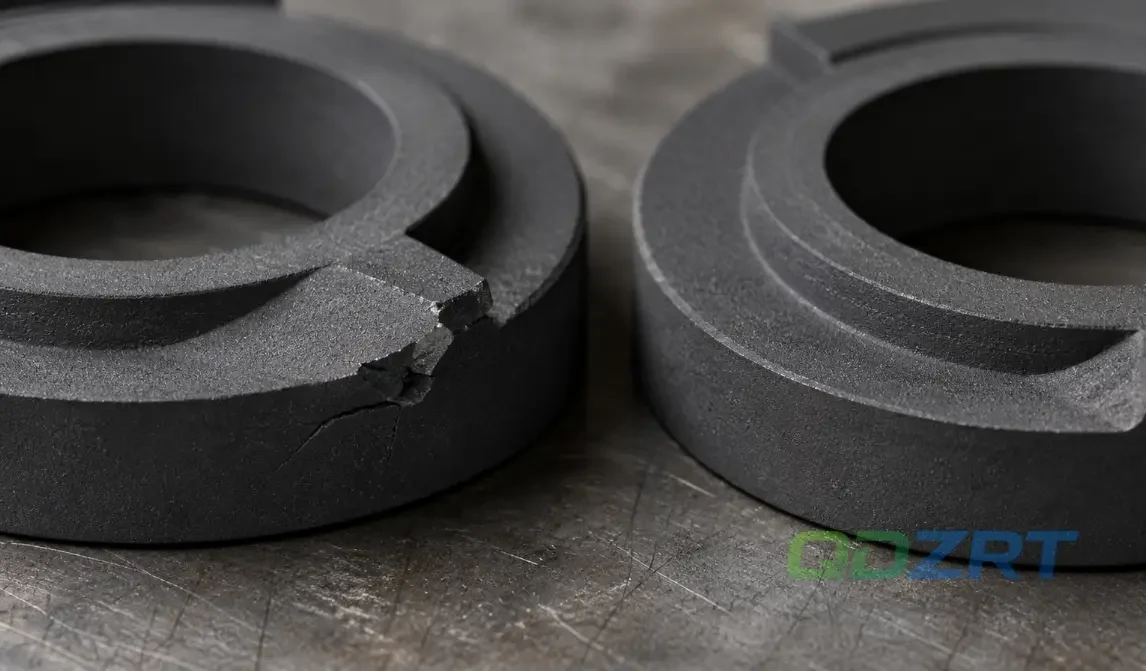
For example: “Because the through-hole exits close to a functional edge, breakout may occur during drilling or cleaning, leading to an unacceptable sealing-land defect.” This form gives engineering, machining, quality, and packing teams the same problem to control.
Keep fragile features separate instead of collapsing them into one broad line. A thin wall that may crack under clamp force, a sharp edge that may chip during cleaning, and a deep hole that may retain dust require different evidence and different owners.
Separate the feature itself from the way it can fail. The drawing identifies the geometry; the register states the failure condition, detection method, and closure check.
The thin-wall and small-hole quotation guide helps identify feature-specific manufacturing concerns. The graphite drawing-review guide provides the datum, edge, chamfer, radius, and hole-to-edge context needed to write a precise register line.
2. Score Severity, Likelihood, and Detectability
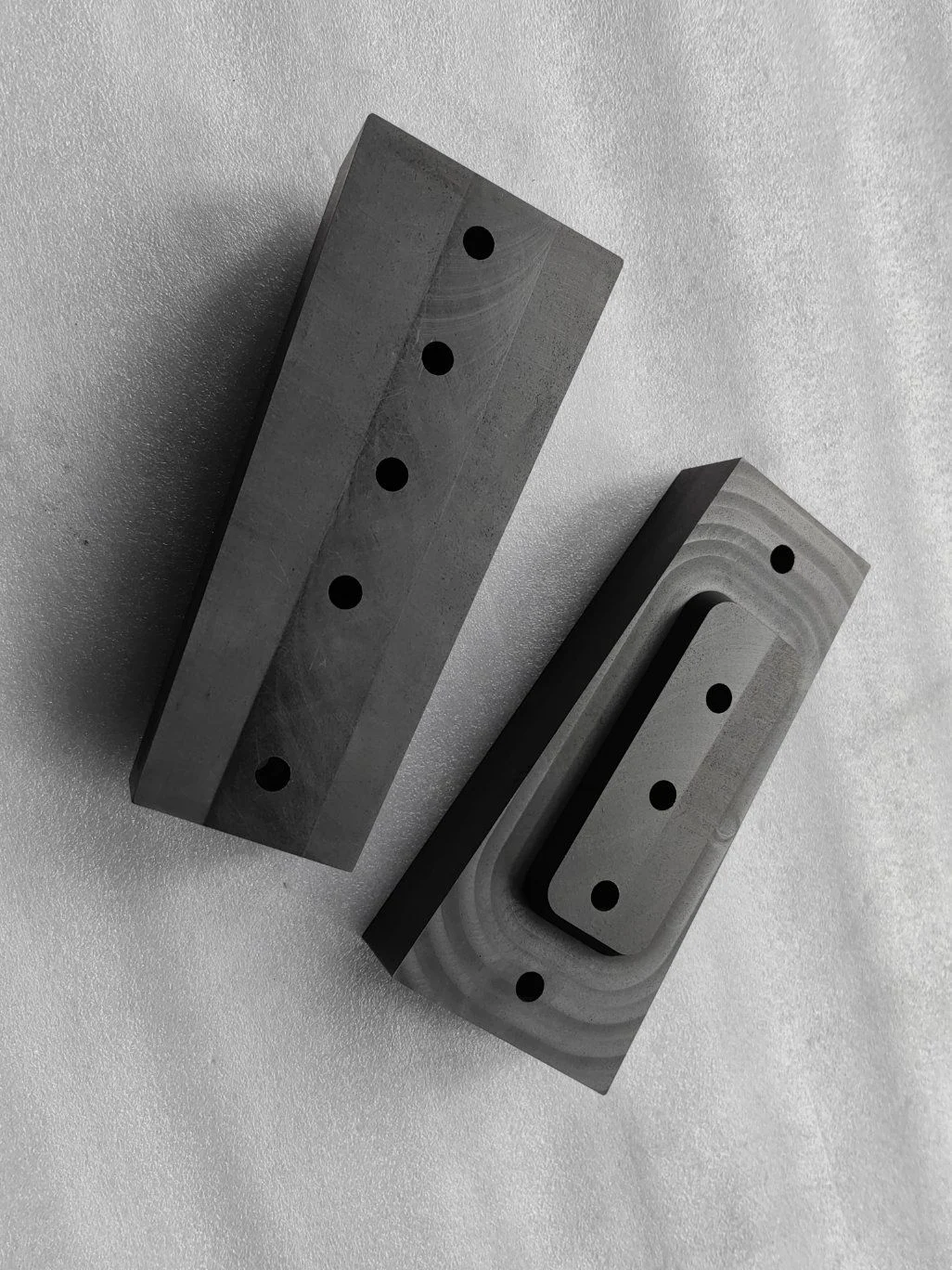
Use a consistent escalation method. Whether qualitative or numerical, distinguish functional consequence, probability based on available data, and how readily the failure can be detected before shipment.
Do not let one dramatic-looking feature control the entire review. A visible cosmetic chip may be easy to detect and low in functional consequence, while a gradual diameter drift or hidden crack can be more serious because it may pass an incomplete inspection.
| Scoring dimension | Question to answer | Escalation condition |
|---|---|---|
| Severity | What happens if the event occurs? | Escalate when the result can affect sealing, fit, electrical function, furnace support, cleanliness, safety, or customer acceptance. |
| Likelihood | What evidence suggests the event may occur? | Escalate when the grade, geometry, tool reach, fixture, quantity, or similar-part history is unknown or unfavorable. |
| Detectability | Can the event be found before release? | Escalate when the defect is hidden, difficult to measure, appears only after cleaning or assembly, or requires destructive verification. |
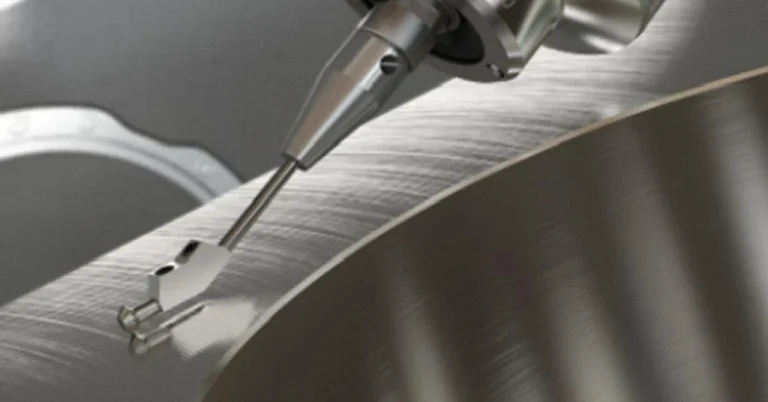
Tooling evidence is one example. Mersen’s EDM graphite machining guidance discusses tooling choices and thin-rib machining, but a project register still needs the actual grade, feature, run length, tool condition, and inspection response.
Tool wear belongs in the register when it can change a critical feature before the change is obvious. Name the trend feature, the check interval or event that triggers review, the action taken when drift appears, and the evidence required before production resumes.
For parameter relationships, use graphite machining speeds from the shop floor. The article on common graphite machining mistakes helps separate tool wear from material, fixture, and measurement causes. The risk register should record which evidence will distinguish those causes.
3. Define the Evidence Before Release
A risk line is incomplete until it states what evidence will close the concern. “Control dust,” “use a suitable grade,” or “inspect carefully” are instructions, not release conditions.
Match the evidence to the failure mechanism. Material risk may require supplier data and batch identity. Geometry risk may require a marked drawing and support plan. Tooling risk may require a first-off trend. Cleanliness risk may require a defined method and inspection condition.
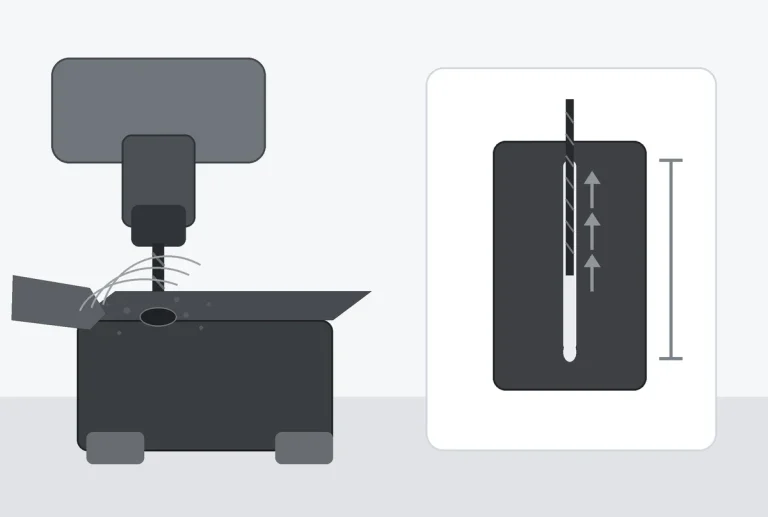
For holes, grooves, blind pockets, or contamination-sensitive surfaces, the register should separate extraction during machining, cleaning after machining, inspection of the cleaned condition, and protection during packing.
Dust illustrates why one type of evidence cannot stand in for another. Workplace exposure control addresses airborne risk through facility-specific engineering controls and assessment. Product cleanliness addresses datums, holes, sealing faces, packaging, and application requirements. A clean-looking enclosure does not prove either objective by itself.
NIOSH and OSHA publish graphite particulate references; these are listed in the References section. Toyo Tanso notes the need for dust collection, while POCO’s graphite-dust guidance discusses source capture and housekeeping. The risk register converts those principles into project evidence. Broader execution controls remain in successful graphite machining and the graphite packaging and logistics guide.
4. Assign an Owner and a Stop-or-Continue Rule
A risk may cross several departments, but one person or function should own the close-out decision. Without an owner, engineering may expect machining to solve the issue, machining may expect quality to detect it, and quality may expect packing to protect it.
The owner is responsible for confirming the evidence, not merely performing the task. A fixture can be built by machining, reviewed by engineering, and verified by quality, but the register must state who decides that the risk is closed.
The same line also needs a stop-or-continue rule. If the evidence is missing, contradictory, or outside the approved condition, the project stops at the named gate instead of continuing on verbal assumptions.
Workholding is a useful example because clamp force, cutting force, datum stability, measurement support, and fragile geometry intersect. The owner should confirm the permitted contact surfaces, support state, fixture condition, and whether the part is accepted free, restrained, or on a defined support.
| Register owner | Evidence to review | Stop condition | Continue condition |
|---|---|---|---|
| Engineering / DFM | Marked feature map, geometry risk statement, material and application inputs | Functional feature, allowable edge state, or support concept is undefined | Drawing and risk statement are approved for the named grade and operation |
| Machining / process | Fixture or support method, tool access, extraction route, first-off result | Part cannot be supported without loading a fragile or functional surface | The approved setup protects the feature and produces the required first-off evidence |
| Quality / inspection | Datum plan, measurement method, gauge capability, cleaned inspection condition | Feature cannot be measured reliably or the result depends on an undefined support state | Method, support, equipment, and acceptance rule are documented |
| Packing / release | Protected surfaces, separation, restraint, orientation, handling instruction | Accepted features can contact, move, or carry load during transport | Packing preserves the verified condition through shipment |
| Project owner | Open-risk list, concessions, customer approvals, release record | Any high-consequence item remains open or approval is missing | All required evidence and approvals are linked to the current revision |
These roles are examples, not a mandatory organization chart. The key requirement is that every open item has one accountable owner, one decision point, and one traceable record.
5. Convert Geometry Concerns Into Separate Register Lines
A drawing may contain several risks that look similar but require different controls. QDZRT Graphite reviews drawing-based parts from available graphite grades, but the register must connect each feature to the actual material, operation, support condition, inspection method, and delivery state.
Do not write one line called “complex geometry.” Split the concern into the events that can occur: edge breakout during drilling, wall fracture during clamping, dust retention in a blind feature, gauge access blocked by depth, or packing load applied across a fragile section.
Three questions for each geometry line:
1 Where can the event occur? Name the operation, handling step, inspection, or shipment stage.
2 What evidence detects or prevents it? Identify the marked drawing, support, first-off check, cleaning method, or inspection record.
3 Who releases the risk? Assign the owner and approval boundary before production.
Quotation is the correct point to expose these register lines because every later change affects material, program, fixture, inspection, and delivery. Put quoted risks directly into the assumptions, first-article scope, inspection evidence, and packing requirement.
The OEM customization options article shows how optional processes and packaging enter the project scope. Semiconductor-related risks are covered in graphite machined parts for semiconductor equipment. EDM-specific evidence belongs in the EDM graphite electrode guide.
6. Separate Review Triggers From Acceptance Limits
A review trigger tells the team to stop and examine a condition. An acceptance limit tells the team whether the finished part passes. Confusing the two creates false rejections, unsupported capability claims, or production that continues without the necessary evidence.
A risk threshold is a signal to review the feature; the drawing or approved quality requirement still defines acceptance.
✓ Better release rule
“When a feature crosses the project review trigger, engineering and quality confirm the named grade, support condition, measurement method, first-off evidence, and customer acceptance requirement before release.”
This distinction is especially important for tolerance, hole depth, wall thickness, inspection frequency, measurement uncertainty, and dust values. The register may use a conservative trigger to force review, while the final acceptance rule still comes from the approved drawing, standard, customer requirement, facility assessment, or project quality plan.
NIST dimensional-metrology publications emphasize measurement uncertainty and traceability. In the register, that means a measurement risk cannot close until the instrument, contact condition, environment, support state, and feature access are suitable. The graphite tolerance confirmation guide and precision graphite machining guide explain the underlying dimensional-control methods.
7. Minimum Information for a Usable Risk Register
A photograph or nominal outside dimensions are not enough to complete the register. The project record should identify the current drawing, application, material status, quantity, functional features, cleaning and packing requirements, and the evidence expected at first article and lot release.
💡 Single Most Useful Sentence for the RFQ:
“Please identify the graphite-machining risks that require evidence or approval before quotation, first article, production, inspection, or shipment release.”
Minimum register inputs:
- Current drawing, revision, units, and controlling 2D or 3D file
- Application, atmosphere, load, contact, electrical, thermal, sealing, or cleanliness function
- Exact grade or approved material selection
- Prototype, trial, or production quantity and repeat-order expectations
- Critical dimensions, functional edges, fragile sections, and inspection access
- Cleaning, handling, packaging, labeling, and delivery conditions
- Required records, customer approvals, concessions, and change-control rules
Our team can convert this information into register lines linked to the current drawing revision. Each line should show the risk event, trigger, evidence, owner, decision date, and release condition. Move verbal decisions into the controlled project record before the next gate.
Stock-material inquiries can begin with the Graphite Block page. Finished drawing-based components use the Custom Graphite Machined Parts route. For high-temperature applications, the thermal management and high-temperature processing solution provides the service context needed to define the register.
8. Use a Six-Category Graphite Machining Risk Register
The register keeps material, geometry, process, inspection and delivery decisions visible through quotation, first article, production and release. It is most useful when each risk has a concrete check and a named decision owner.
| Risk category | Register trigger | Evidence required before release | Release decision |
|---|---|---|---|
| 1. Material and grade definition | Grade, forming route, orientation, purity basis, or approved equivalent is not fixed. | Current supplier data, batch identity, application requirements, and documented approval of the named grade or substitution. | Stop until the material basis is traceable to the current part and revision. |
| 2. Geometry and feature integrity | Thin wall, rib, hole exit, deep feature, sharp functional edge, or limited tool access can fail during a named stage. | Marked drawing, risk statement, support and sequence plan, allowable edge condition, and inspection access. | Release only when prevention and detection evidence are both defined. |
| 3. Tooling and process stability | Wear-sensitive detail, long run, unstable trend feature, uncertain tool reach, or new process route. | First-off result, tool and setup condition, trend feature, change rule, extraction condition, and responsible owner. | Release production only after the trial shows a stable and measurable response. |
| 4. Dust, cleaning, and contamination | Dust can affect exposure, datums, holes, surfaces, packaging, or the application. | Facility-specific control where required, extraction and cleaning method, inspection condition, and packaging requirement. | Separate occupational and product-cleanliness evidence; close both when both apply. |
| 5. Workholding and measurement | Clamp force, support state, datum selection, gauge contact, or access can alter the part or result. | Fixture/support definition, contact surfaces, measurement method, uncertainty or capability basis, and free/restrained-state rule. | Stop when the feature cannot be supported and measured under an agreed condition. |
| 6. Packing and delivery preservation | Accepted surfaces, edges, thin sections, cleanliness, or orientation can change after inspection. | Protection map, separation and restraint plan, handling instruction, package check, and release record. | Release only when the delivered condition preserves the verified condition. |
If a part fails, the team compares the actual evidence with the release condition for each category. This prevents a corrective action from focusing only on the last visible symptom while the original material, drawing, setup, measurement, or packing cause remains open.
Supporting context is available in custom graphite parts in industrial applications, the graphite block industrial uses guide, and the custom graphite manufacturer guide.
For the underlying machining and drawing methods, see precision graphite machining and drawing review for graphite parts. Here the focus is how those technical concerns are recorded and released before production.
9. Verify the Highest Risks in a First-Article Run
The first-article record needs to reference the open register lines and show which risks were tested, which evidence was collected, what result was obtained, and who approved the disposition. A list of measured dimensions alone does not close material, cleanliness, handling, or packing risks.
| Verification step | Evidence linked to the register | Decision |
|---|---|---|
| Material and revision | Approved grade or batch, one active drawing revision, units, part number, and any customer-approved substitution | Stop if the part and material cannot be tied to the current project definition. |
| Setup and support | Fixture or support condition, permitted contact surfaces, tool access, extraction route, and pre-cut checks | Stop if a high-risk feature cannot be supported without loading or obscuring it. |
| Trial machining | First-off observations for edge condition, trend features, tool response, dust evacuation, and fragile sections | Continue only when the trial addresses the named risk events, not just nominal dimensions. |
| Inspection and cleaning | Cleaned measurement condition, datum and support state, equipment, results, photos where useful, and open deviations | Stop when the method cannot distinguish process variation from measurement or cleaning effects. |
| Packing and release | Protected features, separation, restraint, orientation, labels, approval record, and remaining concessions | Release only when the packed condition preserves the accepted first-article condition. |
A first article is a controlled experiment against the risk register. It tests whether the evidence and release assumptions are valid for the actual material, geometry, setup, inspection method, cleaning route, and delivery condition. Failed evidence sends the project back to the responsible register owner.
Practical Conclusion
A generic list of brittleness, dust, tooling, workholding, and tolerance concerns is not enough to manage graphite machining risk. They become controllable when each concern is written as a specific event with a trigger, required evidence, owner, and release condition.
A good register also preserves the difference between review triggers and acceptance limits. It tells the team when to stop and investigate without turning one supplier example, one pilot result, or one conservative DFM trigger into a universal graphite rule.
For the underlying machining methods, use the Custom Graphite Machined Parts page and the related technical guides. For stock material and machining blanks, the Graphite Block page is the more relevant starting point.
Frequently Asked Questions
What is the difference between a graphite machining guide and a risk register?
A machining guide explains technical methods. A risk register records project-specific events, evidence, ownership, and release decisions. The register points to the technical method but does not repeat it.
How should a graphite machining risk be written?
Write the cause, the event, the stage where it may occur, and the functional or commercial effect. Then add the evidence, owner, and release condition.
Does every risk need a numerical score?
No. A consistent low, medium, and high method can work if severity, likelihood, and detectability are defined. Numerical scoring should not imply precision that the available evidence does not support.
Can a DFM trigger be used as an acceptance limit?
A trigger starts the review. The acceptance limit comes from the approved drawing, customer requirement, applicable standard, quality plan or documented concession.
Who should own a cross-functional risk?
One person or function should own the close-out decision even when engineering, machining, quality, and packing all provide evidence.
What closes a dust or cleanliness risk?
The evidence depends on the objective. Workplace exposure control, in-process extraction, product cleaning, inspected cleanliness, and packing protection are separate controls and should not be treated as interchangeable.
What should a first article prove?
It should test the highest register risks using the actual material, setup, inspection, cleaning, and packing conditions. A dimensional report alone may not close all open risks.
References & Sources
- NIST Dimensional Metrology Publications — Supports the measurement-method and uncertainty discussion.
Request a Graphite Machining Risk Review
Start the inquiry through the QDZRT Graphite contact page with the application, exact grade if known, quantity, functional features, cleaning requirement, inspection scope, and delivery method. After we reply, send the latest controlled drawing, 3D reference file, and other project documents by email or another agreed secure channel. The review can identify project-specific register lines, evidence gaps, owners, and release conditions before the blank is released.