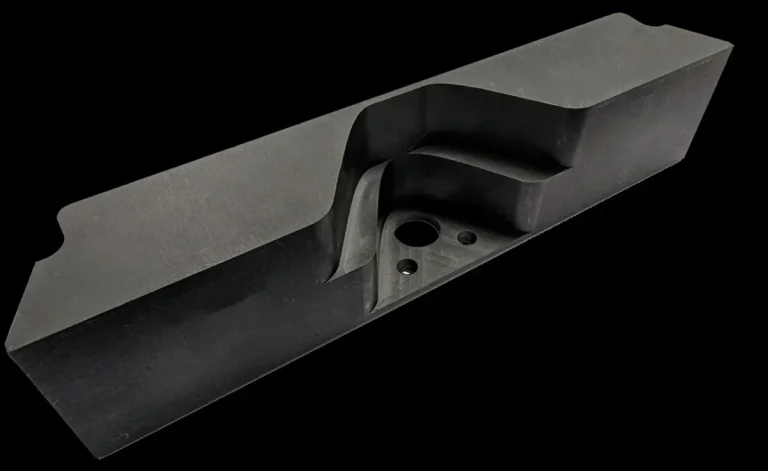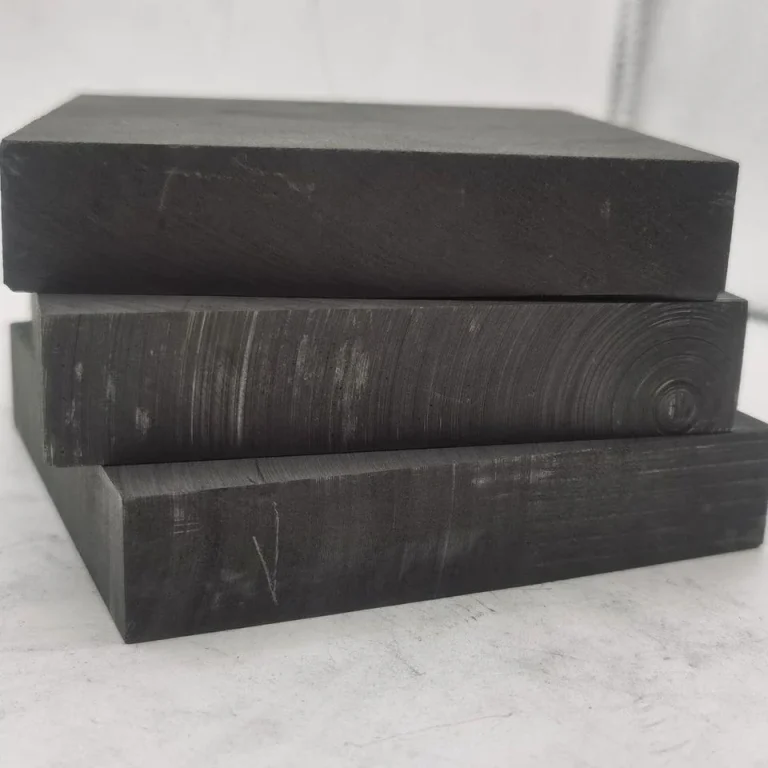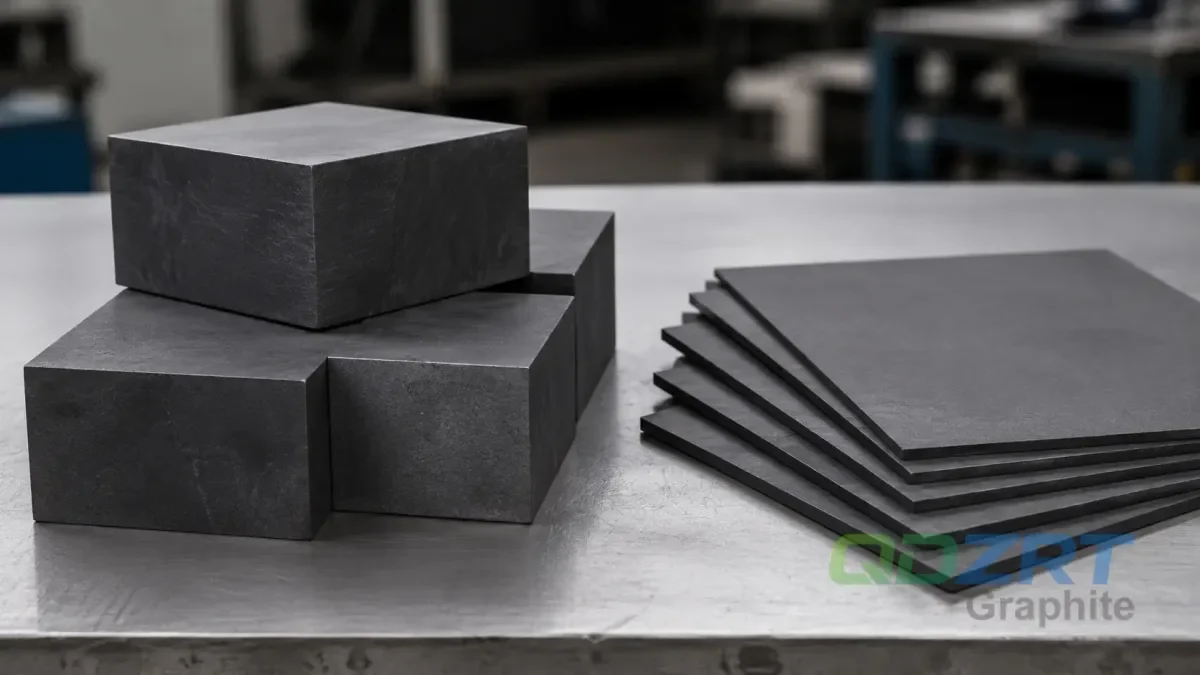
Graphite block, flexible graphite sheet, and graphite paper are not interchangeable forms of one material. They can appear in the same procurement project, but they are produced by different routes and are selected for different mechanical functions. A rigid synthetic graphite block is normally purchased as stock for machining or as a finished three-dimensional component. Expanded-natural-graphite sheet and paper are thin, flexible materials used as compressible layers, sealing stock, roll-conversion material, or selected heat-spreading layers.
The first purchasing question is therefore not “Which graphite is cheaper?” It is “What must the part do in the assembly?” A part that must retain a machined pocket, bore, thread, datum, or unsupported shape points toward rigid graphite stock. A layer that must conform, compress, wrap, laminate, or be die cut points toward flexible sheet or paper. Some assemblies use both: a rigid graphite component provides geometry, while a flexible graphite layer provides sealing, contact conformity, or an interface function.
Thickness is useful, but it is not a complete product definition. A thin plate cut from solid synthetic graphite remains a rigid and brittle machined material. A flexible graphite sheet of similar nominal thickness can bend and compress because its structure and manufacturing route are different. Reinforcement, adhesive, carrier film, metal insert, laminate construction, support condition, and service environment can change the correct product name and the required inspection plan.
QDZRT Graphite uses a form-and-function review to separate graphite block, flexible graphite sheet, graphite paper, reinforced sealing sheet, and finished machined parts before quotation. This guide provides a buyer-facing selection method, current reference ranges published on our product pages, form-specific RFQ fields, inspection boundaries, combined-assembly controls, and practical packing examples.
Core rule: identify the material by manufacturing route, mechanical response, support condition, and final function. Do not classify it by thickness or by the word “sheet” alone.
1. Start with the Material Family and Manufacturing Route
The word “graphite” covers several industrial material families. A correct RFQ begins by separating the families that may look similar in a photograph or product list but behave differently during machining, conversion, installation, and service.
| Material form | Primary route | Mechanical behavior | Typical purchasing option |
|---|---|---|---|
| Rigid synthetic graphite block or plate | Molded, extruded, vibration-molded, or isostatic graphite body; cut and machined as required. | Self-supporting and machineable, but brittle. Strength, directionality, grain, purity, and temperature behavior depend on the named grade and route. | EDM electrodes, furnace fixtures, molds, jigs, supports, heaters, plates, and custom three-dimensional parts. |
| Expanded-natural-graphite flexible sheet | Purified natural graphite is expanded and calendered into sheet or roll material. | Flexible, compressible, and conformable. It does not replace a rigid machined body. | Gasket stock, sealing layers, thermal barriers, insulation, roll conversion, and custom cut pieces. |
| Expanded-natural-graphite paper | Thin expanded graphite material rolled into paper, foil, sheet, or continuous roll formats. | Thin, flexible, easy to slit, laminate, and die cut; often evaluated by thickness, density, areal mass, surface, and conversion behavior. | Heat-spreading layers, die-cut pads, adhesive-backed parts, sealing inserts, laminates, and converter stock. |
| Reinforced or laminated graphite sheet | Flexible graphite combined with foil, tanged metal, mesh, carrier film, adhesive, release liner, or another approved layer. | Composite behavior. The reinforcement or carrier changes handling, cutting, compression, electrical isolation, and packing requirements. | Industrial gasket sheet, converted sealing parts, supported thermal layers, and multi-layer assemblies. |
This guide does not treat every thin thermal graphite product as expanded-natural-graphite paper. Panasonic, for example, distinguishes natural graphite sheet from PGS, which it identifies as Pyrolytic Graphite Sheet. Panasonic explains that its natural graphite sheet and PGS use different production routes: natural graphite powder is press molded into sheet, while PGS is produced by high-temperature decomposition of polymer film. That route distinction matters because thermal directionality, thickness, handling, coating, insulation, and qualification can be different. A pyrolytic or synthetic thermal graphite sheet should therefore be quoted under its own grade and datasheet rather than being placed automatically into an expanded-graphite-paper specification.
2. our Product-Page Reference Ranges
The figures below are public product-page ranges for initial inquiry routing. They describe broad product families, so the buyer still needs a named grade, approved specification, quotation, drawing, sample, or certificate to confirm which thickness, density, width, grade, reinforcement, and length combinations are actually available and guaranteed.
| Product family | Current public reference | What still requires confirmation |
|---|---|---|
| Graphite block | Molded, extruded, isostatic, and fine-grain options; density about 1.70–1.90 g/cm³ by grade. | Named grade, forming route, grain class, size, property direction, purity, machining allowance, finished drawing, and guaranteed or typical status. |
| Flexible graphite sheet | Thickness 0.1–3.0 mm; density approximately 1.0–1.7 g/cm³; sheet, roll, reinforced, and laminated options. | Available thickness-density combination, width, length, carbon or ash requirement, reinforcement, surface, conversion, tolerance, packing, and service conditions. |
| Graphite paper | Thickness 0.1–2.0 mm; density 1.0–1.7 g/cm³; sheets, rolls, slit rolls, and laminated options. | Material grade, roll width, usable width, roll length or mass, winding, splice policy, areal mass, surface, adhesive or carrier, die-cut requirements, and thermal test direction. |
Range boundary: a product-family range is an inquiry map. It is not a universal catalogue limit, a guaranteed COA range, or evidence that any two values can be ordered together.
3. Use Function First: Rigid Part or Flexible Layer
When the final part is CNC milled, turned, drilled, slotted, threaded, ground where appropriate, or inspected against three-dimensional datums, start with a rigid graphite block or a block-derived plate. When the final item is slit, wound, die cut, laminated, wrapped, compressed between mating surfaces, or installed with continuous backing, start with flexible sheet or paper.
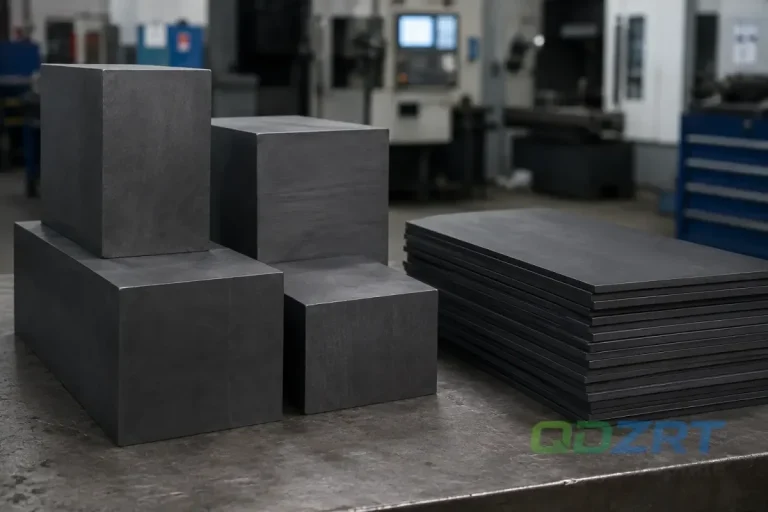
A buyer can usually classify the inquiry by answering six questions:
- Shape: must the item retain a three-dimensional geometry without continuous backing?
- Processing: will it be machined, or will it be slit, cut, stamped, laminated, or wound?
- Contact: must it conform under controlled compression, or preserve a fixed datum relationship?
- Load: is the requirement only shape retention, or is the part a verified structural load path?
- Thermal direction: is heat expected to move mainly in plane, through thickness, through a rigid body, or across an interface?
- Assembly: is the graphite self-supporting, bonded to a carrier, compressed between flanges, or combined with another graphite component?
These questions are more reliable than a product name written by a buyer who may be translating “plate,” “sheet,” “foil,” or “paper” from another language. Photos and drawings remain useful, but the application description should explain how the item is supported and installed.
4. An Illustrative Rigidity–Compliance Selection Grid
Use the following grid to organize the questions that must be closed before selecting a material form. It is not an engineering acceptance standard; replace every numerical example with the actual drawing, assembly, grade, load, service environment, and approved test plan.
| Application signal | Project question | Likely starting form | Required confirmation |
|---|---|---|---|
| Self-supporting geometry | Must the item retain an unsupported span, pocket, rib, bore, or machined datum? | Graphite block or block-derived plate | Grade, span, section thickness, support, stress mode, orientation, temperature, atmosphere, and safety factor. |
| Conforming interface | Must the layer accommodate surface irregularity under a defined assembly pressure? | Flexible graphite sheet or approved laminate | Contact pressure, surface condition, compressed thickness, recovery or creep requirement, media, temperature, and joint design. |
| Thin converted layer | Will the material be supplied in a roll, slit, laminated, adhesive backed, or die cut? | Graphite paper or thin flexible sheet | Base route, thickness, density or areal mass, width, roll build, liner, adhesive, minimum feature, and conversion trial. |
| Bolt-loaded gasket | Is the graphite a sealing material compressed by a defined flange and bolting system? | Flexible or reinforced graphite sealing sheet | Gasket construction, flange, media, temperature, pressure, gasket stress, leakage criterion, installation, and qualification method. |
| Machined feature | Does the drawing require a deep hole, thread, pocket, step, fit, or positional tolerance? | Graphite block | Feature geometry, tool access, edge distance, wall thickness, datum scheme, measurement method, and drawing revision. |
| Thermal spreader or interface | Is the requirement in-plane spreading, through-thickness transfer, interface conformity, or a rigid thermal path? | Depends on the approved thermal architecture | Material family and construction, directional properties, electrical insulation, carrier, adhesive, contact pressure, temperature, heat-source geometry, and system test. |
| Rigid part plus flexible layer | Do different graphite forms perform separate functions in the same assembly? | Separate line items linked by one assembly drawing | Interface faces, stack order, orientation, revision control, packing separation, and assembly responsibility. |
Earlier screening examples sometimes use values such as an unsupported span above 20 mm, a machined depth above 2 mm, a surface mismatch of 0.05–0.20 mm, or a fit tolerance tighter than ±0.10 mm. Those values can be retained in an internal worked example, but they are not universal triggers. A 20 mm span can be low or high risk depending on thickness, grade, support, temperature, vibration, and load. A 0.10 mm tolerance can be routine for one block geometry and inappropriate for another. The drawing and the approved process decide the requirement.
5. Thickness Is a Clue, Not the Product Definition
A 1 mm rigid graphite plate and a 1 mm flexible graphite sheet can have the same nominal thickness but different behavior. The rigid plate is cut from a solid graphite body and retains shape until its section, support, defect population, or handling load causes fracture. The flexible sheet is produced to bend and compress, but it cannot hold an unsupported threaded feature or a deep machined pocket. A reinforced sheet can be stiffer than an unreinforced sheet, while a thin block-derived plate can be more fragile than a thicker one. Thickness alone does not identify any of these structures.
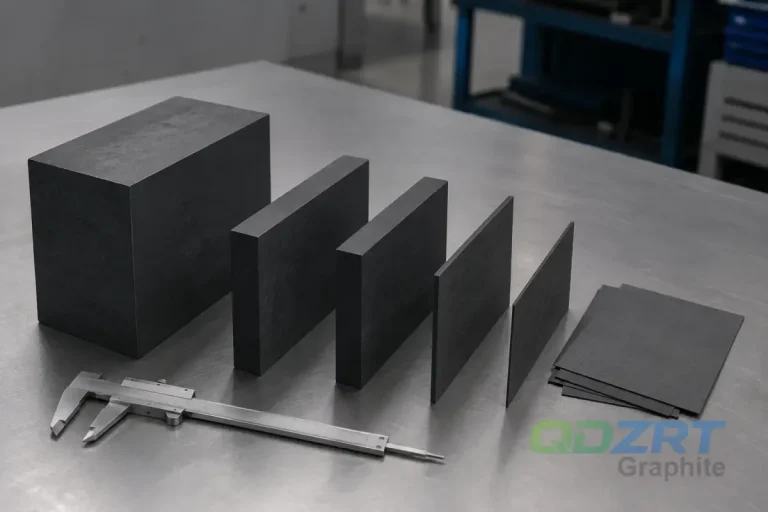
A 50 mm product described as “flexible graphite sheet” needs clarification rather than immediate rejection. It could be a stack, molded ring, compressed laminate, packed assembly, gasket set, or simply a translation issue. Ask for the cross-section, reinforcement, layer count, flexibility, support condition, and final function.
6. Separate Shape Retention from Verified Load-Bearing Capacity
Choose rigid graphite block when the component must preserve a three-dimensional geometry. Its rigidity does not make every graphite part a qualified structural member: load capacity still depends on the named grade, forming route, grain structure, material direction, defect population, surface condition, notch geometry, section size, temperature, atmosphere, load mode, duration, and safety factor.
ASTM C695 determines compressive strength of carbon and graphite at room temperature. A coupon result can support material characterization, but it does not by itself define the allowable load of a finished fixture, heater support, mold, plate, or furnace component. A design review must connect the coupon method to the actual geometry and service condition.
For a load-sensitive block component, the RFQ and approval record should identify:
- named graphite grade and forming route;
- material or test direction where relevant;
- room-temperature and service-temperature property basis;
- compression, bending, tension, impact, vibration, or combined load mode;
- minimum section, holes, notches, threads, sharp corners, and support contact;
- operating atmosphere and oxidation exposure;
- design load, proof requirement, inspection method, and approved safety factor;
- responsible engineering party for final structural acceptance.
For general sourcing, a phrase such as “rigid locating plate” is more accurate than “load-bearing graphite plate” unless the load case has been defined and approved.
7. Form-Specific RFQ and Inspection Fields
A single generic graphite specification cannot control all forms. Density, strength, compressibility, thermal conductivity, surface condition, and purity can only be compared when the material family, manufacturing method, direction, sample, and service context are stated. The following table separates the minimum RFQ and inspection fields for three common purchasing routes.
| Control group | Rigid graphite block or machined part | Expanded graphite sheet or paper | Reinforced or laminated sheet |
|---|---|---|---|
| Identity | Named grade, molded/extruded/isostatic route, block or lot ID, orientation. | Expanded-natural-graphite grade, roll or lot ID, plain or treated structure. | Graphite grade plus insert, foil, mesh, adhesive, film, liner, or carrier construction. |
| Dimensions | Raw blank, finished drawing, datums, tolerances, machining allowance, edge and surface requirements. | Thickness, width, length or roll mass, usable width, winding, splice policy, outline, and thickness tolerance. | Total thickness, individual layer thickness, insert position, edge exposure, outline, and registration. |
| Properties | Density, grain, resistivity, strength, ash, carbon or purity, thermal property, typical/guaranteed status. | Density or areal mass, carbon/ash, thickness, compressibility if relevant, directional thermal property, surface, handling strength. | Composite density, insert material, adhesion, facing integrity, compression/recovery, leakage or service qualification where required. |
| Method and sample | Test method, specimen direction, location, quantity, conditioning, instrument, and acceptance rule. | Measurement pressure, positions, sample count, conditioning, mass/area method, visual defect standard, and roll sampling plan. | Method suitable for the laminate, specimen orientation, penetrator or fixture, sample preparation, and layer-specific inspection. |
| Service and approval | Temperature, atmosphere, electrical duty, load, contamination, machining, cleaning, and first-article approval. | Media, temperature, contact pressure, bending, thermal direction, adhesive, electrical insulation, conversion equipment, and trial roll. | Flange or assembly design, media, stress, temperature, carrier compatibility, die cutting, installation, and qualification record. |
ASTM F36 is useful only within its stated scope. The current active listing identifies it as a method for short-time compressibility and recovery of gasket materials at room temperature. It does not establish long-term creep behavior, hot compression, actual flange leakage, or service life. Laminated composites may require a method intended for their structure, such as ASTM F806, or a project-specific procedure. The buyer should name the method and the acceptance value rather than writing “compressibility required” without context.
8. Conversion, Machining, and Packing Follow the Material Form
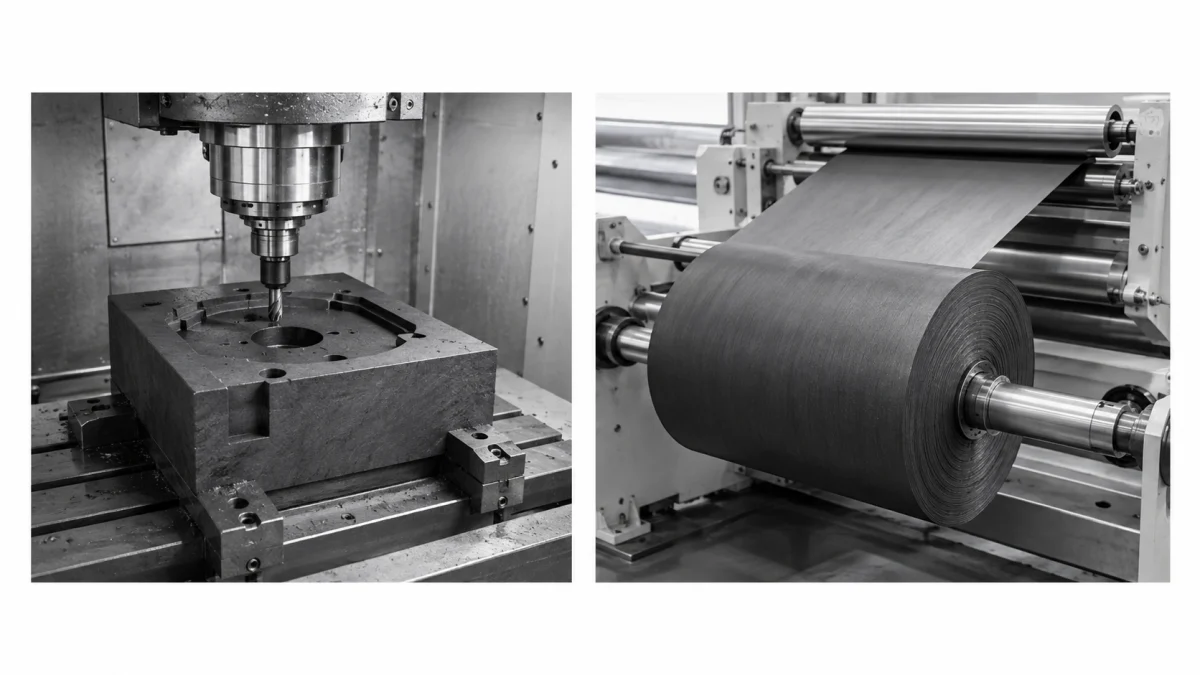
Rigid graphite and flexible graphite move through different production routes. Block stock may be sawed, squared, milled, turned, drilled, cleaned, dimensionally inspected, protected at fragile edges, and restrained against impact during shipment. Flexible sheet and paper may be calendered, slit, laminated, die cut, inspected for thickness and surface condition, supported flat or wound on a suitable core, and protected from crease, puncture, telescoping, moisture exposure, or edge damage.
Practical numbers can help explain the difference, but they must remain project examples:
- A 15 kg rigid plate may require blocked movement, protected corners, lifting instructions, and separation from hardware. That does not establish a universal weight threshold.
- A 0.1 mm roll may require a core, end protection, controlled winding, and restraint against telescoping. The approved core and winding plan depend on width, length, density, laminate, and transport route.
- A 0.5 mm die-cut gasket may require flat support, interleaving, quantity control, and protection from curled or damaged edges.
- A block-derived part may use 1–3 mm machining allowance per face in an illustrative quotation, but the actual allowance depends on grade, raw-stock condition, flatness, size, tool path, finishing method, and drawing tolerance.
Our team can discuss separate layers, cavities, labels, or kit records where the approved project requires them. These are packaging-plan options rather than automatic conditions for every shipment. The RFQ should identify whether rigid and flexible items are packed separately, grouped by assembly, delivered as individual line items, or supplied under a buyer-controlled kit number.
For additional process detail, buyers can review the graphite paper roll quality checks, the graphite paper heat-spreading pad conversion guide, and the graphite block OEM sourcing guide.
9. When One Assembly Uses Both Rigid and Flexible Graphite
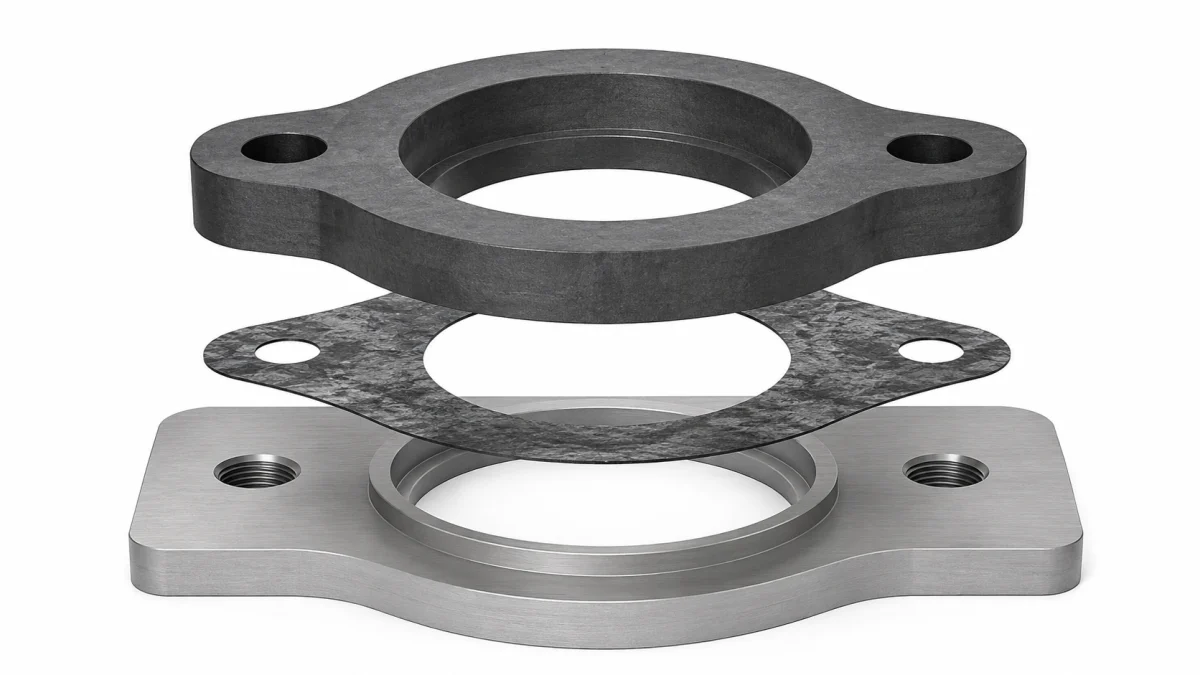
Some equipment genuinely needs both material forms. A machined graphite plate can provide a fixed geometry, heater support, mold surface, electrode body, fixture, or rigid thermal path. A flexible graphite layer can provide sealing, conformity, a thin thermal interface, a sacrificial layer, or conversion into a defined outline. The materials should remain separate line items even when they share one assembly drawing.
A practical combined-assembly record includes:
- assembly drawing and revision;
- rigid line-item grade, route, drawing, datums, and inspection report;
- flexible line-item grade, thickness, density, structure, outline, and compression or thermal condition;
- contact faces, stacking order, orientation, adhesive or insert, and protective film;
- installation responsibility and any required surface preparation;
- packing relationship: separate items, matched set, or approved kit;
- change-control rule for each line item.
A revision to gasket thickness does not automatically require a change to the rigid graphite grade. A change to a recess, contact face, or assembly pressure may, however, change the flexible outline or compressed condition. Each change should be evaluated only where it affects the approved interface.
The sealing and industrial gasket solution provides context for sealing systems. For machined-part applications, see the custom graphite parts application guide and the semiconductor-related machined graphite guide.
10. Thermal Applications Need a Separate Directional Review
“Graphite thermal sheet” is not a sufficiently precise RFQ term. A buyer must state whether the material is expanded-natural-graphite paper, flexible graphite foil, pyrolytic graphite sheet, a rigid graphite plate, or a laminate. It should also state whether the requirement is in-plane spreading, through-thickness transfer, interface conformity, electrical insulation, shielding, temperature resistance, or mechanical support.
For an electronic heat spreader, the RFQ may need:
- base material and manufacturing route;
- in-plane and through-plane thermal property by named test method;
- thickness, density or areal mass, and directional orientation;
- heat-source size and target spreading area;
- adhesive, carrier, insulation film, coating, release liner, or edge sealing;
- bending radius, die-cut geometry, minimum web, and registration;
- electrical conductivity or insulation requirement;
- assembly pressure and system-level thermal test.
The flexible graphite foil versus thermal graphite sheet article addresses this boundary directly. The graphite thermal management guide explains why temperature, atmosphere, direction, and assembly architecture must be considered together. For thin expanded-graphite converter stock, see graphite paper in electronic thermal management and the graphite paper thickness and density guide.
11. Common Buyer Mistakes
Calling every flat product “graphite sheet”
A flat rigid plate, flexible expanded graphite sheet, pyrolytic thermal sheet, reinforced gasket sheet, and adhesive-backed converted part may all be described informally as sheet. The RFQ should identify route, rigidity, support, and final function.
Using density without identifying the material family
Density is not directly interchangeable across rigid synthetic graphite, expanded graphite, reinforced laminate, and pyrolytic material. A density value must be tied to the named grade, method, sample condition, direction where relevant, and typical or guaranteed status.
Specifying only thickness and width
Thickness and width can route an inquiry, but they do not define the application. A complete request also describes rigidity, conversion, support, service temperature, media, pressure, thermal direction, reinforcement, and installation.
Using block tolerances for roll material
A machined part may use datums, positional tolerance, flatness, parallelism, bore size, and surface requirements. A roll may use thickness locations, width, winding, splice rules, telescoping, surface defects, edge condition, and usable yield. These are different inspection systems.
Assuming a compressibility test proves a gasket joint
A room-temperature material test is not a substitute for joint design, gasket stress, bolt load, media compatibility, creep relaxation, leakage qualification, and installation control. The high-temperature gasket material guide provides a service-based selection framework.
Combining different graphite forms under one line item
Separate line items allow each form to retain the correct identity, manufacturing route, inspection method, acceptance standard, packing method, and change history. The assembly drawing can then reconnect the items without mixing their specifications.
12. A Clear RFQ Template
The following wording can be adapted when the buyer knows the material form:
Rigid graphite block or machined part
“Please quote a rigid synthetic graphite component. Application: [ ]. Preferred forming route or named grade: [ ]. Raw blank or finished part: [ ]. Drawing revision: [ ]. Finished dimensions and tolerances: [ ]. Required properties and methods: [ ]. Operating temperature, atmosphere, load, electrical duty, and contamination limits: [ ]. Quantity, inspection, cleaning, packing, and documentation: [ ]. Please identify which values are typical and which are guaranteed.”
Expanded graphite sheet or paper
“Please quote expanded-natural-graphite [sheet/paper]. Application and conversion method: [ ]. Thickness: [ ]. Density or areal mass: [ ]. Width and supply form: [ ]. Roll length or mass: [ ]. Carbon, ash, sulfur, chloride, surface, reinforcement, adhesive, liner, or laminate: [ ]. Compression, thermal, or service conditions: [ ]. Measurement method, tolerance, sampling, packing, and trial quantity: [ ].”
Uncertain material form
“Please review whether this requirement should use rigid graphite block, expanded graphite sheet or paper, reinforced graphite sheet, or another thermal graphite grade. The part must [retain shape/conform/compress/spread heat/seal]. It is supported by [ ]. Processing includes [machining/die cutting/lamination/winding]. Operating conditions are [ ]. The drawing, photographs, section view, and assembly information are available for follow-up through email or another agreed secure channel after the initial inquiry.”
This is more useful than forcing an uncertain product name. It gives the supplier enough information to correct the material selection before a sample or quotation is issued.
FAQ About Graphite Block, Flexible Sheet, and Paper
Can flexible graphite sheet replace graphite block?
Usually not when the component needs self-supporting geometry, a machined pocket, bore, thread, datum, rigid location, or a verified structural path. Flexible sheet may replace a rigid item only when the actual function is a supported, conforming, compressible, sealing, or thin thermal layer.
Can graphite block be cut into thin plates?
Yes. A plate cut from block remains a rigid and brittle synthetic graphite part. Grade, span, thickness, flatness, support, edge risk, and handling must be reviewed. It should not be treated as flexible graphite sheet merely because it is thin and flat.
What is the practical difference between graphite paper and flexible graphite sheet?
The names overlap in the market. In our current product range, graphite paper generally refers to thinner roll material for lamination, die cutting, adhesive backing, heat-spreading layers, and conversion, while flexible graphite sheet is a broader industrial family that includes sealing sheet, gasket stock, rolls, reinforced sheets, and laminates. The RFQ should still state thickness, density, route, structure, supply form, and final application.
Does thickness determine whether the product is block, sheet, or paper?
No. Thickness is one clue. Manufacturing route, rigidity, reinforcement, carrier, support condition, processing method, and final function define the product more reliably.
Can rigid graphite carry load?
Rigid graphite can retain shape and may be used in fixtures or supports, but allowable load cannot be inferred from the word “block” or from density alone. The named grade, orientation, geometry, defects, temperature, atmosphere, stress mode, test basis, and safety factor must be reviewed by the responsible engineer.
Can one RFQ include block, sheet, and paper?
Yes, but each form should be a separate line item with its own specification, inspection, quantity, and packing. An assembly drawing can link the items through contact faces, orientation, stack order, and revision control.
What information should I send when I am unsure?
Send photographs, drawings, section dimensions, support condition, whether the part must hold shape or conform, operating temperature, pressure or contact load, media, machining or die-cut features, thermal direction, quantity, and assembly method. Our team can then identify the correct inquiry path before quotation.
References and Source Boundaries
- Our team: Graphite Block — supports the current product families offered by our team and the public density reference.
- Our team: Flexible Graphite Sheet — supports the current thickness, density, supply-form, and expanded-natural-graphite material-family reference.
- Our team: Graphite Paper — supports the current thin-gauge range, density range, supply forms, and product scope.
- ASTM C695 — supports the room-temperature compressive-strength test boundary for carbon and graphite.
- ASTM F36 — supports the short-time, room-temperature compressibility and recovery test boundary for gasket materials.
- USGS: Graphite Statistics and Information — provides general graphite commodity and industrial context, not the product-selection thresholds in this article.
- U.S. Department of Energy: Cost Analysis of PEM Fuel Cell Systems — provides historical application and manufacturing context for selected fuel-cell components; it does not define the product ranges offered by our team.
- U.S. Department of Energy: Graphite Current Collectors — provides a specific electrochemical application example, not a universal graphite-paper specification.
- OSTI: Historical Technical Report on Graphite Materials — provides historical graphite-material context and is not used as evidence for current supply ranges from us.
Choose the Correct Graphite Form Before Quotation
QDZRT Graphite supplies rigid graphite block, flexible graphite sheet, graphite paper, sealing materials, and drawing-based custom graphite machined parts. A useful inquiry states what the part must do, how it is supported, how it will be processed, and which service conditions matter. That information makes it possible to separate a machined rigid component from a compressible sealing layer, a converter roll from a reinforced laminate, and expanded graphite paper from another thermal graphite technology.
For rigid applications, review the graphite block industrial uses guide. For flexible materials, see the graphite paper properties and uses guide and the graphite sealing materials product family. Share the application, drawing or section view, dimensions, quantity, service conditions, and required processing so the correct material form can be confirmed before price comparison or sample approval.