An expandable graphite certificate can look acceptable while the PU foam trial still fails. The raw material may expand strongly in a laboratory test and yet disperse poorly in the foam mix, disturb cell structure, change processing behavior, or activate in a temperature range that does not match the thermal event used in the finished-product test. The trial has to prove the material and the formulation together.
Expandable graphite is not a drop-in performance number. The supplier controls the raw-material characteristics; the foam developer controls formulation, mixing, specimen preparation, conditioning, and the fire-test method. A useful qualification record keeps both sides visible.
The current Chinese national standard GB/T 10698-2023, Expansible graphite, provides a current product-standard reference for the raw material. It does not replace the PU foam trial. The buyer still needs a formulation-specific acceptance plan that connects the qualified graphite lot to the finished foam result.
What the Foam Trial Is Actually Trying to Prove
The foam trial must prove that the selected expandable graphite can be processed reproducibly in the defined PU formulation and that the finished specimen meets the required performance test without creating unacceptable processing or physical defects. That is a broader objective than “does the graphite expand?”
A useful trial covers four layers: raw-material identity, processing behavior, physical foam quality, and the required fire-performance test. Keep the graphite grade and lot tied to the observations so a processing or fire result can be traced back to the material actually used.
These layers should not be compressed into one pass/fail statement. If a foam specimen passes a fire test but shows unacceptable collapse, nonuniform cells, severe settling, or large lot-to-lot variation, the formulation is not yet a reliable production specification. If the foam processes well but misses the required fire result, increasing expandable graphite loading without diagnosing the failure can introduce a second problem while leaving the first one unresolved.
| Trial layer | Record during the trial | Question the record must answer |
|---|---|---|
| Expandable graphite | Lot, grade, PSD, expansion test basis, sulfur/chemistry fields, moisture where relevant | Was the same raw material used in every comparison? |
| PU formulation | Formulation revision, component lots, catalyst/surfactant package, other fillers, addition level | What changed besides the graphite? |
| Processing | Mixing sequence, mix time, temperatures, cream/rise observations, processing anomalies | Can the material be incorporated without destabilizing the process? |
| Foam specimen | Density, dimensions, conditioning, cut-face appearance, visible distribution, defects | Did the graphite change the structure being tested? |
| Fire evaluation | Named method, specimen orientation, conditioning, measured outputs and observations | Did the finished system meet the actual project requirement? |
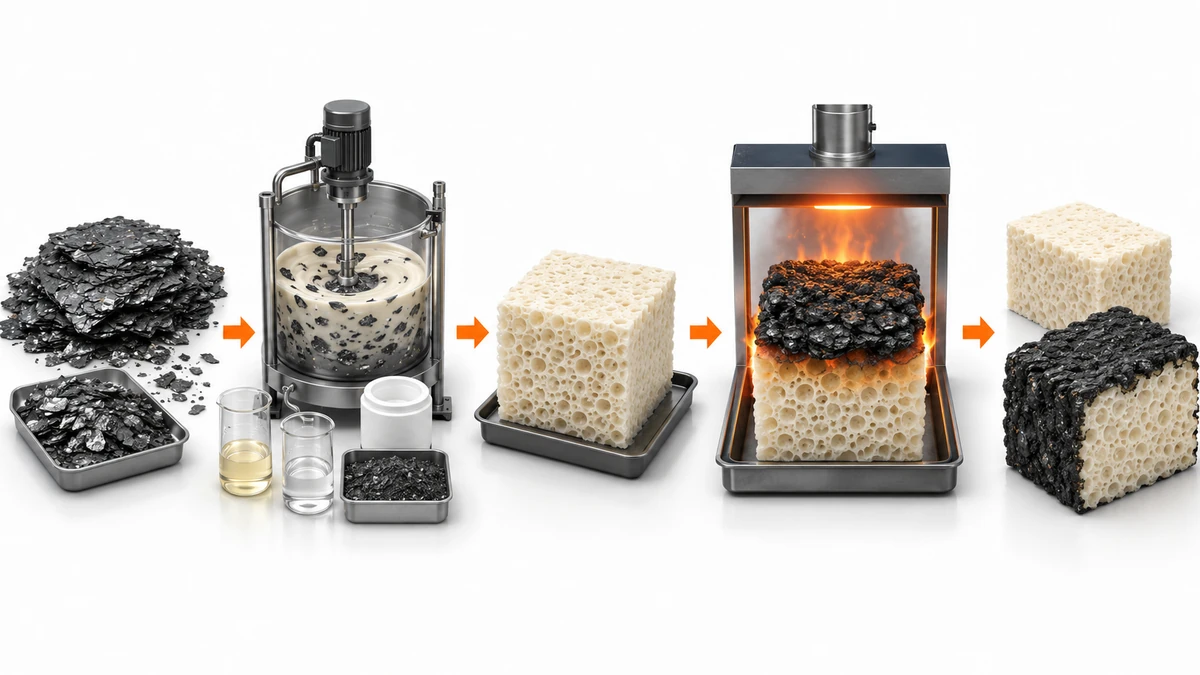
Chinese academic work illustrates why these records matter. A 2017 study published through Sichuan University’s journal platform evaluated expandable graphite in a specific all-water-blown semi-rigid polyurethane formulation. At 20 wt% EG in that formulation, the authors reported a limiting oxygen index of 29.4%. That number belongs to the stated formulation and method; it is not a recommended universal loading for rigid, flexible, spray, or other PU foams. Its value for procurement is the opposite lesson: loading must stay attached to formulation and test context.
Match Expansion Onset to the Thermal Event
The activation window should keep the expandable graphite stable through normal foam processing while allowing it to respond during the abnormal heating or fire exposure for which the formulation is designed. The lowest possible expansion temperature is therefore not automatically the best choice.
A PU system experiences several temperature histories. Raw materials may be stored or conditioned at one temperature, the reacting mix generates heat during foaming, post-cure or downstream operations may add another exposure, and the final fire test produces a much more severe thermal event. The graphite must pass through the normal stages without premature expansion that damages the foam structure.
The raw-material certificate also needs a clear definition of the temperature value being reported. A laboratory temperature used to measure expansion volume is not necessarily the same as an observed expansion onset. Neither is automatically the same as the temperature at an individual flake inside a reacting or burning foam specimen. Heat-transfer rate, foam thickness, cell structure, other fillers, surface exposure, and test duration all affect the local temperature history.
For a first screening, compare the supplier’s defined expansion-temperature result with the highest normal process exposure and the intended fire-response window. Then verify that screening decision in the actual formulation. If the material shows signs of premature expansion, unusual viscosity, collapse, surface disruption, or other process changes, the trial should investigate the temperature window instead of simply changing loading.
The expandable graphite selection guide explains how expansion temperature should be considered together with volume, particle size, and chemistry. The PU trial should use that raw-material framework without requalifying unrelated parameters every time a formulation adjustment is made.
Choose Particle Size for Processing and Distribution
Particle-size distribution must fit the PU mixing and foam structure because the flakes have to remain sufficiently uniform in the reacting system before any fire-protection function can be evaluated. A single mesh label does not prove that fit.
Coarse and fine fractions create different processing questions. A coarse fraction may preserve large flakes but can be harder to distribute uniformly in a constrained mix or fine-cell structure. A higher fine fraction can change powder handling, wetting demand, apparent viscosity, dusting, or the way solids occupy the polymer matrix. The direction and magnitude of these effects depend on the formulation, so they belong in a controlled trial rather than in a universal purchasing claim.
Record the full size definition used for the candidate material. If the supplier uses a mesh grade, ask what retained and passing fractions define that grade and how oversize and fines are controlled. China’s current GB/T 3520-2024, Test method for fineness of graphite, is a current national reference for graphite fineness testing. Where the project uses that method, both supplier and buyer should identify it explicitly.
During the foam trial, particle size should be assessed through more than a sieve result. Observe whether the graphite feeds consistently, whether agglomerates remain after mixing, whether solids settle before the foam structure develops, and whether cut sections show obvious local concentration. Where the project uses microscopy or image analysis, the method should be applied consistently across the compared specimens rather than used only on the best-looking sample.
A change in particle-size distribution after qualification should trigger review even if the nominal mesh label stays the same. Two lots can share the same commercial grade name while the tails of the distribution move enough to change mixing or foam appearance. That is one reason a repeat-order specification should control the distribution characteristic that actually correlated with the successful trial.
Check Formulation Compatibility Before Changing Loading
Formulation compatibility should be checked before changing expandable graphite loading because the graphite interacts with the complete PU system rather than with the fire-test specimen in isolation. A loading increase can change processing and physical properties at the same time that it changes fire response.
Start with the liquid and solid package that already exists. Record the polyol blend, isocyanate basis, catalysts, surfactants, blowing system, water content where applicable, pigments, fillers, and other flame-retardant components. Identify which ingredients are fixed by the product design and which can be adjusted during development. If two candidate graphite grades are compared while catalyst level, surfactant, or another filler also changes, the result cannot cleanly identify the effect of the graphite.
Compatibility questions include wetting, dispersion, viscosity, reaction profile, rise behavior, cell structure, density, dimensional stability, and the condition of the cured foam. A formulation may show acceptable initial mixing but poor distribution after rise. Another may produce an acceptable specimen at laboratory scale but become unstable when the mixing energy, batch size, or processing time changes.
Surface treatment can also change the result. A 2015 study published by Chemical Research in Chinese Universities through Jilin University compared boron-coated expandable graphite with untreated expandable graphite in a rigid PU foam system. At a 10% loading in that research formulation, the coated material changed fire and mechanical results relative to the untreated EG. The numerical outcome is specific to that study, but it demonstrates a purchasing point: “expandable graphite” is not enough information when surface treatment or modification differs.
Do not respond to every failed fire result by increasing loading. First identify whether the limiting problem is insufficient expansion response, activation timing, particle distribution, formulation chemistry, specimen density, test variation, or another component in the flame-retardant system. A loading change is meaningful only when the rest of the trial remains controlled.
Design a Trial Matrix and Record the Right Observations
A useful trial matrix changes one main variable at a time and records enough raw-material, processing, specimen, and test information to explain the result. Random formulation iteration can find a passing sample but cannot reliably produce a repeat-order specification.
For an initial material screen, keep the PU formulation fixed and compare a small number of graphite candidates. If the candidate grade is fixed and loading needs optimization, keep the graphite lot and process constant while changing only the planned loading levels. If particle-size distribution is the question, compare defined distributions while keeping the same formulation and nominal graphite addition. When a surface treatment is evaluated, treat it as a separate material identity rather than a cosmetic variation of the same grade.
| Variable group | Keep fixed when possible | Change deliberately | Record as output |
|---|---|---|---|
| Raw material screen | PU formulation, process, specimen, fire method | Expandable graphite grade / lot | Mixing behavior, foam structure, physical properties, fire result |
| Loading screen | Graphite grade and lot, PU ingredients, process | Expandable graphite addition level | Process window, density/structure changes, fire result |
| PSD screen | Graphite chemistry and expansion basis, PU formulation | Defined particle-size distribution | Dispersion, surface/cell observations, process behavior, fire result |
| Compatibility correction | Qualified graphite where possible | One formulation variable at a time | Whether the identified process defect improves without losing fire performance |
Specimen preparation deserves the same discipline as formulation. Record mold or free-rise condition, specimen location within the foam, cutting orientation, dimensions, conditioning time, density measurement, and any rejected specimens. Fire tests are sensitive to specimen preparation; comparing a dense skin region from one block with an interior section from another can create a false material conclusion.
Photographs can support the record when they show cut-face distribution, collapse, surface defects, char condition, or another defined observation. They should not be treated as a substitute for a measured test or as proof of composition. Use the same lighting, scale, orientation, and specimen location when photographs are intended for comparison.
End the trial with a clear disposition for each candidate: reject, investigate, re-test, provisionally qualify, or qualify. “Best sample” is not enough; record what was controlled and which conditions must remain comparable for the result to be repeatable.
Turn Trial Results into a Repeatable Purchase Specification
The purchase specification should capture the expandable-graphite characteristics and change controls that were connected to the successful PU trial, not every number that happened to appear on the original supplier data sheet. This keeps the specification technically meaningful and easier to enforce.
Start with identity: approved product family or grade, supplier code if one is formally controlled, and lot traceability. Add particle-size distribution using the same definition used in qualification. Add expansion volume and expansion-temperature requirements with their test bases. Include sulfur, moisture, ash, fixed carbon, pH, or other chemistry fields only where the trial, customer specification, or application risk gives them a reason to be contractual.
Then define change control. A change in raw graphite source, intercalation route, surface treatment, nominal grade, particle-size distribution, expansion-response method, or another characteristic connected to the trial may require notification or requalification. The list should be proportional to risk; it should not freeze every production detail that has no demonstrated effect on the application.
- Application identity: PU foam type and intended fire-performance requirement.
- Qualified formulation revision: identify the formulation used to approve the graphite.
- Raw-material identity: grade/product family and traceable lot.
- Expansion response: agreed volume and temperature fields with test methods.
- Particle distribution: target fraction plus oversize/fines or full distribution as qualified.
- Chemistry: only the fields linked to formulation, corrosion/contamination risk, customer requirement, or repeatability.
- Incoming checks: define which characteristics are checked per lot and which are reviewed periodically.
- Change notification: identify changes that require buyer review or a repeat trial.
- Application verification: retain the qualified fire-test method and specimen preparation as the final system-level evidence.
For a new inquiry, the most useful information is not simply “PU foam flame retardant.” Send the foam type, formulation constraints that can be disclosed, normal processing temperature range, existing fillers or flame-retardant package, target particle-size preference if known, raw-material chemistry limits, sample quantity, specimen preparation, and the fire-test method that will decide qualification. Those inputs let the trial start from a defined raw-material scope instead of an assumed universal grade or dosage.
Before freezing the graphite specification, repeat the approved formulation with another production lot where project risk justifies it. Compare the same processing, foam-structure, and fire-test outputs. This checks whether the purchase limits tolerate normal lot variation without requiring every shipment to repeat the full development program.
Scale-up should be treated as a separate confirmation step when production mixing differs materially from the laboratory route. Larger batches can change powder induction time, local solids concentration, wetting, shear history, reaction timing, and the delay between mixing and rise. Record the production equipment and sequence used in the scale-up lot, then compare the same process and specimen outputs that were important in the laboratory screen. If scale-up fails while the incoming graphite still meets the qualified raw-material limits, investigate the process change before tightening the graphite specification.
Use routine incoming checks for the graphite, periodic verification for slower-moving characteristics, and full PU requalification only after a material or formulation change that can affect the qualified result.
References and Sources
- National Standard Information Public Service Platform — GB/T 10698-2023, Expansible graphite. Current Chinese national product standard for expandable graphite.
- National Standard Information Public Service Platform — GB/T 3520-2024, Test method for fineness of graphite. Current Chinese national fineness-test standard.
- Polymer Materials Science & Engineering — study of expandable graphite in semi-rigid polyurethane foam. Used only as a formulation-specific Chinese research example; the reported loading and LOI result are not universal purchasing targets.
- Chemical Research in Chinese Universities — boron-coated expandable graphite in rigid polyurethane foam. Used to support the need to treat surface modification as a qualification variable.