BET surface area is useful because it gives a method-defined measure of the gas-accessible specific surface area of a solid. It becomes misleading when the number is treated as a stand-alone verdict on whether a graphite anode material is good, bad, safe, high performance, or equivalent to another grade.
China’s current national method reference is GB/T 19587-2017, Determination of the specific surface area of solids by gas adsorption using the BET method. Graphite anode materials themselves are covered at product-category level by GB/T 24533-2019. Those references give the buyer a measurement and product framework, but they do not create a universal “best BET” value.
The useful question is whether a BET shift helps explain a real change in the material, electrode process, or cell result. BET is valuable for screening and troubleshooting, but it is a poor stand-alone ranking metric when PSD, morphology, surface treatment, and test method are ignored.
What BET Surface Area Measures
BET surface area measures gas-accessible surface per unit mass under a defined adsorption method, so the result describes an analytical surface property rather than complete electrochemical behavior.
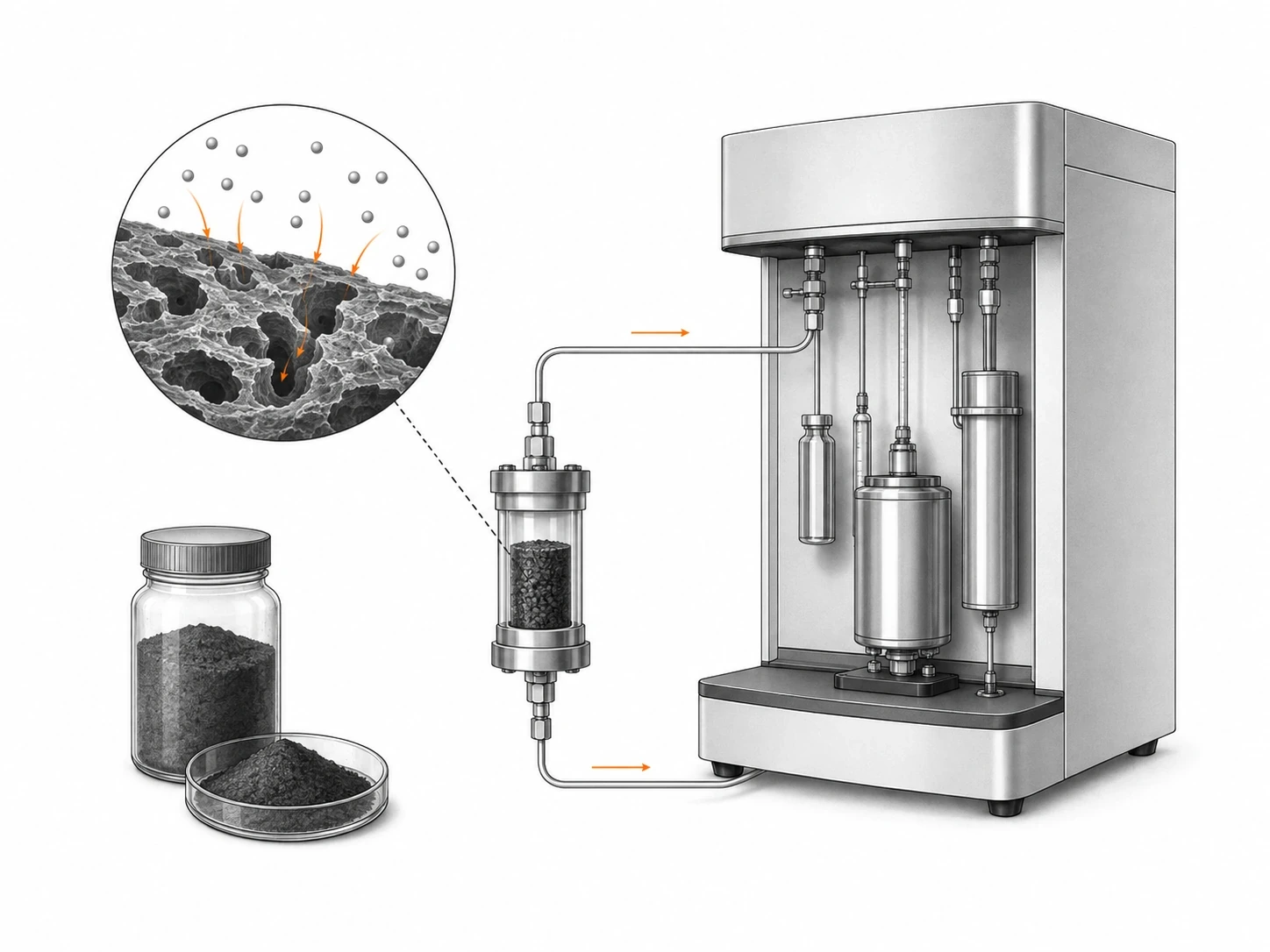
The test exposes a prepared sample to an adsorptive gas under controlled conditions and uses the adsorption response to calculate specific surface area according to the BET model. The reported value therefore depends on the material and on the measurement procedure: sample preparation, degassing, adsorptive, instrument execution, calculation region, and other method details affect comparability.
For graphite anode materials, the accessible surface can reflect particle size, roughness, porosity, morphology, fracture state, attached fines, and surface modification. A lower or higher value can therefore indicate a real material difference, but the number does not identify which structural feature caused it.
BET is especially useful as a lot-comparison and change-investigation tool when the same method is preserved. If an approved material normally occupies one analytical window and a new lot moves materially outside it, the shift gives the team a reason to examine PSD, morphology, coating, processing history, and electrode behavior.
Why Surface Area Can Influence Anode Behavior
Surface area can influence anode behavior because more or less accessible surface changes the interface available for wetting, binder interaction, electrolyte contact, surface-film formation, and other interfacial processes.
In electrode processing, a higher accessible surface may change how much binder or liquid phase is needed to wet and stabilize the particles. It can affect slurry viscosity, mixing demand, dispersion state, and the sensitivity of the formulation to fines or agglomeration. Those effects depend on the binder, solvent system, solids content, mixing route, and surface treatment.
At cell level, surface area can be one factor in early interfacial reactions and formation behavior. However, it should not be isolated from surface chemistry, coating, defect structure, pore structure, particle morphology, electrolyte, and formation protocol. Two materials with similar BET can still behave differently if their surfaces are chemically different.
This is why qualification should connect BET with observed process or cell behavior. If a BET shift accompanies a viscosity change, formation shift, or another repeatable symptom, the parameter becomes more informative. If the BET value changes but the qualified process remains stable across repeat lots, the field may be better suited to monitoring than to a narrow release limit.
What a BET Number Does Not Tell You
BET does not identify the surface feature that created the measured area, nor does it describe particle distribution, surface chemistry, packing, or final cell performance.
A rise in BET may come from more fines, rougher particles, porosity, fracture, or a coating change. PSD and microscopy are therefore cross-checks, not substitutes for the BET result.
Nor should BET be read as tap density or electrode density. Packing and electrode densification involve different material and process variables; the spherical graphite guide covers those relationships in more detail.
It also does not prove electrochemical superiority. A low value is not automatically better, and a high value is not automatically worse. The direction that matters depends on the qualified material architecture and cell process.
How PSD, Morphology, and Surface Treatment Complicate Interpretation
PSD, morphology, and surface treatment complicate BET interpretation because each can change accessible surface through a different mechanism, and several can move at the same time.
PSD is the first cross-check. More fine particles generally increase the amount of surface available per unit mass, but the relationship is not a simple one-to-one conversion for irregular or porous particles. A change in D50 with stable tails can mean something different from stable D50 with a large increase in fines. Use the full distribution and the qualified laser-diffraction method where applicable. GB/T 19077-2024 is the current Chinese national reference for laser-diffraction particle-size analysis.
Morphology is the second cross-check. Plate-like, rounded, angular, fractured, rough, and agglomerated particles present different accessible surface. Spheroidization can change geometry and create fines that are later classified away. Milling can increase fracture surfaces. Handling can break weak particles or agglomerates.
Surface treatment is the third cross-check. Coating can change gas accessibility, roughness, pore access, and the external surface that the instrument measures. A BET shift after coating may therefore be part of the intended modification rather than a defect. The buyer should compare like material states: coated with coated, uncoated with uncoated, and the same sample-preparation basis.
| BET change | Possible related cause | What to check next |
|---|---|---|
| BET rises and fines rise | Classification or breakage state changed. | PSD tails, microscopy, slurry behavior. |
| BET changes with stable PSD | Surface treatment, roughness, porosity, or method may have changed. | Coating identity, microscopy, method record. |
| BET stable but electrode behavior changes | Another powder or process variable may be responsible. | Chemistry, moisture, tap density, binder, mixing, coating, calendaring. |
| BET differs between laboratories | Sample preparation or method execution may not be equivalent. | Run a split-sample comparison and method bridge. |
Interpretation is stronger when the team asks what mechanism could plausibly connect the BET shift to the observed process. If the symptom is a slurry-viscosity increase, compare fines, surface treatment, and binder demand. If the symptom appears only after calendaring, packing and electrode structure may deserve more attention. If the symptom is a chemistry-sensitive cell failure, surface composition may matter more than total accessible area. This mechanism-first approach prevents the team from treating every outlying BET result as the root cause.
Trend direction can also be more informative than one isolated lot. A gradual movement across several production lots may indicate a process drift in shaping, classification, coating, or handling even while every result remains inside the current release window. The response should be investigation and correlation, not automatic rejection. If the application remains stable, the trend may justify supplier discussion or expanded monitoring before the limit is changed.
Measurement Method and Sample Preparation Affect Comparability
BET values are comparable only when the method and sample preparation are controlled well enough that the analytical difference represents the material rather than the laboratory.
Degassing or conditioning is a central part of the measurement because adsorbed species on the sample can affect the available surface seen by the test. The procedure must remove what the method intends to remove without altering the material in a way that destroys comparability. Follow the agreed method rather than improvising a preparation because another laboratory uses a different routine.
Sample representativeness also matters. A small test portion can fail to represent a production lot if the powder segregates by size or if fines concentrate during handling. Use the supplier’s lot-sampling plan or an agreed buyer sampling procedure that preserves the delivered distribution.
If the BET procedure or laboratory changes, protect the historical trend before resetting any limit. Measure the same identified material under both procedures where practical, quantify the method-to-method shift, and decide whether the existing control window can be translated or needs a new baseline. Preserve the old results instead of rewriting them onto the new numerical scale.
The same logic applies when a new instrument provides more decimal places. Extra digits do not create extra material control unless method repeatability supports them. Specifications should reflect meaningful analytical and process variation rather than cosmetic precision.
Storage and packaging can affect the sample state presented to the laboratory as well. Moisture adsorption, handling, and fine-particle segregation may change a test portion even though the underlying production material is unchanged. If the buyer is comparing retained samples over long periods, record storage condition and container history so aging of the sample does not become confused with supplier drift.
For supplier comparisons, normalize the method before ranking the numbers. A value from one certificate should not be treated as lower or higher in a meaningful way until the analytical basis is comparable. When method equivalence is uncertain, ask for split-sample or retained-sample testing instead of creating an acceptance decision from non-equivalent reports.
Use BET as One Qualification Parameter, Not a Stand-Alone Verdict
BET should be used as one qualification parameter inside a broader evidence set that includes material identity, PSD, morphology, packing-related data, chemistry, moisture, surface treatment, electrode processing, cell results, and repeat-lot behavior.
The graphite anode qualification guide places BET at the powder-screening gate and then moves the candidate into controlled electrode and cell trials. That position is deliberate: BET can help select, explain, and monitor a material, but the application decides whether the measured surface area is acceptable.
For an initial qualification, characterize several accepted or promising lots where possible. This helps distinguish the normal BET variation of a working material from a one-off development value. If the process accepts a wider analytical range with no negative application effect, a narrow specification may create unnecessary rejection.
For troubleshooting, compare the new lot with a retained qualified lot. Keep the same BET method, then compare PSD, morphology, surface treatment, moisture, and the electrode process. If the BET shift follows the failure while other variables remain controlled, the parameter becomes stronger evidence. If the failure occurs with stable BET, do not force the explanation onto surface area.
When requesting graphite anode material from QDZRT Graphite, include BET only if it is part of the current material definition, supplier comparison, or trial plan. Provide the method basis, current or target range if it is documented, the associated PSD and material family, and the qualification stage. If the project has not yet established a valid BET window, treat the field as screening or monitoring data rather than inventing a hard acceptance limit.
For mature programs, the BET specification should be reviewed against actual process history. If accepted production lots consistently perform well across a broader analytical range than the original development limit, the team can consider whether the release window is unnecessarily narrow. If failures cluster near one edge of the range, the evidence may justify tighter control. The limit should follow demonstrated process sensitivity rather than remain frozen because it appeared on the first approved data sheet.
When method uncertainty is larger than the observed lot-to-lot shift, resolve the analytical basis before changing the material specification. A split-sample comparison between laboratories or instruments can show whether the difference follows the graphite or the measurement system.
BET is most informative as part of a change pattern. Higher BET together with more fines and higher slurry viscosity suggests a plausible material-to-process link. A BET shift with stable PSD, morphology, slurry behavior, and cell results is different: the analytical change may be real, but its application significance is still unproven.
For supplier changes in coating, shaping, or classification, a BET shift can act as an early signal. The required response can then be scaled to the risk—from document review or powder recharacterization to electrode or cell confirmation.
References and Sources
- National Standard Information Public Service Platform — GB/T 19587-2017, Determination of the specific surface area of solids by gas adsorption using the BET method.
- National Standard Information Public Service Platform — GB/T 24533-2019, Graphite negative electrode materials for lithium ion battery.
- National Standard Information Public Service Platform — GB/T 19077-2024, Particle size analysis—Laser diffraction methods.