A graphite anode material is not qualified because its COA passes. The certificate can show that a production lot meets agreed powder-level requirements, but qualification is a broader demonstration: the material must be identified correctly, processed into a controlled electrode, tested in the intended cell context, reproduced across lots, and protected by supplier change control.
China’s current product reference GB/T 24533-2019, Graphite negative electrode materials for lithium ion battery, provides a national framework for the product category. Other measurement standards, such as GB/T 19077-2024 for laser-diffraction particle-size analysis and GB/T 19587-2017 for BET specific surface area, help define individual tests. None of them replaces the buyer’s application qualification.
Use staged gates so a candidate cannot move from an attractive powder datasheet straight to production approval. Each stage should answer a different question before the next test consumes more time and material.
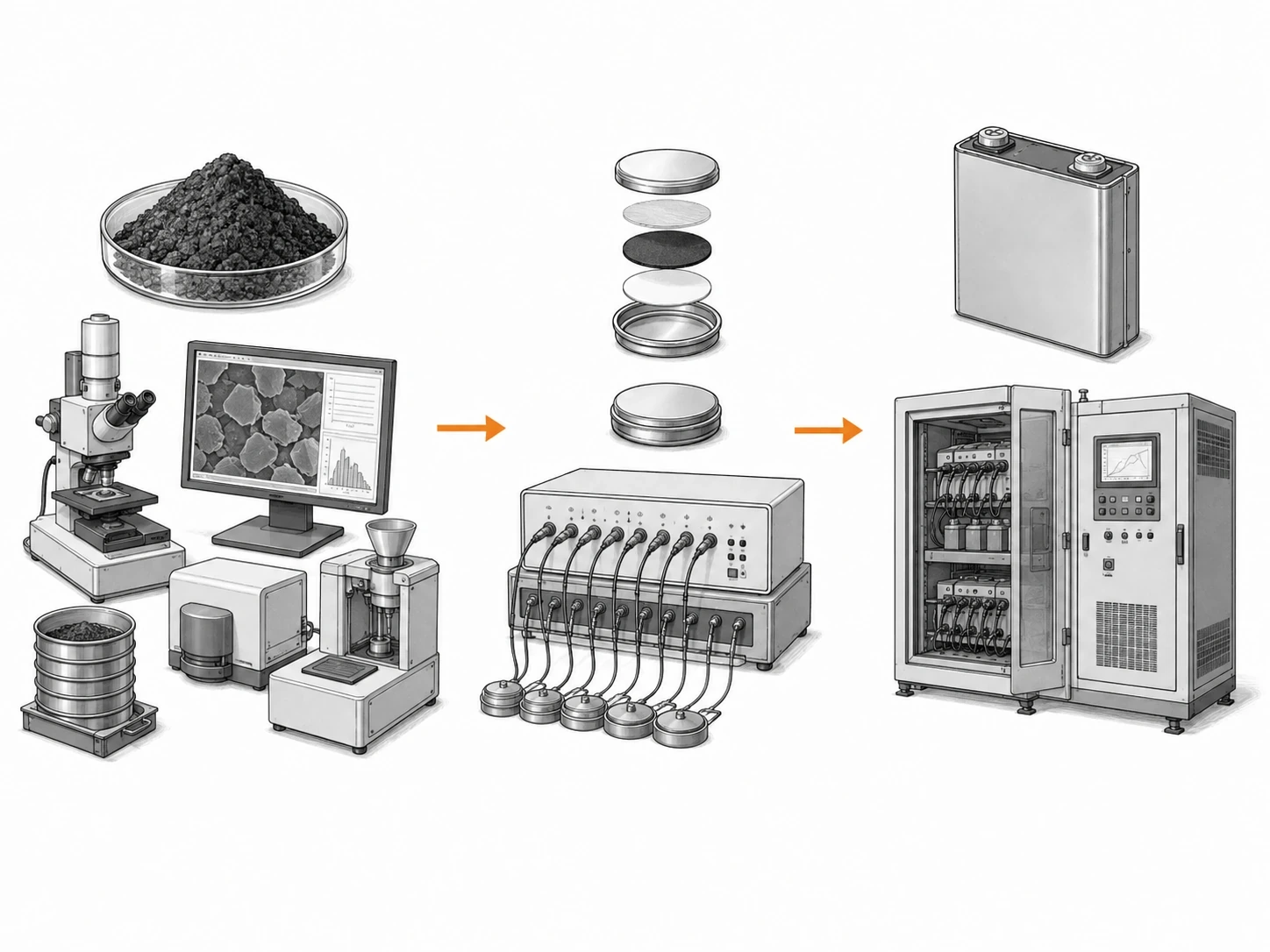
Gate 0: Define the Cell, Electrode, and Process Target
Gate 0 defines the battery system and manufacturing objective before any graphite candidate is judged, because qualification criteria are meaningless without the process and cell they are intended to protect.
Define the trial around the variables that determine comparability: cell format and chemistry, electrode design, loading basis, formulation, mixing and coating sequence, drying and densification history, formation, and the performance question assigned to that gate. The team does not need to publish confidential design values; it needs a controlled internal reference.
Also define the project type. A first-source development project may allow process optimization around a new graphite. A second-source project may require a closer drop-in comparison. A cost-reduction project may have a stricter process-equivalency requirement. A high-power, fast-charge, long-life, low-temperature, or another specialized program may emphasize different failure signals.
Gate 0 should end with a written qualification objective and a list of variables that must remain fixed during the first candidate comparison. If the team changes binder, coating condition, calendaring, electrolyte, and graphite at the same time, later data will not show which change caused the result.
Note: A qualification target is not the same as a universal graphite specification. It belongs to the defined cell and process that the team is trying to reproduce.
Gate 1: Screen Powder-Level Data
Gate 1 screens graphite candidates using a controlled powder data package so that obviously non-equivalent or poorly documented materials do not consume electrode and cell resources.

Start with material identity: natural, synthetic, shaped, spherical, coated, blended, or otherwise modified. Then review the particle-size distribution, morphology evidence, packing-related data such as tap density where relevant, BET surface area, moisture, selected chemistry, lot identity, and the methods behind contractual fields.
The battery-grade graphite anode materials guide explains how those material families fit together. The spherical graphite article goes deeper into shape, tap density, and PSD, while the BET guide covers surface-area interpretation.
Do not reject or approve a candidate solely because one number differs from the incumbent. Ask whether the difference sits inside a process-sensitive field. A different BET value may matter if it changes wetting, binder demand, or formation behavior; it may be less important if the controlled electrode and cell trial reproduces the required result. The same logic applies to PSD, tap density, or selected chemistry.
At the end of Gate 1, keep a candidate shortlist, retained samples, and a normalized comparison of the powder differences that need attention in the electrode trial.
Gate 2: Build a Controlled Electrode Trial
Gate 2 converts powder candidates into electrodes under controlled conditions so the team can see whether material differences affect mixing, coating, drying, calendaring, and the physical electrode before cell data are interpreted.
Use the same base formulation and process for the initial comparison wherever practical. Record the graphite lot, binder and additive lots, addition sequence, mixing equipment, time, temperature, solids level, coating method, wet and dry film observations, loading, drying condition, calendaring condition, and any process signal used by the plant or laboratory.
Watch for process failure rather than only final numbers. A candidate may create unstable viscosity, poor wetting, agglomeration, slow incorporation, foaming, coating streaks, edge defects, unusual drying behavior, weak adhesion, or an excessively narrow calendaring window. Those observations can explain later cell differences.
Scale matters. A material can pass a small-batch laboratory trial and expose feeding, mixing, dust, or coating issues when the batch becomes larger. Qualification should therefore include a scale-up checkpoint before production approval when the manufacturing process is sensitive to those factors.
Caution: Do not “fix” a difficult candidate by changing several process variables during the first comparison. Establish the baseline difference first; optimize only after the team understands what needs to change.
Gate 2 should leave a clear electrode-process record and a decision on which candidates deserve cell testing.
Before leaving Gate 2, decide whether the candidate needs route-specific optimization or must prove drop-in compatibility. That distinction should be written into the record. If the project allows optimization, first complete the baseline comparison, then change one process variable at a time and document why the adjustment was made. If the project requires a drop-in second source, excessive optimization can hide the fact that the material is not operationally equivalent.
Keep enough equipment context to explain transfer between lines: mixer geometry, batch scale, coating route, drying path, and calendaring equipment where relevant. The record does not need every machine setting.
Gate 3: Evaluate Cell-Level Performance and Failure Signals
Gate 3 evaluates the candidate in the defined cell system and test plan, using side-by-side evidence rather than universal graphite performance thresholds.
The exact metrics depend on the program. They may include formation behavior, first-cycle efficiency, reversible capacity, impedance-related observations, rate response, retention over the defined cycle protocol, swelling, gas, temperature response, or another failure signal. The buyer should use the metrics already tied to the product objective.
Control cell build and test conditions tightly enough that the graphite remains the main intentional variable. If electrolyte, separator, cathode, cell pressure, formation, or test temperature changes simultaneously, route conclusions become weak. Replicates should be defined by the development plan rather than added casually after an unexpected result.
Also record failure patterns, not only average performance. One material may show acceptable initial capacity but greater variation, unstable impedance, poor process yield, or a different failure mode later in the test. Qualification should capture those signals because production risk is often driven by variation and failure distribution rather than one mean value.
Gate 3 ends with the cell evidence and a clear pass, hold, or reject decision under the tested conditions.
Gate 4: Confirm Lot-to-Lot Reproducibility
Gate 4 confirms that the preferred material can reproduce both powder data and application behavior across additional production lots; one successful development lot is not enough for repeat supply.
Compare repeat lots on the powder fields shown during qualification to matter: PSD, morphology, BET, tap density or packing data, moisture, chemistry, coating or modification identity, and any other monitored characteristic. Use the same methods and sample preparation so analytical drift is not mistaken for material drift.
Then process the repeat lots through the qualified electrode route. A stable COA does not guarantee stable application behavior if the supplier made an unreported process change or if the buyer’s own manufacturing conditions moved. A retained approved lot is valuable because it can be run beside a new lot during investigation.
Packaging and transport should also be included where they alter the delivered powder state. Vibration, storage, moisture exposure, compaction, and transfer can change handling or agglomeration. If commercial packaging differs from the laboratory qualification container, test the commercial state before locking the final specification.
Gate 4 establishes whether repeat production lots remain compatible with the qualified material and process window.
When a repeat lot fails, investigation should move in a controlled sequence: confirm lot identity and packaging, verify the buyer’s process and equipment state, compare the new lot with the retained reference, repeat the agreed powder tests, and then reproduce the electrode or cell symptom. This order prevents a supplier claim from being opened solely because one production run drifted.
Use the variation across accepted lots to set the final operating window. It is usually more useful than forcing every future lot to reproduce one development sample exactly.
Gate 5: Lock the Supplier Data Package and Change-Control Rules
Gate 5 converts the qualification evidence into a supplier specification, COA requirement, retained-sample plan, and change-control agreement that can protect future production without over-specifying irrelevant fields.
Separate release fields from monitoring fields. A release field has a demonstrated connection to material identity, customer requirement, or application risk. A monitoring field is trended because it may help explain future changes but has not earned a hard rejection limit. Qualification-only fields may be tested during development or after major change without appearing on every routine COA.
| Control layer | Typical content | Purpose |
|---|---|---|
| Material identity | Material family, modification, approved grade/sample reference | Defines what was actually qualified. |
| Routine release | Agreed PSD, chemistry, moisture, BET or packing fields where proven necessary | Releases each production lot. |
| Monitoring | Additional morphology, trend, handling, or diagnostic fields | Provides early warning and investigation evidence. |
| Change control | Supplier process changes requiring notification/requalification | Prevents silent drift after approval. |
| Application record | Electrode and cell qualification evidence | Shows why the material window is acceptable. |
Do not copy every development measurement into the purchase specification. Excessive limits can create false failures, reduce sourcing flexibility, and make normal analytical variation look like material nonconformance. Keep only the fields that protect the qualified system.
What Evidence Belongs in the Qualification Record
The qualification record should preserve enough evidence for a future engineer to reproduce the decision, investigate a complaint, or judge a supplier change without rebuilding the program from memory.
At minimum, keep the project objective, approved material identity, supplier and lot records, powder data and methods, retained sample information, electrode formula and process, cell build and test plan, failure observations, repeat-lot evidence, final release fields, monitoring fields, and change-control rules.
Also preserve rejected or borderline candidates with the reason for rejection. A future supplier may propose a similar material, and the earlier record can prevent the team from repeating an already-resolved experiment. The record should distinguish “failed because the powder was outside the material window” from “failed because the process was not controlled.”
When a laboratory or test method changes, document the bridge between old and new methods. This protects historical trends. When the supplier changes a critical process, document whether the change was reviewed, partially requalified, or fully requalified.
Principle: Qualification is complete only when the buyer can trace a future production lot back through material identity → powder evidence → electrode process → cell evidence → repeat-lot control → supplier change rules.
For a new graphite anode request to QDZRT Graphite, provide the route being considered, current reference material if available, the powder fields already tied to the process, sample quantity, and the qualification stage. If the project is still at Gate 0, say so; an exploratory candidate should not be forced into a production specification before the evidence exists.
Deviation handling should be defined before production release. A temporary waiver needs a named lot, a stated reason, the additional checks required before use, and an expiry or requalification trigger. Without those controls, a one-time exception can quietly become the new specification without the evidence that justified the original approval.
For production use, define who reviews supplier changes, deviations, containment, and requalification so technical decisions have a clear owner.
As the program matures, reduce monitoring that no longer adds useful control and expand it again when a trend moves or a supplier makes a relevant process change.
Each gate also needs a stop condition: weak material identity or powder evidence at Gate 1, unreproducible electrode processing at Gate 2, failed cell criteria at Gate 3, unstable repeat lots at Gate 4, or unresolved supplier change rules at Gate 5.
The thresholds belong to the project. The purpose of the stop rule is simply to prevent expensive cell work from continuing when material identity or process compatibility is still unresolved.
Gate ownership should be explicit. Assign who signs off powder screening, electrode processing, cell evidence, repeat-lot acceptance, and supplier changes so a candidate cannot bypass a failed gate simply because responsibilities are unclear.
For second-source qualification, run the candidate beside a retained or current approved material whenever practical. The reference lot provides a control for electrode preparation, cell build, test equipment, and laboratory timing that may have changed since the original qualification. If both materials move in the same direction, investigate the shared process before blaming the new source. If only the candidate moves, the comparison gives the team a stronger basis for deciding which earlier gate needs to be reopened.
References and Sources
- National Standard Information Public Service Platform — GB/T 24533-2019, Graphite negative electrode materials for lithium ion battery.
- National Standard Information Public Service Platform — GB/T 19077-2024, Particle size analysis—Laser diffraction methods.
- National Standard Information Public Service Platform — GB/T 19587-2017, Determination of the specific surface area of solids by gas adsorption using the BET method.