QDZRT Graphite selects cutting tools against the actual job: graphite abrasiveness, feature geometry, batch quantity, tolerance, surface requirement, machine condition and the risk of losing a nearly finished part. Tool price alone does not determine the lowest manufacturing cost.
In graphite CNC machining, carbide and diamond-coated tools can both be appropriate. The useful comparison is not “which one is better?” but “which tool keeps the required geometry and surface condition at the lowest total cost for this specific production run?”
This article focuses on tool-material selection. It does not repeat general feeds-and-speeds guidance, because cutting parameters must still be established for the actual tool, graphite grade, machine, feature, and workholding condition.
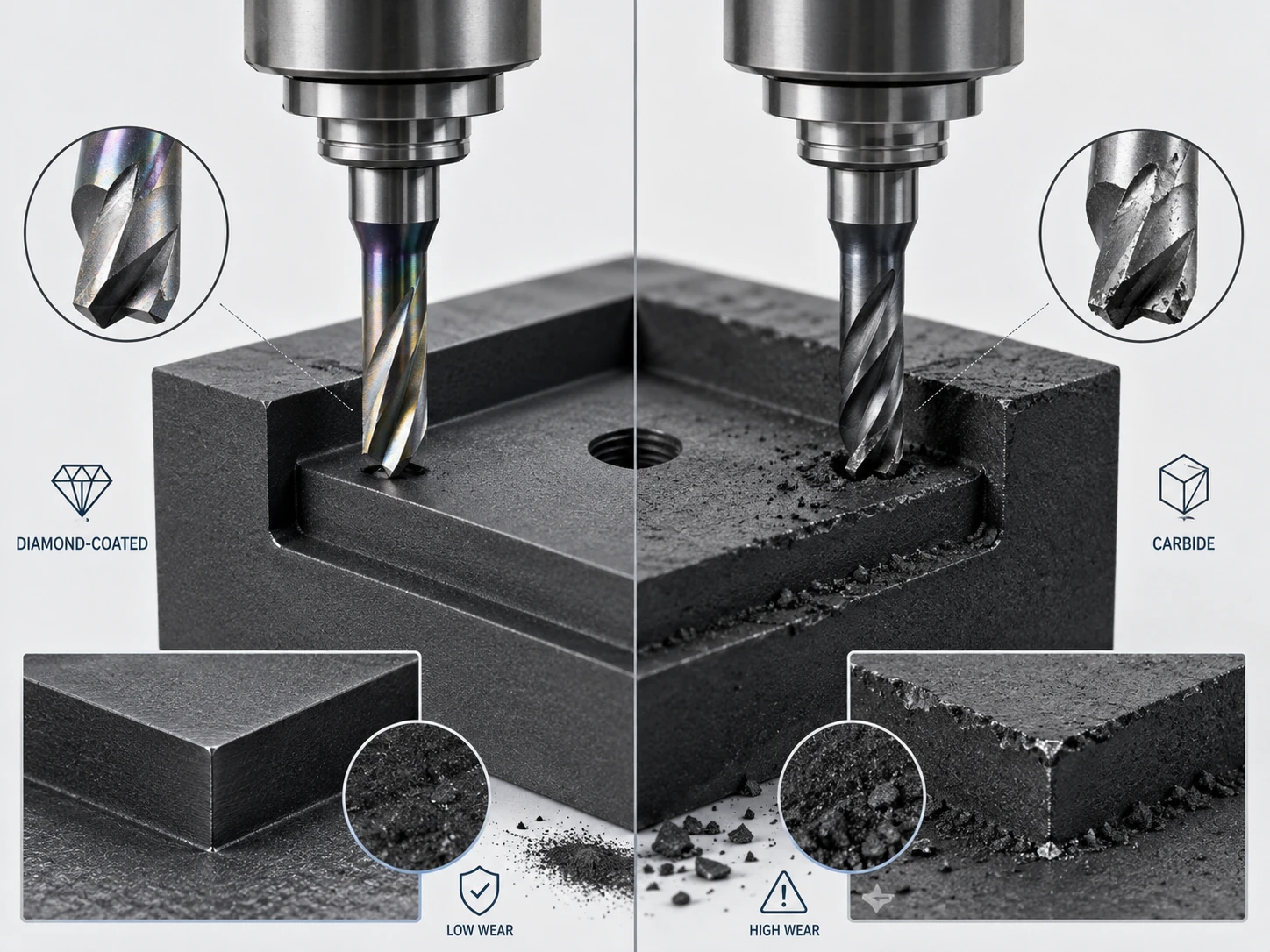
Start with Abrasion, Edge Quality, and Production Volume
Graphite is abrasive. That makes tool wear a central process variable, especially when the part contains long toolpaths, fine details, narrow ribs, small holes, or repeated production quantities.
Before choosing a tool, define what failure looks like. A tool can still cut while already being unsuitable for the part. Wear can show up as dimensional drift, rounded corners, increased chipping, changing surface texture, burr-like graphite debris at fragile edges, or a loss of repeatability between the first and last component in a batch.
For prototypes and short development runs, we may approve carbide when its expected wear remains within the inspection plan. For repeat batches, a suitable diamond-coated tool may reduce tool changes, offsets, inspections and rejected parts. The decision is recorded against the actual part and process.
Part value also matters. If a graphite blank is large, highly purified, or already contains many hours of machining, losing the part near the end of the process because a tool has drifted can cost far more than the cutting tool itself. Tool selection should therefore consider the value at risk when each feature is machined.
A useful first comparison records:
- graphite grade and general structure;
- total cutting length or estimated machining time;
- batch quantity;
- smallest edges, slots, holes, and corner features;
- required tolerances;
- function-critical surface-finish requirements;
- tool-change access and preset capability;
- cost of a damaged or scrapped workpiece;
- whether the tool will be reused on repeat orders.
This frames the decision in production terms rather than tool-catalog terms.
Carbide Tools: Strengths, Wear Pattern, and Best-Fit Jobs
Carbide tooling is widely available, relatively economical, and offered in a broad range of geometries. It can be a practical choice for prototypes, short runs, roughing, less demanding features, or jobs where a tool can be changed before wear affects critical dimensions.
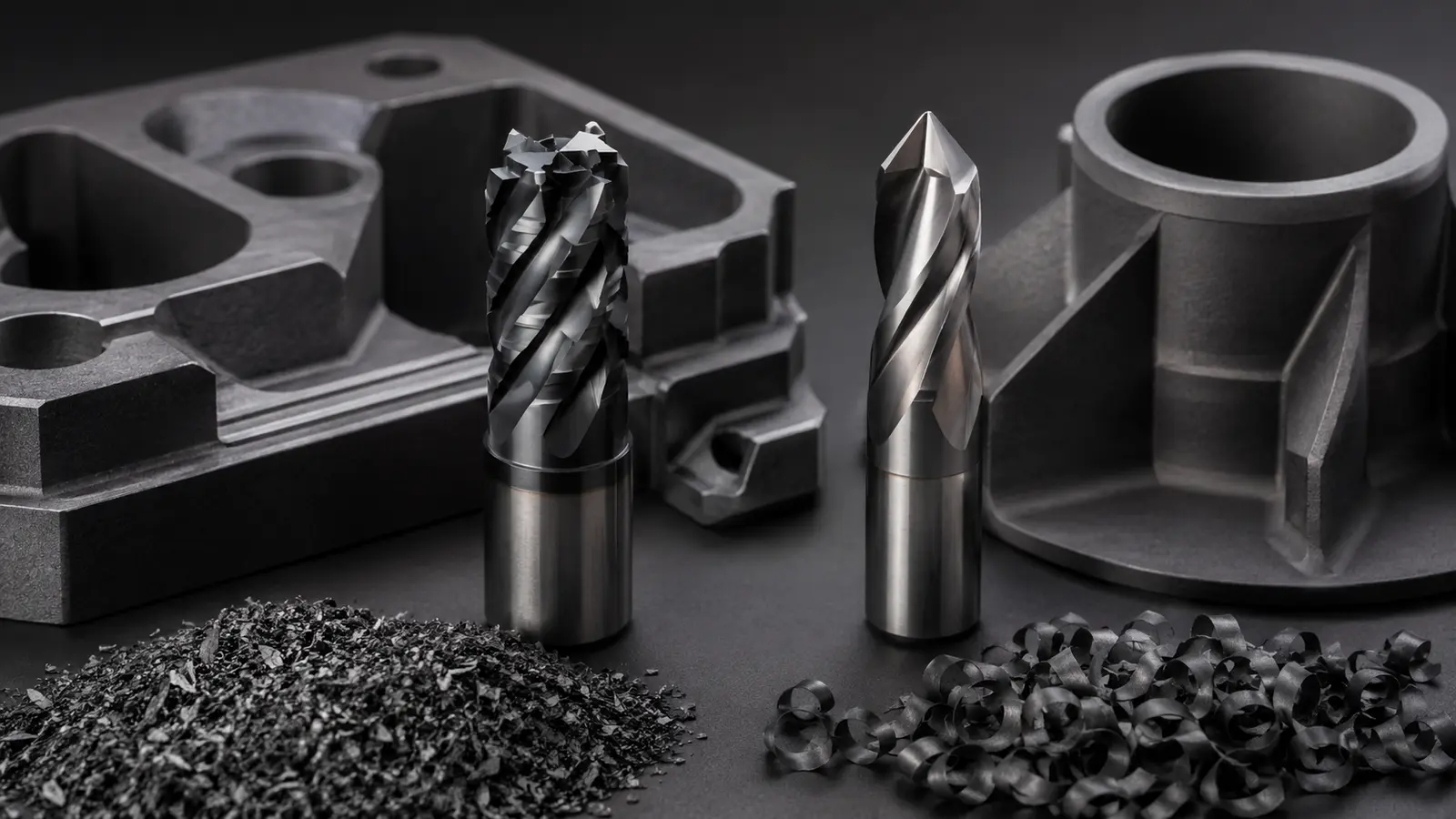
Its advantage is not that it ignores graphite abrasion. Carbide still wears. The advantage is that the acquisition cost and flexibility may fit the economics of the job.
During prototype manufacturing, we use carbide where appropriate to verify workholding, access, sequence and geometry before approving more specialized tooling. If the drawing changes, the tooling decision is reviewed again.
Carbide is also useful when a feature needs a geometry not readily available in a preferred coated tool. A custom-ground or specialized carbide tool can sometimes solve a short-run access problem more efficiently than selecting a coating that is poorly matched to the geometry.
We measure critical features at planned intervals and record part count or cutting length before an offset or replacement is required. This creates QDZRT Graphite process evidence for the actual grade and feature instead of relying on a universal tool-life claim.
Carbide becomes a poor choice when tool wear causes repeated interruptions, dimensional instability, edge degradation, or inspection burden that exceeds the savings in purchase price. At that point, the economics should be recalculated using cost per acceptable part.
Diamond-Coated Tools: Strengths, Wear Pattern, and Best-Fit Jobs
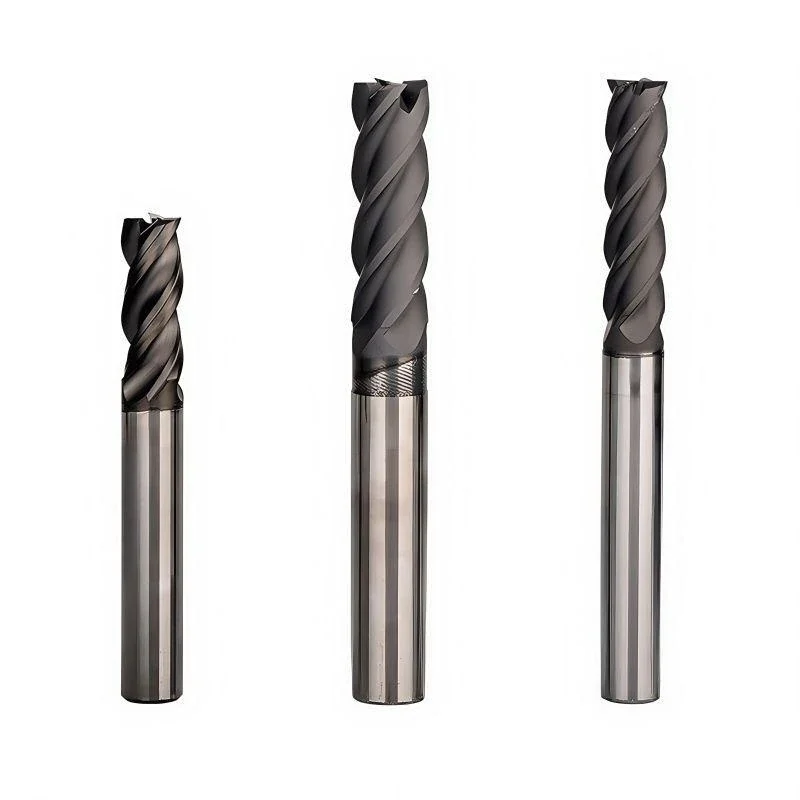
Diamond-coated tools are often selected for graphite because the coating can provide strong wear resistance in abrasive machining. Their value becomes most visible when a stable process repeatedly uses the same or similar tool geometry over substantial cutting time.
A coated tool can support longer intervals between tool changes, but coating alone does not guarantee success. Tool substrate, coating quality, edge preparation, flute geometry, tool diameter, machine runout, workholding, dust control, and cutting conditions still affect performance.
Very fine or sharp features require particular attention. Coating thickness and edge preparation can influence the effective cutting edge. A tool that has excellent wear resistance but an edge geometry unsuitable for a fragile graphite detail may not produce the best result.
Diamond-coated tools tend to make more economic sense when:
- the same feature is repeated across many parts;
- tool wear is a known source of dimensional drift;
- tool changes interrupt an expensive production process;
- critical edges or surfaces deteriorate as carbide wears;
- machine time and inspection labor are more significant than tool purchase price;
- the part program is stable enough to use the tool over multiple repeat orders.
We verify actual savings from production records for our graphite grades, part families and approved processes.
Part Geometry and Edge Design Can Override Tool Material
Tool material cannot rescue a poor machining geometry. A brittle graphite part with a very thin wall, deep narrow pocket, unsupported edge, or aggressive internal corner can chip even when the cutting tool has little wear.
Feature geometry should therefore be reviewed before concluding that a tooling upgrade will solve a quality problem. If the defect always occurs at the same corner or exit edge, the root cause may involve support, tool engagement, machining direction, breakthrough, or part design.
Small-diameter tools create another constraint. Tool stiffness, flute length, reach, runout, and holder condition can become more important than coating choice. A long-reach coated tool may perform worse than a shorter carbide tool if the setup forces excessive deflection or vibration.
Deep cavities also change tool economics. A premium tool used mainly to reach through an unnecessarily long stick-out may spend little time cutting at its best stiffness. A revised machining sequence or different tool access can provide more benefit than changing material.
For edges that must remain sharp, plan the cut direction, support, stock allowance, and final pass. Tool wear is one variable within that strategy, not the entire strategy.
QDZRT Graphite can review the drawing together with the tooling plan to identify where a fragile feature requires additional process control.
Surface Finish and Tolerance Requirements
Surface finish in graphite is influenced by material structure, tool condition, tool geometry, toolpath, engagement, machine behavior, and measurement method. It is incorrect to promise a fixed Ra value based only on carbide versus diamond coating.
A fresh tool may produce a consistent surface at the beginning of a batch, while a worn tool gradually changes the texture. If the surface is function-critical, the process should define how tool condition is controlled across the batch.
Tolerance behaves similarly. Tool wear can reduce the effective cutter size and create drift in pockets, slots, profiles, or hole-related features. A long batch may therefore require planned tool-life management even when every individual cut appears stable.
Instead of applying the same tooling strategy to the whole part, identify critical features. Roughing and noncritical areas may use one tool class, while final finishing of critical dimensions or surfaces uses another. This hybrid strategy can reduce total tooling cost.
Inspection data guide our tooling decision. If carbide keeps critical dimensions stable through the batch, a change may offer no economic benefit. If records show repeated offsets, remeasurement or tool replacement, we evaluate a suitable coated tool.
Compare Tool Cost by Parts per Tool, Not Purchase Price
Purchase price is the most visible cost and often the least useful number for a production decision. The real comparison is total machining cost per acceptable part.
A useful cost model includes:
- tool purchase cost;
- number of acceptable parts produced before replacement;
- machine time lost during tool changes;
- presetting and offset-setting time;
- extra inspections needed to manage wear;
- scrap or rework linked to tool drift;
- risk to high-value graphite blanks;
- inventory cost of keeping backup tools;
- whether the tool can be reused on future orders.
Suppose a coated tool costs several times more than a carbide tool. That price difference says nothing by itself. If it lasts through a large batch with stable dimensions while several carbide tools would be consumed, the coated option may be cheaper. If a prototype requires only a few minutes of cutting, the coated option may never recover its higher purchase price.
We do not publish a universal “diamond lasts X times longer” rule without comparable data for the same tool geometry, graphite, machine and process. Tool-life ratios depend on the actual conditions.
Our production record links tool ID, graphite grade, part number, program revision, quantity, cutting time, dimensional trend, removal reason and observed wear. Repeat runs provide evidence for future manufacturing reviews and quotations.
Our Tool-Selection Record
A decision matrix makes tool selection repeatable without pretending that one tool wins every category.
| Job Condition | Carbide May Fit | Diamond-Coated May Fit |
|---|---|---|
| Prototype / very short run | Often practical | May not recover higher initial cost |
| Stable repeat production | Possible with managed wear | Often worth evaluating |
| Long abrasive toolpath | Wear may drive changes | Strong candidate for evaluation |
| Specialized one-off geometry | Broad availability can help | Availability may limit options |
| Tight dimensional consistency over many parts | Requires wear control | May reduce wear-driven drift |
| High-value blank | Tool-cost saving may be secondary | Lower change/scrap risk may matter more |
| Roughing | Often economical | Depends on volume and tool life |
| Critical finishing | Can work with fresh-tool control | Often attractive where wear is limiting |
This matrix supports the initial review; final selection comes from our actual production and inspection evidence.
Tool-Wear Symptoms and What to Check
When graphite machining quality changes, use the symptom to guide investigation.
Dimensional drift across a batch: inspect tool wear, effective diameter, offsets, runout, holder condition, and measurement consistency.
Increasing edge chipping: inspect tool edge condition, cutting direction, support, engagement, part geometry, and whether a previously sharp tool has become rounded.
Surface texture gets progressively worse: compare tool wear, material lot, dust evacuation, machine condition, and toolpath.
Tool breaks unexpectedly: inspect reach, diameter, flute loading, holder runout, collisions, excessive engagement, and whether the tool was already damaged.
One feature fails while others remain good: investigate local geometry and tool access before blaming overall tool material.
How Tool Selection Is Approached
For custom graphite components, the practical approach is to match the tooling strategy to the drawing and production quantity. QDZRT Graphite can review thin walls, small holes, narrow slots, edge-sensitive features, surface requirements, and inspection access before machining begins.
For repeat orders, tool-life records from the approved process can be carried forward with the part program when available. That gives later production a stronger basis than starting each batch from a generic recommendation.
Customers requesting a quotation should provide the drawing, graphite grade if already specified, required quantity, critical tolerances, surface-finish requirements, and any features known to be especially sensitive. This information helps determine where tooling cost should be concentrated.
Tool Selection Should Be Revalidated When the Part Changes
A tooling decision proven on one revision should not be carried forward blindly after the customer changes geometry. A deeper pocket, smaller corner radius, longer reach, tighter surface requirement, or increased quantity can shift the economics between carbide and diamond-coated tools. The same is true when the graphite grade changes.
For repeat production, keep the tool choice linked to the part revision and material. When engineering changes arrive, review the features that drove the original selection before releasing the old process unchanged. This small control prevents a tool strategy optimized for the previous geometry from becoming a hidden source of cost or quality drift.
Separate Tool-Life Evidence from Marketing Claims
Supplier application guidance is useful, but we distinguish catalog claims from our own capability evidence. Our strongest record is the acceptable-part count, cutting time, dimensional trend, surface result and tool-removal reason for the same graphite and feature family.
That evidence can support future quotations and inventory planning. It also makes the carbide-versus-coated decision auditable instead of relying on personal preference.
Inspection Trend as Our Tool-Change Trigger
A tool should not be replaced only because it has reached an arbitrary part count, and it should not remain in service simply because it has not broken. The useful replacement trigger is the feature that first shows wear-related loss of control. Depending on the job, that may be hole size, edge chipping, corner definition, slot width, or a function-critical surface.
Define that feature before production begins and measure it consistently across the batch. The record should show the tool ID, part sequence, measured feature, any offset correction, and the reason the tool was removed. This separates true wear progression from one isolated inspection result or a change caused by workholding, measurement, or material lot.
For repeat orders, the same feature can become a practical tool-life indicator. If carbide repeatedly reaches the replacement trigger earlier while a diamond-coated tool keeps the feature stable for materially longer under comparable conditions, the coated tool has demonstrated value on that job. If both tool classes remain inside the same acceptance window for the full batch, paying more for coating may not improve total production cost.
This method also prevents a universal tool-life claim from entering quotations. The record belongs to a defined graphite grade, tool geometry, machine setup, program revision, and inspected feature. When any of those change, the previous tool-life history becomes a reference rather than an automatic guarantee.
Separate Roughing and Finishing Tool Decisions
The most economical tooling plan may use different tool materials at different stages. A carbide tool can be adequate for stock removal where edge wear does not yet control the part, while a diamond-coated tool may be reserved for features whose dimensional stability or edge condition determines acceptance. Compare the complete routing cost rather than forcing one tool material onto every operation.
Record the inspection feature used as the wear trigger so later tool-life comparisons remain tied to the same acceptance condition.
Tool choice should also be separated from material microstructure. The fine-grain graphite guide explains when grain structure can influence edge integrity, while the graphite surface-finish guide keeps Ra requirements tied to function and measurement method.
References and Sources
- Lu et al. (2025) — Milling performance of diamond-coated tools with varying flute numbers and diamond grain sizes in graphite machining. Demonstrates that coating structure and tool geometry materially affect wear and machined-surface behavior.
- Lee et al. (2022) — Analysis of Tool Wear and Roughness of Graphite Surfaces Machined Using MCD and NCD-Coated Ball Endmills. Graphite-machining study linking coating type, wear progression, and surface result.