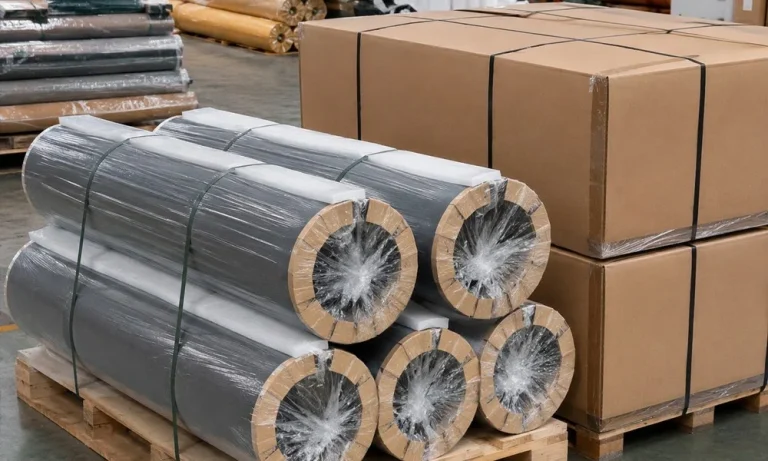
For each international export project, QDZRT Graphite identifies the exact material grade, product form, composition, technical parameters, quantity, destination, end user, and end use before quotation and shipment release. Flexible graphite rolls, metal-reinforced sheets, machined synthetic-graphite components, natural flake graphite powder, and graphite anode materials follow different manufacturing, inspection, export-control, documentation, and packing routes.
Start with exact product identification. The order file should state material origin, product form, composition or reinforcement, technical parameters, quantity, destination, consignee, final user, and final use; commercial documents then need to reconcile with the specification, drawing, certificate, package labels, physical goods, and any required licence.
Regulatory reference point: China’s unified Dual-Use Items Export Control List took effect on December 1, 2024. The 2026 Catalogue of Dual-Use Items and Technologies Subject to Import and Export Licence Administration took effect on January 1, 2026 and replaced the previous annual catalogue. The live list, annual catalogue, graphite-specific rules, destination, end user, end use, and shipment date must be checked for each transaction.
This is a B2B procurement and documentation guide, not a substitute for a formal item-identification decision, licence decision, customs declaration review, or legal advice.
1. Product Identification Comes Before Documentation
Classification follows the exact material, form, composition, technical parameters, destination, end user, and end use—not a broad label such as “industrial graphite.” Routine industrial use can still fall within a controlled description, while the mere presence of the word “graphite” in a product name does not make an item controlled.
A practical product identity should answer the following questions:
- Is the material natural graphite, synthetic graphite, expanded graphite, flexible graphite, or a composite containing graphite?
- Is the product powder, granule, block, plate, sheet, foil, roll, gasket, packing, ring, electrode blank, machined part, or battery anode material?
- Does it contain metal foil, tanged metal, wire mesh, fiber, PTFE, aramid, or another reinforcement?
- Which technical values are relevant: purity, density, flexural strength, particle-size distribution, moisture, ash, sulfur, chlorine, thickness, dimensions, or drawing tolerances?
- Who is the importer, consignee, intermediate trader, and actual final user?
- What equipment, process, product, or production step will use the material?
- What is the destination country and final delivery address?
The Graphite Products category and Graphite Raw Materials category illustrate why product form must be fixed before the commercial and regulatory files are prepared.
2. Product-Specific Review Routes
2.1 Reinforced Graphite Sheet, Gaskets, Packing, and Rings
Reinforced graphite sealing materials may include flexible graphite combined with stainless-steel foil, tanged metal, wire mesh, fiber, PTFE-related reinforcement, or another carrier. The actual construction must be identified in the specification and commercial description. A broad description such as “reinforced graphite sheet” is not enough when the reinforcement type changes the product structure, packing method, downstream conversion route, or item-identification analysis.
The official graphite FAQ states that specific products reinforced with metal or fiber materials—graphite packing, graphite gaskets, graphite composite boards, graphite wires, and graphite rings—are not within the graphite dual-use item scope addressed by that FAQ. This statement must be applied narrowly to the actual product form and structure. It must not be expanded into a general claim that every reinforced graphite sheet, every PTFE-containing product, or every sealing product is automatically outside all export-control, customs, transport, destination-country, or sanctions requirements.
For a reinforced sealing-material order, record:
- graphite layer type and nominal density;
- reinforcement material and construction;
- thickness, sheet size or roll width/length;
- carbon, ash, sulfur, chlorine, or other agreed chemical values;
- quantity and unit of measure;
- gasket-conversion or sealing application;
- packing method and edge-protection requirement.
Relevant product context is available on the Graphite Sealing Materials page and the sealing and gasket solution page.
2.2 Plain Flexible Graphite Sheet, Foil, Roll, and Expanded Graphite
Plain flexible graphite sheet, graphite foil, graphite paper, expanded graphite sheet, and roll material are not interchangeable descriptions. Identify the source material, manufacturing route, supply form, thickness, density, width, length, reinforcement status, and agreed chemical limits.
China’s graphite-specific control rule covers natural flake graphite and its products, including spherical graphite and expanded graphite. When a proposed export is based on natural flake graphite or is an expanded-graphite product, the exporter must complete item identification before quotation commitments, sample dispatch, or bulk shipment. If the product falls within the controlled scope, export without the required licence is not permitted. The issue is therefore not merely whether “additional documents may be needed”; the correct sequence is identification first, then the required licence and declaration route if controlled.
Use the Flexible Graphite Sheet, Graphite Paper, and Expandable Graphite pages to separate these forms during the RFQ stage.
2.3 Synthetic Graphite Blocks and Machined Components
Synthetic graphite blocks, plates, rings, bushings, molds, crucibles, furnace components, EDM blanks, and other machined products require both manufacturing review and item-identification review. A drawing alone may define geometry but not the material properties needed for classification.
Under the graphite-specific rule, synthetic graphite materials and products are within the specified controlled scope when all three stated conditions are met simultaneously:
- purity greater than 99.9%;
- flexural strength greater than 30 MPa;
- density greater than 1.73 g/cm³.
A single value—such as 99.9% carbon, high density, or a marketing grade name—does not independently establish the result. The technical description or test report should state the actual purity, flexural strength, and density values and identify the test basis where relevant. Drawing revision, named material grade, part number, quantity, critical dimensions, inspection scope, and packing protection should remain connected to the same controlled order record.
QDZRT Graphite can review manufacturing feasibility and organize the technical file for Custom Graphite Machined Parts. The exporter remains responsible for item identification, licence application where required, and truthful customs declaration.
2.4 Graphite Powders Must Be Separated by Material and Function
“Graphite powder” is too broad for a reliable export file. At minimum, separate the following categories:
- Artificial graphite powder: identify manufacturing origin, carbon or purity basis, particle-size specification, moisture, ash, packing, and industrial use.
- Natural flake graphite powder: identify natural origin, flake or micronized form, carbon basis, particle-size distribution, moisture, ash, and use. Natural flake graphite and its products require the applicable controlled-item review.
- Micronized or application-specific industrial graphite powder: identify whether it is natural or synthetic and whether the specification is based on mesh, D10/D50/D90, or another method.
- MOFCOM and GACC Announcement No. 58 of 2025 — controls covering specified battery cathode materials and graphite anode materials, with a scheduled effective date of November 8, 2025; Announcement No. 70 of 2025 suspends No. 58 through November 10, 2026.
- plain, reinforced, natural, synthetic, expanded, or composite construction;
- drawing or dimensions;
- quantity and unit;
- grade or target properties;
- application and service conditions;
- destination country and requested delivery term;
- certificate, test report, SDS, or inspection requirements;
- packing and marking requirements.
Formal signed end-user documents are not required by default merely to ask for a price. They become relevant when the product and transaction require a controlled-item or enhanced compliance review.
4.2 Commercial Order Package
After the product and quotation are agreed, the commercial package normally connects the purchase order, quotation, pro forma invoice or contract, approved specification or drawing, delivery term, payment terms, packing requirement, and change record. The seller, buyer, consignee, currency, quantity, unit price, total value, and named Incoterms® 2020 place should remain consistent.
4.3 Customs Declaration and Shipment Package
China Customs’ service guide identifies contracts, invoices, transport documents, packing lists, licences, and other required supporting documents as the standard types of declaration materials. The exact set depends on the goods and transaction. The customs package should use the verified product description, quantity, unit, net weight, gross weight, package count, value, country information, and any licence data required for the shipment.
4.4 Dual-Use Licence Application Package
Where a controlled-item licence is required, the application package is separate from the normal commercial file. Depending on the item and application, it may include:
- export contract or agreement;
- technical description or test report stating the actual controlled parameters;
- final-user and final-use certificate;
- importer and final-user information;
- relationship explanation where an intermediate trader or separate consignee is involved;
- applicant and responsible-person identification materials;
- other documents requested by the competent authority.
Official guidance states that the final use should be specific, accurate, and consistent across the application and the final-user/final-use certificate. The required original document should be signed by the responsible person and stamped where applicable. Product quantity may need to be reconciled in kilograms, and intermediate-party relationships should be explained rather than left implicit.
5. Document Packages at a Glance
| Document/control | Minimum numerical or identity content | Primary purpose |
|---|---|---|
| Commercial invoice | Invoice number/date, product identity, quantity, unit price, total value, currency, and named delivery term where used | Commercial settlement, customs valuation, and shipment identification |
| Packing list | Package count, item quantity, net weight, gross weight, dimensions, marks, and package-to-line-item relationship | Cargo reconciliation, freight booking, customs check, and receiving control |
| Product specification or drawing | Named grade, origin, form, dimensions, agreed properties, tolerance, drawing revision, and quantity | Connects the commercial description to the actual graphite product |
| Certificate or inspection report | Batch/lot, actual test values, method where agreed, report date, and acceptance result | Provides order-specific material or dimensional evidence |
| Export-control review record | Product form, composition, technical parameters, destination, importer, final user, and specific final use | Supports item identification, licence routing, and declaration accuracy under current rules |
6. Product-to-Document Matrix
Boundary for all examples below: the dimensions, tolerances, purity values, mesh ranges, inspection percentages, quantities, weights, and prices are illustrative order-reconciliation examples only. They are not our team standard specifications, customs classifications, export-control thresholds, or universal acceptance criteria.
| Product | Technical data | Packing evidence | Common document risk |
|---|---|---|---|
| Graphite block; illustrative blank 500 × 300 × 100 mm with 2–5 mm machining allowance by specified face | Named grade, origin, forming route, dimensions, face-specific allowance, density, purity, flexural strength, and other agreed values | Block count, net/gross weight, support, moisture protection, and crate dimensions | Vague “graphite” description, missing actual values, or mismatch between grade and certificate |
| Flexible graphite roll or sheet; illustrative 0.4/0.6 mm thickness, 500 mm width, and project-approved ±10% dimensional tolerance | Natural/expanded basis, thickness, density, width, length, reinforcement, chemical limits, and lot | Roll/sheet count, core, wrapping, support, carton/pallet data, and labels | Roll and sheet units mixed, reinforcement omitted, or controlled-item review delayed |
| Machined graphite part; illustrative ±0.05 mm critical tolerance and first-off inspection of stated characteristics | Drawing revision, named grade, actual material properties, part number, dimensions, and inspection plan | Part separation, cavity/support layout, package count, revision and part labels | Invoice description not linked to the part number, drawing revision, or material record |
| Industrial graphite powder; illustrative 99.9% carbon and 100–325 mesh or stated D50/D90 basis | Natural or synthetic origin, particle-size method, carbon/purity basis, moisture, ash, lot, and net weight | Bag size/count, inner liner, pallet, leakage control, moisture barrier, and lot labels | Assuming that one purity value or the word “powder” determines control status |
| Graphite anode material | Artificial, natural, or mixed composition; particle distribution; electrochemical and physical data; lot; and intended battery process | Bag/drum count, moisture barrier, pallet, lot labels, net weight, and controlled-package record | Declaring anode material as ordinary synthetic graphite powder or delaying licence review until dispatch |
The illustrative 99.9% carbon value in the powder row is a commercial example, not an item-identification conclusion. The synthetic-graphite material rule uses a purity condition greater than 99.9% together with flexural strength and density conditions, while anode material is handled under a separate controlled-product classification.
7. Shipment Reconciliation Check
| Check | Illustrative equation | Release rule |
|---|---|---|
| Quantity | 10 cartons × 20 parts = 200 parts | Purchase order, invoice, packing list, labels, and physical count must match |
| Net weight | 10 packages × 18 kg product = 180 kg net | Net weight excludes packing and reconciles with the commercial line items |
| Gross weight | 180 kg net + 35 kg packaging = 215 kg gross | Freight and customs documents use the verified gross value |
| Package volume | 0.80 × 0.60 × 0.50 m = 0.24 m³ per crate | Dimensions and package count support freight booking and receiving preparation |
| Value | 200 units × USD 12 = USD 2,400 | Currency, quantity, unit price, total, contract, and payment data remain consistent |
Reconciliation is not only arithmetic. Product names, model numbers, grade names, drawing revisions, batches, package marks, consignee data, licence descriptions, quantity units, net/gross weights, and physical goods must describe the same shipment. A technically correct certificate cannot correct an invoice that identifies a different product.
The packaging and logistics guide explains how package design and shipment records remain connected.
8. Export Documentation Control Chain
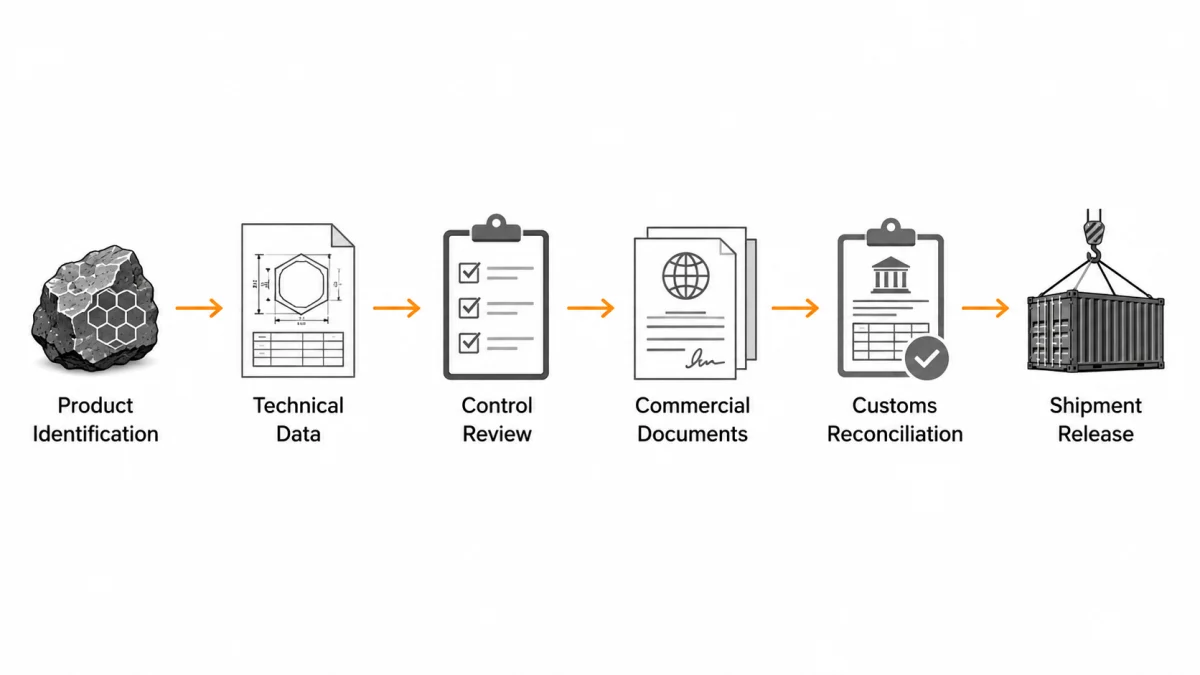
The six-stage control chain is: Product Identification → Technical Data → Control Review → Commercial Documents → Customs Reconciliation → Shipment Release. Each stage must close before the next stage becomes the controlling shipment record. A product-description change, technical-parameter change, destination change, party change, or final-use change returns the order to the relevant earlier review stage.
9. Support and Responsibility Boundary
Our team can support the transaction by collecting product information, reviewing manufacturing feasibility, organizing specifications and drawings, confirming quotation details, coordinating certificates and inspection records, planning packing, and reconciling commercial documents with the finished goods.
For flexible graphite and sealing-material inquiries, our team can review:
- plain or reinforced construction;
- stainless-steel insert, tanged metal, mesh, fiber, or other reinforcement;
- thickness, density, sheet size, roll width, and chemical limits;
- gasket-conversion or sealing application;
- packing, labels, certificates, and inspection requirements.
For machined graphite components, buyers can provide drawings, material requirements, actual property targets, quantities, inspection priorities, application details, and packing constraints. Our team can then prepare a controlled manufacturing and documentation file.
The legal and operational responsibilities remain separated:
- Exporter: performs item identification, applies for the required licence, keeps compliance records, and makes a truthful declaration.
- Customs declaration agent: acts within the authorization provided and submits the declaration and supporting documents.
- Competent commerce authority: reviews and decides the licence application.
- Customs: supervises the declaration and release of the goods.
- Buyer, importer, consignee, and final user: provide accurate company, destination, end-use, and end-user information and report changes.
- Our team: supports technical review, manufacturing coordination, document consistency, inspection evidence, packing, and communication without representing itself as the final legal decision-maker.
The global customer communication guide explains how open questions and revisions are tracked, while the production and delivery management article covers the handoff from technical approval to shipment.
10. Practical Inquiry Checklist
- What is the complete product name and material origin?
- Is it natural, synthetic, expanded, flexible, reinforced, composite, or anode material?
- What is the exact product form?
- What reinforcement, coating, binder, or additional material is present?
- Which actual technical values are available?
- What dimensions, drawing revision, quantity, and unit are required?
- What is the final application and specific final use?
- Who is the importer, consignee, intermediate trader, and actual final user?
- What is the destination country and final delivery address?
- Which certificates, reports, labels, marks, packing methods, and transport preferences are required?
- Has any product, destination, party, end user, or final-use information changed from the previous order?
A structured first inquiry helps our team separate manufacturing questions from export-control questions and prevents formal original documents from being requested before the relevant product classification is known.
11. Frequently Asked Questions
Which documents are normally required for a graphite export shipment?
The normal commercial set may include a contract or purchase order, commercial invoice, packing list, transport document, specification or drawing, certificate, inspection report, certificate of origin, and other customer or destination documents. A dual-use licence and end-user/end-use materials are additional requirements when the product and transaction fall within the applicable controlled route.
Does every graphite product require an export licence from China?
No. The decision depends on the exact controlled-item description, material, form, composition, technical parameters, destination, end user, and end use. Natural flake graphite and its products, qualifying synthetic graphite materials and products, and specified graphite anode materials require the applicable controlled-item review. The word “graphite” alone does not determine the answer.
Are reinforced graphite gaskets automatically outside every control requirement?
No. The official FAQ provides a specific graphite-item scope statement for metal- or fiber-reinforced graphite packing, gaskets, composite boards, wires, and rings. The actual product structure must match the statement. Other export-control, customs, destination, transport, or sanctions requirements may still apply.
Can artificial graphite powder be treated the same as graphite anode material?
No. The FAQ explanation concerning artificial graphite powder and flexural strength does not override the separate controls that apply to specified graphite anode materials. Product function and technical identity must be determined before the commercial description is fixed.
What should a commercial invoice describe?
Use a clear product description, model or part number where relevant, quantity, unit, unit price, total value, currency, seller, buyer/consignee, country information, and agreed delivery term. The description must align with the specification, packing list, certificate, licence where required, labels, and physical goods without disclosing unnecessary proprietary drawing detail.
Why are net and gross weight both required?
Net weight represents the goods; gross weight includes packaging. The two values support freight booking, customs declaration, cargo handling, and receiving control. Bag, carton, crate, pallet, product, and package totals must reconcile.
What information is needed for an export-control review?
Provide the exact product, material origin, composition, reinforcement, dimensions or form, actual technical parameters, quantity, destination, importer, consignee, final user, specific final use, and application. Supporting registration, relationship, end-use, technical, or identity documents may be requested where the route requires them.
How are repeat orders kept consistent?
Retain the approved product description, specification revision, named grade, actual property evidence, certificate format, package design, labels, invoice/packing-list structure, and item-identification basis. Any change in the product, parameters, destination, parties, final user, final use, or official rules triggers a new review before the previous document set is reused.
12. Official References
- MOFCOM, MIIT, GACC and State Cryptography Administration Announcement No. 51 of 2024 — Dual-Use Items Export Control List.
- MOFCOM and GACC Announcement No. 91 of 2025 — 2026 Catalogue of Dual-Use Items and Technologies Subject to Import and Export Licence Administration.
- MOFCOM and GACC Announcement No. 39 of 2023 — Graphite item export-control measures.
- China Export Control Information — Frequently asked questions on graphite dual-use items.
- China Export Control Information — Dual-use export licence application guidance.
- MOFCOM and GACC — Announcement No. 58 of 2025 covering specified battery cathode materials and graphite anode materials; implementation is suspended through November 10, 2026 under Announcement No. 70 of 2025.
- MOFCOM Announcement No. 46 of 2024 — paragraph 2 covers stricter U.S. end-user/end-use controls; Announcement No. 72 of 2025 suspends paragraph 2 through November 27, 2026.
- General Administration of Customs — Cargo Declaration Service Guide.
- USGS — Graphite Statistics and Information.
Official lists, catalogues, FAQs, declaration rules, and destination controls can change. The live official sources should be checked against the actual shipment before a release decision is recorded.
13. Conclusion
A reliable graphite export order is built in sequence: identify the product, collect actual technical data, perform the applicable control review, prepare the commercial documents, reconcile the customs and physical shipment records, and release only after all required approvals and documents are complete.
The decisive question is not whether a product is described as “ordinary,” “industrial,” “sealing,” “powder,” or “custom.” The decision depends on the actual material, structure, technical parameters, destination, end user, and final use. A clear order file also protects manufacturing quality because the drawing, grade, certificate, quantity, packing, labels, and commercial description remain linked.
Start the inquiry through the contact page with the quantity, buyer and consignee details, destination, intended use, required certificates, transport preference, and packing requirement. After we reply, send the controlled product specification, drawing, or other project files by email or another agreed secure channel. QDZRT Graphite will separate technical review, manufacturing control, export-control evidence, commercial documentation, and shipment reconciliation for the quotation process.