A maintenance team rarely chooses packing form from a datasheet alone. The difference becomes obvious when the stuffing box is opened: one solution arrives as preformed rings with a defined cross-section and joint arrangement, while the other arrives as braided packing that must be cut, fitted, compressed, and adjusted in the gland. Both can use flexible graphite as a sealing material, but the work required to install and keep them stable is not the same.
That is the useful way to compare graphite packing rings and braided packing. The question is not which form is “better” in the abstract. The question is which construction gives the maintenance team the most controllable fit, adjustment behavior, replacement process, and service record for the actual valve, pump, or other packed equipment. The broader graphite sealing guide for valves, pumps, and flanges explains why static flange joints and moving packed seals are different sealing jobs; this article stays inside the packing lifecycle.
China’s current standards also treat the forms as distinct products and test subjects. GB/T 29035-2022 covers test methods for flexible graphite packing rings, while JB/T 6617-2016 is the current technical-condition reference for flexible graphite packing rings. Braided flexible graphite packing is covered separately by JB/T 7370-2014. That separation is useful for purchasing: the buyer should identify the packing form, not send a generic request for “graphite packing.”
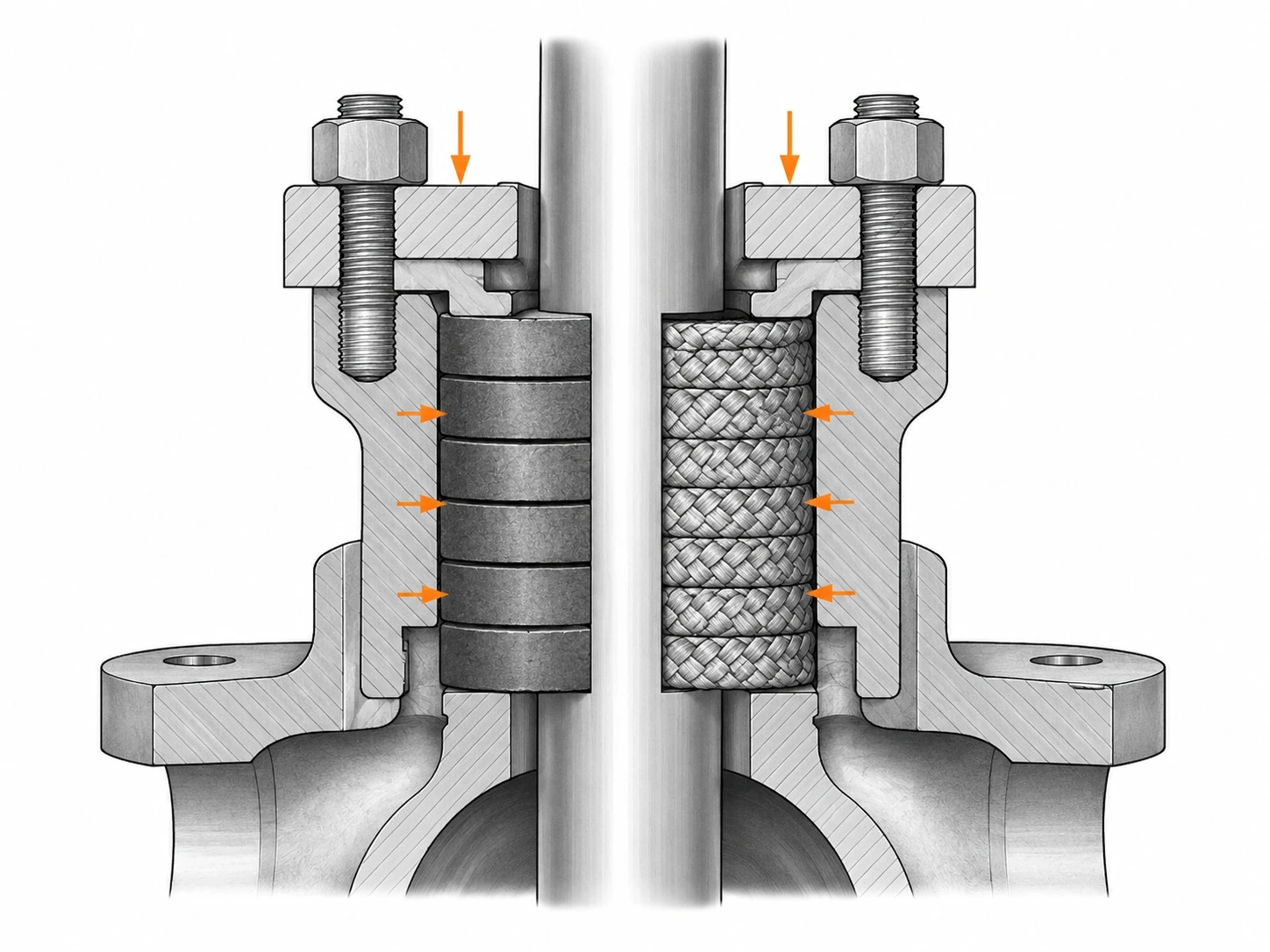
Construction: Preformed Rings vs Braided Packing
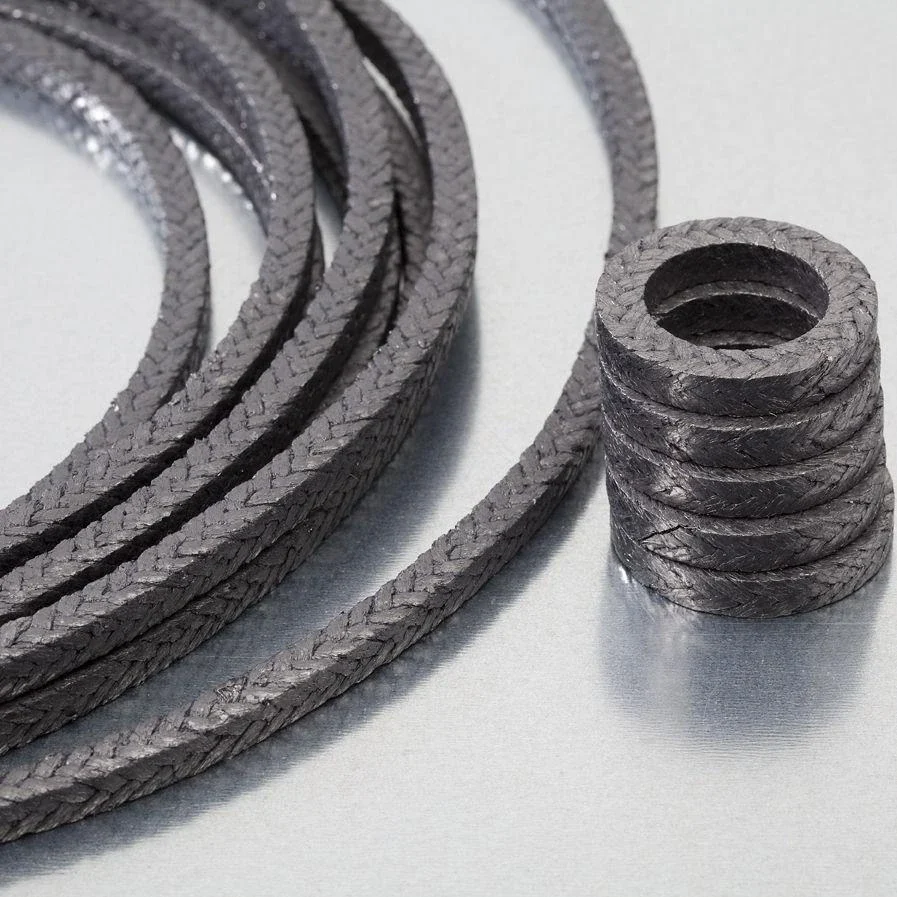
Preformed graphite rings arrive with the sealing cross-section and basic geometry already established, whereas braided packing arrives as a flexible length that becomes a set of rings only after cutting and installation. This construction difference determines how much geometry is controlled by the supplier and how much is created by the installer.

A preformed ring can be produced as a closed ring or as a split form that allows installation around a stem or shaft without full disassembly. The buyer still has to define the equipment dimensions and the required ring arrangement, but the cross-section, density state, and ring geometry can be controlled before the material reaches the maintenance site. That can be useful where repeated shutdown work benefits from a known replacement set rather than field fabrication.
Braided packing is more adaptable in the field. A maintenance technician can cut rings from a continuous length, fit them into the stuffing box, stagger joints, and build the set one ring at a time. That flexibility is valuable when equipment dimensions vary, drawings are incomplete, or the plant wants to stock a smaller number of packing sizes for several assets. The trade-off is that cut length, joint quality, ring seating, and initial compression depend more heavily on installation practice.
Construction also affects what “same size” means. A nominal cross-section for braided packing does not guarantee that an installed ring will occupy the gland exactly like a preformed ring of the same nominal dimension. Braiding structure, compressibility, cutting accuracy, and how strongly the installer seats each ring can change the installed condition. For a conversion from one form to the other, the packing-space geometry should be checked rather than assuming that the old purchase description can be copied.
| Lifecycle point | Preformed graphite rings | Braided graphite packing |
|---|---|---|
| Geometry before installation | Ring form and cross-section are established before delivery. | Final ring length and joint are created during installation. |
| Field adaptability | Depends on having the correct ring set for the equipment. | Continuous packing can be cut for different stuffing-box dimensions. |
| Installer influence | Focused on orientation, seating, ring sequence, and gland loading. | Includes cutting, joint preparation, seating, sequence, and gland loading. |
| Replacement inventory | Often managed by equipment-specific ring sets. | Can support broader maintenance stock when one cross-section fits several assets. |
Installation Time, Fit, and Packing-Gland Setup
Installation is usually more repeatable when the packing form reduces the amount of geometry that must be created at the equipment. Preformed rings do that work before shutdown; braided packing gives the installer more flexibility but also more decisions.
For a preformed set, the maintenance plan should confirm stem or shaft diameter, stuffing-box bore, available axial depth, ring count, ring orientation, and any end-ring or anti-extrusion arrangement used by the equipment design. A ring that is technically the correct material but does not fit the actual box creates the wrong starting condition. For split rings, joint location and staggering also remain installation variables.
With braided packing, cut length becomes part of the installation quality. Rings cut too short can leave an excessive joint gap; rings cut too long can bunch or create a locally over-compressed joint. The technician also has to seat each ring instead of loading the entire set as one loose stack. If several rings are inserted before the earlier rings are properly seated, the apparent gland position can be misleading because compression is concentrated near the follower.
The gland is part of the sealing system, not merely a device that tightens the packing. Stem or shaft condition, box concentricity, follower alignment, available follower travel, and the cleanliness of the packing space affect how evenly load reaches the rings. A form change cannot correct a damaged stem, a misaligned follower, or a gland that has run out of adjustment.
Shutdown planning is therefore different. Preformed rings can reduce cutting work and simplify preparation when the correct set is already identified. Braided packing can reduce dependence on equipment-specific inventory but requires suitable cutting tools, a ring-cutting method, and technicians who know the intended joint and seating sequence. The economic comparison should include shutdown time, adjustment work, replacement labor, and material price.
Adjustment and Run-In Behavior
Initial adjustment should create enough controlled packing load to establish sealing without treating maximum gland compression as the objective. The required run-in behavior depends on equipment motion, packing construction, surface condition, and the way the installed set redistributes load.
Preformed rings begin from a more defined geometry, but that does not mean they need no run-in observation. The set can still settle as the rings conform to the stem or shaft and as load redistributes through the stack. A maintenance record should note initial gland position, leakage observation, any permitted adjustment, and the condition after the equipment reaches its normal operating state.
Braided packing can show more installation-dependent settling because each ring was cut and seated in the field. A set that was inserted with uneven ring seating may require more follower movement during early operation, while a carefully installed set can stabilize with much less correction. This is one reason the first adjustment should not be used as the only comparison between packing forms.
Frequent tightening is a diagnostic signal, not a normal maintenance strategy to repeat indefinitely. If the follower continues moving while leakage or friction behavior does not stabilize, the team should investigate ring fit, stem condition, packing damage, wrong construction, thermal effects, or a process condition outside the qualified service envelope. Continually adding gland load can hide the original problem until follower travel is exhausted or the moving surface is damaged.
When a plant evaluates two packing forms, the run-in record should use the same equipment and observation logic. Record the installation date, packing construction, ring count, gland position, adjustment events, leakage observations, operating changes, and the reason for removal. That turns a subjective statement such as “this packing needed more tightening” into evidence that can support the next purchase decision.
Maintenance, Re-Tightening, and Replacement
The maintenance burden of a packing form is the total work required from installation through final removal, including adjustment frequency, access time, spare-part control, and the ability to restore the equipment to a known condition. Purchase price alone does not measure that burden.

Preformed ring sets can simplify repeat maintenance when assets are standardized and the correct ring specification is controlled. The maintenance store can issue a labeled set against an equipment number, reducing field measurement and cutting. That approach becomes less attractive if the plant has many legacy boxes with undocumented dimensions or if equipment has been repaired with nonstandard clearances.
Braided packing is operationally flexible because one coil can serve several planned jobs within the same cross-section. It also allows the technician to replace the full set without waiting for a custom ring set, provided the packing construction and service suitability are already qualified. The cost is more field workmanship and more opportunity for variation between technicians or maintenance shifts.
Re-tightening should be recorded as an event with a reason. A small planned correction during stabilization is different from repeated emergency tightening to control deteriorating leakage. If the latter becomes routine, the plant should stop comparing packing by unit price and compare the complete history: number of adjustments, labor hours, shutdown exposure, damage found at removal, and whether the next installation required stem or box repair.
Replacement difficulty also matters. Preformed split rings may be easier to install around equipment that cannot be fully disassembled, while removal can depend on how the rings have consolidated in service. Braided rings may be individually extracted, but a poorly cut or heavily compacted set can also be difficult to remove. The maintenance procedure should include extraction tools and inspection of the packing space before the new material is installed.
Failure Clues and What They Say About the Packing Form
Failure clues should be used to distinguish a packing-form problem from an installation, equipment, or service problem. Changing from braided packing to preformed rings—or the reverse—without identifying the failure mechanism can reproduce the same problem in a different construction.
A visible joint gap, unevenly cut ends, twisted rings, or inconsistent ring seating points toward field fabrication or installation control. Those clues are more directly associated with braided packing because its final rings are created at the equipment. The corrective action may be a better cutting fixture, a defined cut method, separate seating of each ring, or clearer training rather than a new material.
Crushed rings, severe local compaction, a follower that is visibly out of square, or damage concentrated on one side of the set points toward load distribution or alignment. Preformed rings do not eliminate those problems. A precisely manufactured ring can still fail if the gland applies load unevenly or if the stem is eccentric.
Scoring, deposits, corrosion products, or dimensional damage on the stem or shaft can make any packing form difficult to seal. The removed packing should therefore be inspected together with the hardware. A leakage event that is logged only as “packing failed” loses the information needed to prevent recurrence.
Thermal or chemical degradation requires the same discipline. If the service environment raises questions about sulfur or other chemistry in flexible graphite, the buyer should treat that as a material specification issue rather than assuming packing form resolves it. The low-sulfur flexible graphite specification guide separates chemistry requirements from the mechanical form of the seal.
| Observed clue | First question | Do not assume |
|---|---|---|
| Large or inconsistent ring joints | Was cutting and ring sizing controlled? | That graphite chemistry is the cause. |
| Frequent follower adjustment | Is the set settling normally, or is fit/load distribution wrong? | That more tightening will solve the root cause. |
| One-sided damage | Are stem, box, and follower aligned? | That a preformed ring automatically corrects alignment. |
| Scored moving surface | What is the hardware condition and friction history? | That leakage alone identifies packing quality. |
| Chemical or thermal deterioration | Was the material specification matched to service? | That ring versus braid is the main variable. |
Compare Total Maintenance Burden, Not Only Purchase Price
The economically preferable packing form is the one that produces the lower controlled maintenance burden for the asset group, not necessarily the lower price per kilogram or per ring. The calculation should include preparation, installation, adjustment, shutdown exposure, inventory, repeatability, and replacement work.
A plant with many identical critical valves may benefit from equipment-specific preformed ring sets because inventory can be tied to an asset list and installation steps can be standardized. A maintenance contractor working across mixed legacy equipment may value braided packing because it reduces the number of exact ring sets that must be carried. Neither case establishes an overall winner; it changes which cost dominates for that installation.
Inventory obsolescence is another variable. Preformed sets can become stranded if equipment is modified or a drawing dimension was wrong. Braided packing can be more flexible across assets, but a broader stock policy can also create mistakes if different braid constructions or service grades look similar. Identification and lot control remain necessary in either case.
The buyer should also separate expected maintenance work from failure cost. If one packing form consistently reduces installation variability on a critical asset, the value may be far larger than the material-price difference. Conversely, if preformed rings require frequent custom orders for low-criticality equipment that technicians already maintain reliably with braided packing, the extra logistics may add no useful control.
A controlled trial can compare the forms on selected equipment. Keep the service, hardware condition, maintenance procedure, and inspection record as consistent as practical. Base the maintenance decision on repeated observations across the run, not on a single leakage comparison.
Specify the Packing Form in the RFQ
A packing RFQ should identify the form explicitly and include the equipment dimensions, material construction, ring or coil requirements, service information needed for qualification, required test or certificate fields, packaging, and the change-control information the buyer expects. “Graphite packing” is too broad for repeat purchasing.
For preformed rings, the RFQ should state the ring dimensions and whether the set is closed or split, the required number of rings, any differentiated end-ring arrangement, and how the set should be identified and packaged. Where the purchase specification relies on flexible graphite ring properties, the current Chinese references include GB/T 29035-2022 for testing and JB/T 6617-2016 for technical conditions. The purchase order should still state the buyer’s actual acceptance requirements rather than assuming that citing a standard automatically defines the project.
For braided packing, identify the packing construction and cross-section, the required supply length or package form, and the service conditions that determine material suitability. JB/T 7370-2014 provides a current Chinese industry reference for flexible graphite braided packing, but the buyer still needs to define the equipment and application requirements.
Use the following lifecycle checklist when the plant has not yet decided which form to standardize:
- Equipment geometry: confirm stem or shaft size, stuffing-box bore, axial depth, and follower travel.
- Maintenance model: decide whether equipment-specific kits or field-cut stock better fit the asset population.
- Installation control: define cutting, joint, seating, ring sequence, and gland setup where they apply.
- Run-in record: record initial condition and every adjustment rather than relying on memory.
- Failure inspection: inspect removed packing together with the stem, shaft, box, and follower.
- Inventory control: identify construction, size, lot, and service grade so visually similar packing is not mixed.
- Change control: require notice when construction or material changes could affect the qualified packing set.
That lifecycle view makes the comparison useful. Preformed graphite rings move more geometry control to the supplier; braided packing keeps more fitting flexibility at the maintenance site. The right choice is the one that gives the plant a repeatable seal with a maintenance process it can actually control.
References and Sources
- National Standard Information Public Service Platform — GB/T 29035-2022, Test method for flexible graphite ring.
- National Standard Information Public Service Platform — JB/T 6617-2016, Technical conditions for flexible graphite packing rings.
- National Standard Information Public Service Platform — JB/T 7370-2014, Flexible graphite braided packing.