Low-sulfur flexible graphite should be specified as a material-compatibility control, not as a marketing adjective. A buyer ordering sheet, gasket material, or valve-sealing material needs to know which sulfur result the supplier is reporting, which method produced it, why the service is sensitive, and whether sulfur is the only chemistry field that matters.
China now has a current industry method dedicated to flexible graphite halogen and sulfur analysis. JB/T 15079-2025, Test methods for fluorine, sulfur and chlorine content of flexible graphite sheets, was published in 2025 and replaced the earlier separate industry methods for fluorine, sulfur, and chlorine. GB/T 33920-2025, Test method for flexible graphite sheets, is also a current national method reference covering flexible graphite sheet properties. The existence of a method does not create one universal sulfur limit for every valve or process application.
Mechanical sealing geometry is covered in the flange, valve-stem, and pump-shaft sealing guide. Here the scope is narrower: converting sulfur sensitivity, test method, material identity, and service context into a traceable flexible-graphite purchase requirement.
Why Sulfur Becomes a Material-Compatibility Question
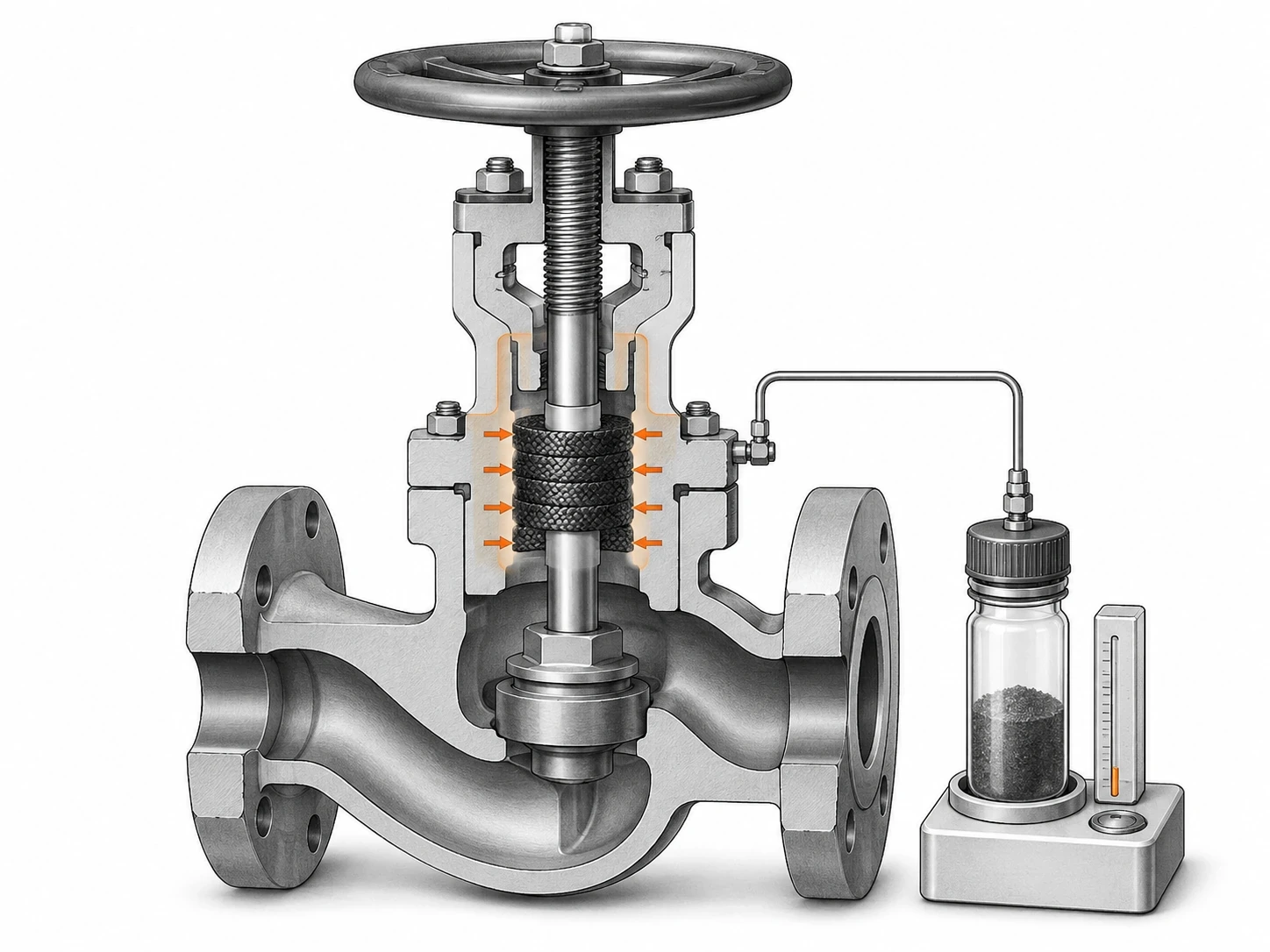
Sulfur becomes a material-compatibility question when the graphite is in contact with metallic components, process media, heat, moisture, or another environment in which sulfur-containing species can contribute to corrosion or contamination risk.

The risk is not created by the word “graphite” alone. It depends on the graphite chemistry, the metal or alloy in contact with it, the service temperature, pressure, medium, presence of moisture or oxidizing conditions, exposure time, and the design of the sealing interface. A sulfur result therefore needs a service reason before it becomes a contractual limit.
In valves and process equipment, the graphite component may be inexpensive compared with the equipment and downtime around it. That justifies careful chemistry control, but not an arbitrarily low sulfur limit.
Start from the failure mechanism. Is the concern corrosion of a particular metal? Contamination of the process? Customer or end-user specification? Nuclear, chemical, refining, or another controlled-service requirement? The answer determines whether sulfur should be a release field, a monitored field, or part of a broader chemistry package.
Note: “Low sulfur” is meaningful only when the buyer knows which sulfur result, which test basis, and which service risk the limit is intended to control.
Clarify Which Sulfur Result the Supplier Is Reporting
Define the sulfur result by the property and method used to produce it; two certificates labeled “sulfur” may not be comparable if their analytical bases differ.
Before comparing grades, ask whether the supplier is reporting total sulfur or another method-defined sulfur result, whether the value is a specification limit or a lot-specific result, and which standard or validated internal method is used. If the buyer’s historical qualification used an older method and the supplier has moved to a newer one, the numerical relationship may need to be bridged.
JB/T 15079-2025 is important because it consolidates current industry test methods for fluorine, sulfur, and chlorine in flexible graphite sheet. A buyer can reference the current method where applicable, but the practical requirement remains method continuity. A production limit set under one analytical procedure should not be transferred blindly to another without understanding comparability.
Reporting format matters as well. “≤ limit” tells the buyer the specification, while an actual measured lot result tells the buyer where the tested sample sits relative to that limit. For controlled applications, the COA should make the distinction clear.
Caution: Do not compare two suppliers by sulfur number until the methods and reporting bases are comparable. A lower-looking value from a different method may not represent a genuinely lower-sulfur material.
Link the Sulfur Requirement to the Service Environment
Tie the sulfur requirement to the real contact system: graphite, metal or alloy, process medium, temperature, and operating conditions.

For a valve body, bonnet, stem, flange, or process-equipment joint, identify the metals and alloys that can contact the flexible graphite. Then identify the process medium and whether the service is wet, dry, oxidizing, reducing, or otherwise chemically active. Temperature and thermal cycling can change both graphite behavior and corrosion mechanisms.
Also distinguish continuous exposure from short upset or start-up conditions; the chemistry requirement should reflect the service being protected.
Customer and regulatory specifications take priority where they exist. If an end user has already defined a sulfur requirement, preserve the requirement and method reference in the RFQ. If the buyer is developing an internal limit, document the failure mechanism, historical material, test evidence, or other basis used to set it.
Avoid universal statements such as “all stainless-steel valves require sulfur below X ppm.” The appropriate threshold depends on alloy, environment, method, and application-specific evidence. Where no verified basis exists, treat the requested level as a qualification target rather than an industry rule.
The same principle applies when low-sulfur graphite is being used outside valves, such as process-equipment gaskets, heat exchangers, chemical piping, or other sealing systems. The material requirement follows the contact system and the consequence of failure.
Do Not Ignore Other Chemistry or Metal Compatibility Factors
Sulfur should not be specified in isolation when other chemistry fields or material interactions can create a comparable corrosion or contamination risk.
Chlorine and fluorine are obvious related fields because current flexible-graphite methods address them alongside sulfur. Ash, other impurities, residual processing species, and metal compatibility may also matter depending on the application. The buyer should control the fields that have a plausible mechanism rather than building a long chemistry panel without reason.
For a corrosion-sensitive service, the reinforcement material can also matter. A reinforced flexible graphite sheet introduces a metal insert whose composition and condition may affect the overall compatibility of the gasket construction. The reinforced graphite sheet comparison explains the structural difference between foil and tanged inserts; chemistry-sensitive service should keep reinforcement metal as a separate RFQ field.
Oxidation is another separate question. Low sulfur does not guarantee oxidation resistance at elevated temperature in air or another oxidizing atmosphere. Likewise, high purity does not automatically guarantee compatibility with every process medium. Keep sulfur, halogens, oxidation conditions, and service design as distinct controls.
| Risk question | Possible control field | Why it should remain separate |
|---|---|---|
| Sulfur-related corrosion or customer restriction | Method-defined sulfur result | Targets the documented sulfur mechanism. |
| Halogen-related compatibility | Fluorine / chlorine where relevant | Different species can create different risks. |
| General non-carbon residue | Ash or broader chemistry evidence | Total residue does not identify sulfur or halogens. |
| Reinforcement compatibility | Metal insert identity | Graphite chemistry does not define the metal layer. |
| Oxidizing high-temperature service | Service-specific material/design qualification | Low sulfur alone does not establish oxidation performance. |
Sampling, Test Method, and Lot Evidence
Sampling, test method, and lot evidence determine whether the reported sulfur result represents the delivered flexible graphite rather than one laboratory portion selected without a clear plan.
Define the production lot and the relationship between the lot, sample, test certificate, and delivered sheet or roll. If the order contains several rolls or sheet stacks, the buyer should know whether the supplier’s test represents one production batch, a composite, or another defined sampling unit.
Contamination during sampling also deserves attention when the chemistry limit is tight. Tools, containers, dust, hands, packaging, and laboratory preparation can introduce material that was not part of the original graphite. Use clean sampling and preparation practices appropriate to the control level.
Retained samples are useful for disputes and trend analysis. If a later test produces a different result, the buyer and supplier can recheck the retained production material instead of relying only on paperwork. The retained sample should be identified clearly enough to connect it to the original lot.
Method changes require formal review. JB/T 15079-2025 replaced earlier separate flexible-graphite methods for sulfur, chlorine, and fluorine. Where a long-running specification was established using an older method, a buyer should compare historical and new results before moving the numerical limit unchanged into a revised purchase specification.
Trend sulfur results only on a stable method and sampling basis. A steady move toward the edge of the qualified window can justify investigation before a formal failure.
Incoming inspection should mirror the risk level. For routine industrial service, the supplier’s lot certificate and periodic buyer verification may be sufficient if the process is stable. For critical service, the buyer may require more frequent confirmation, retained samples, or independent verification. The inspection burden should follow consequence and history rather than a fixed rule applied to every graphite order.
Keep chemistry qualification separate from sealing qualification. Stable sulfur and halogen control does not prove sheet construction or gasket performance, and a successful sealing trial does not prove long-term chemistry compatibility.
When a field complaint occurs, preserve chronology. Record the graphite lot, gasket or packing batch, installation date, service medium, operating history, metal surfaces, and observed damage. Re-test chemistry only as part of that evidence chain. A sulfur result without the service history cannot by itself establish the root cause of corrosion or leakage.
Write a Low-Sulfur Flexible Graphite Purchase Specification
A low-sulfur flexible graphite purchase specification should state material identity, sulfur test basis, service reason, related chemistry controls, lot evidence, construction, and change-control requirements without pretending that one chemistry number guarantees sealing performance.
Start with the product form. Is the buyer ordering unreinforced flexible graphite sheet, reinforced sheet, a cut gasket, a packing ring, or another graphite sealing form? Then state thickness, density or other qualified physical properties, dimensions, and reinforcement structure where applicable.
Next write the chemistry section. Identify the sulfur property and test method, the approved limit or qualification target, and whether a measured lot result must appear on the COA. Add fluorine, chlorine, ash, or another chemistry field only if the service or customer requirement justifies it.
Then define evidence. Require lot identification, test certificate, sampling basis where needed, retained-sample expectation for critical programs, and supplier notification before significant changes to raw material, purification, graphite processing, reinforcement, or analytical method.
Example: A strong RFQ does not say only “low-sulfur graphite sheet.” It identifies flexible graphite form + reinforcement construction if any + physical properties + method-defined sulfur requirement + application-relevant halogen/chemistry fields + lot-specific COA + service context + change notification.
For first qualification, request enough material to run both chemistry confirmation and the real gasket or valve-related evaluation. The chemistry result shows whether the graphite meets the incoming control. The gasket or sealing test shows whether the complete construction works in the intended design. Keep those responsibilities separate.
When requesting material from QDZRT Graphite, provide the flexible graphite form, sheet or gasket dimensions, reinforcement if any, current sulfur requirement and method, other chemistry restrictions, valve/process-equipment service context, metallic contact materials where relevant, sample quantity, and the customer or internal specification basis. If the sulfur target is exploratory, state that clearly.
A practical final checklist is:
- Product form and construction are defined.
- Sulfur property and test method are named.
- The limit is tied to a customer, service, or qualification basis.
- Fluorine, chlorine, ash, and other chemistry fields are added only where relevant.
- Metal reinforcement or contact-material compatibility is not hidden inside the sulfur requirement.
- Lot sampling and COA reporting are traceable.
- Method changes trigger review before historical limits are reused.
- Supplier changes that could alter chemistry or construction require notification.
- Sealing performance remains a separate gasket/valve qualification question.
With the method, service basis, construction, and lot evidence defined, the sulfur value becomes one part of a compatibility specification rather than a marketing label.
For repeat supply, keep the approved chemistry method, service basis, and construction linked so the sulfur number is not preserved while the product around it changes.
Low-sulfur programs should also define what happens when the analytical result is close to the acceptance limit. The buyer can require a repeat test on a representative retained sample, confirmation by the agreed method, or temporary containment while the result is reviewed. This is stronger than making an immediate root-cause claim from one borderline measurement. The repeat decision should be documented so supplier and buyer handle future borderline lots consistently.
Where a process-equipment owner specifies several chemistry limits at once, keep each requirement tied to its own reason and method. Sulfur, chlorine, fluorine, ash, and reinforcement metal identity may all appear in the same purchase specification, but they are not interchangeable indicators of “cleanliness.” A material can pass one field and fail another. The specification should therefore preserve the individual evidence rather than collapse the chemistry package into a generic “high-purity” or “low-corrosion” label.
Use independent chemistry confirmation during initial qualification, after relevant supplier changes, or when service history justifies it; the frequency should follow risk rather than a universal schedule.
Sampling also belongs in the chemistry specification. If the lot is large or supplied in multiple rolls, sheets, or packages, define whether the reported sulfur result comes from one production sample, a composite, or another agreed sampling plan. Retain enough identified material for a repeat determination when practical. This gives both parties a controlled way to investigate a borderline or disputed result without relying on a new sample taken after the original lot has been consumed.
References and Sources
- National Standard Information Public Service Platform — JB/T 15079-2025, Test methods for fluorine, sulfur and chlorine content of flexible graphite sheets. Current Chinese industry method, effective 1 November 2025.
- National Standard Information Public Service Platform — GB/T 33920-2025, Test method for flexible graphite sheets. Current Chinese national flexible-graphite-sheet test reference.