Two expandable graphite grades can have similar expansion response and particle size while carrying different sulfur requirements. That does not make the lower-sulfur grade automatically better. Sulfur becomes a meaningful purchase parameter only when the application, customer specification, downstream process, corrosion or contamination assessment, or qualification plan gives the limit a technical reason.
“Low sulfur” is only a starting label. A purchase specification still needs the sulfur result being controlled, the acceptance limit, the test method, and the sampling basis. Without those fields, two suppliers can use the same label for results that are not directly comparable.
China’s current national product standard is GB/T 10698-2023, Expansible graphite, effective since 1 July 2024. A buyer should use the current standard rather than a withdrawn predecessor, then add any application-specific sulfur requirement that is needed for the project.
Where Sulfur Becomes a Design or Qualification Constraint
Sulfur becomes a design or qualification constraint when a defined failure mechanism or customer requirement can be connected to the sulfur level in the supplied expandable graphite. The limit should follow that mechanism rather than a general preference for the smallest possible number.
One project may control sulfur because the graphite or its expanded product will contact a corrosion-sensitive metal. Another may have a contamination budget for a downstream material. A fire-protection formulation may need to control residual chemistry because it affects the surrounding binder or the gases released during heating. A customer specification may impose a maximum regardless of the supplier’s normal grade structure. These are different reasons, and they may lead to different acceptance limits and test methods.
Before setting the limit, identify why sulfur is controlled. A customer drawing or material specification should be preserved by source and revision. A corrosion or compatibility requirement should be tied to the relevant medium, temperature, contact material, and supporting evidence. An internal target should state whether it is used for qualification or routine lot release.
Do not use a low-sulfur requirement to compensate for an unrelated problem. A coating with poor dispersion will not be corrected by tightening sulfur. A foam with an unsuitable particle-size distribution will not become process-stable because the sulfur value is lower. Expansion volume, particle size, sulfur, activation temperature, moisture, ash, and other chemistry fields are independent controls that have to be connected to the application separately.
The expandable graphite selection guide provides the broader four-parameter framework. The low-sulfur decision begins only after the project has established that sulfur is one of the variables that can affect acceptance.
What the Reported Sulfur Result Actually Represents
A sulfur result is only comparable when the specification identifies what was measured and how the sample was prepared. A unit such as ppm or mass percent does not resolve differences in analytical basis.
A buyer may receive sulfur reported as a mass fraction, a ppm value, or another equivalent expression. Before comparing suppliers, convert the units to one basis and confirm that the analytical method is comparable. More importantly, verify that the method measures the sulfur form relevant to the requirement. A total sulfur result should not be casually treated as equivalent to a soluble sulfate result, an extractable-ion result, or another chemistry measurement unless the methods and purpose support that comparison.
The material condition also matters. Expandable graphite is an intercalated product derived from natural graphite. Washing, drying, intercalation chemistry, raw-flake condition, and later processing can influence the residual chemical profile. If the buyer tests unexpanded material while the application requirement was originally defined for an expanded or converted product, the purchase specification must explain how those two conditions are related.
China’s national standard revision project for expandable graphite publicly documented sulfur as one of the characteristics considered during the revision process. The official project page also described adding a sulfur measurement method to the revised framework. The final contractual requirement should still be based on the current published standard and the actual purchase specification, not on a draft-project explanation or an old supplier data sheet.
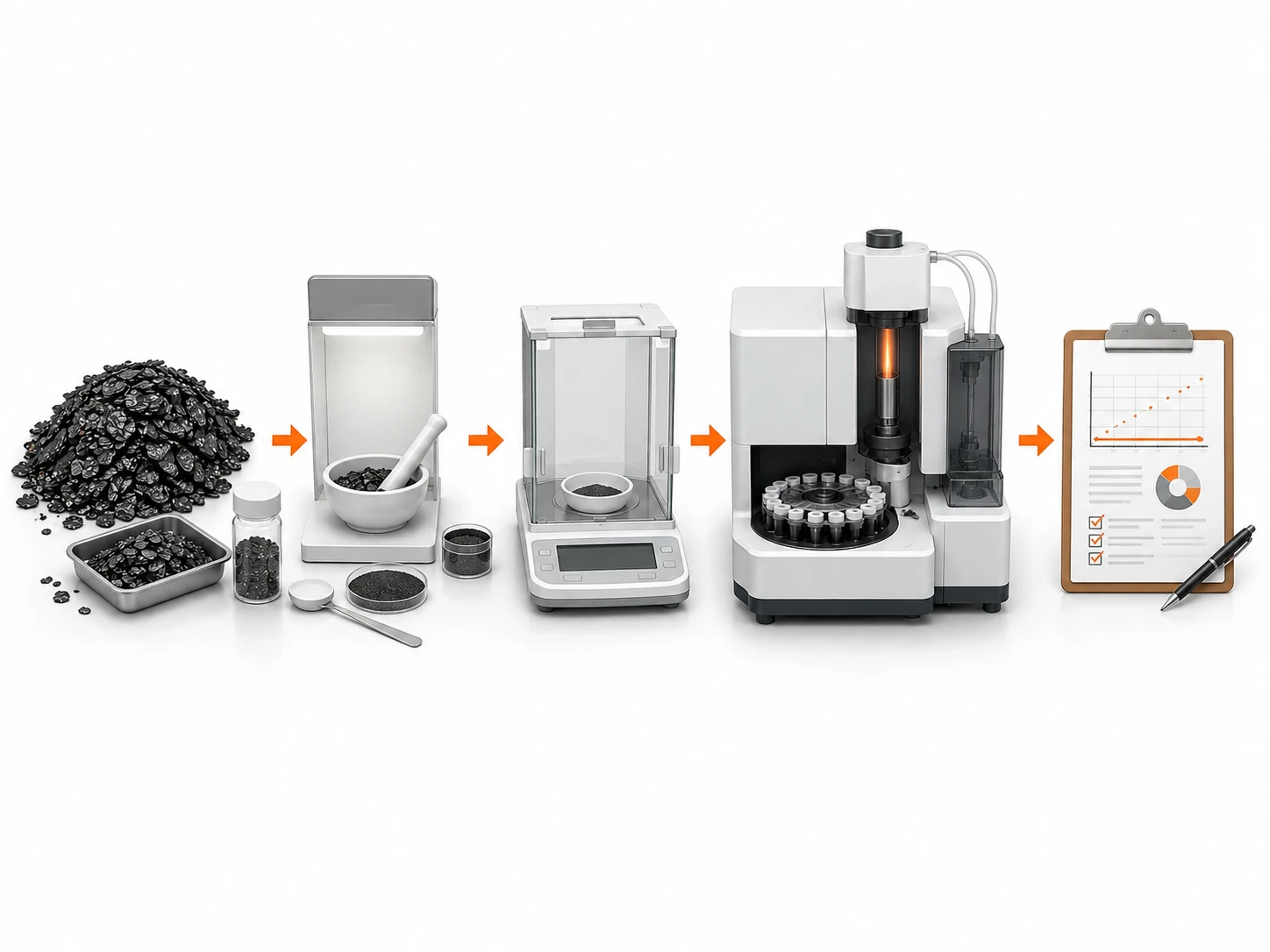
For a sulfur-sensitive order, the COA field should therefore contain more than “S: pass.” It should identify the result, unit, method or agreed method reference, and the lot represented by the test. If a third-party laboratory is used, the report should show the sample identity and method so that the result can be reconciled with the supplier’s lot certificate.
Separate Application Limits from Generic Grade Labels
An application limit is a contractual acceptance requirement; a generic label such as “low sulfur” is only a product-family description until a limit and method are attached. The two should not be used interchangeably.
This distinction is especially important in China because low-sulfur expandable graphite has appeared in different historical standards, research programs, supplier categories, and downstream applications. A buyer searching old documents may find a number that was appropriate to a specific standard or technology project and then copy it into a modern RFQ without checking whether the document is still current or whether the limit applies to the new use.
For example, Heilongjiang previously published DB23/T 2067-2018, “Technical conditions for low-sulfur high-oxidation-resistance expandable graphite,” followed by DB23/T 2067—2019, a processing technical specification. The National Standard Information Public Service Platform now marks both local standards as withdrawn, with a withdrawal date of 26 May 2025. They can provide historical industry context, but they should not be represented as current mandatory specifications in a 2026 purchase order.
The current buyer should instead identify the applicable national standard, customer requirement, or validated internal limit. If a legacy value remains technically necessary because an existing product was qualified against it, document that as a customer or internal requirement rather than describing the withdrawn standard as current.
| Source of sulfur limit | How to use it | Common error |
|---|---|---|
| Current national/product standard | Use the current version and confirm the applicable requirement and method. | Quoting a superseded edition. |
| Customer specification | Record document number, revision, unit, method, and product condition. | Copying only the number into an RFQ. |
| Application qualification | Connect the limit to the tested formulation, component, or service condition. | Treating one successful project as an industry-wide threshold. |
| Legacy standard or historical project | Use as background only unless the buyer explicitly preserves the legacy requirement. | Calling a withdrawn document “current standard.” |
| Supplier grade label | Ask for the actual sulfur result and test basis. | Assuming “low sulfur” means the same value across suppliers. |
Sampling and Test Method Must Travel with the Limit
An acceptance limit is enforceable only when the lot, sample, preparation, and analytical method are defined. Otherwise a precise-looking number can still produce non-equivalent release decisions.
Start with the lot. Define whether the certificate represents one production batch, a blended lot, one bag, or a composite sample from several packages. If a shipment combines several production lots, the quality agreement should state whether each lot requires its own result. A composite certificate can hide a high result in one portion if averaging is allowed without a defined sampling rule.
Sample collection should consider segregation and package size. Flake materials can separate during filling, vibration, transport, and handling. A surface sample may not represent the complete package. The sampling procedure does not need to be elaborate, but it should be repeatable and appropriate to the lot size and the consequence of a false pass.
Then define sample preparation. Drying condition, grinding or size reduction, sample mass, contamination from tools, and storage before analysis can affect some measurements. The analytical method should be appropriate to the material and the sulfur definition being controlled.
A 2024 method-coverage page published by the Jixi municipal government for its graphite product testing center illustrates why method scope deserves attention. Its expandable-graphite section lists expansion volume, ash, moisture, volatile matter, sieve residue, and pH, but it still references the older GB/T 10698-1989 and GB/T 3520-2008 methods. Those editions have since been replaced by current standards. A 2026 RFQ should therefore verify the current method and product-standard version instead of copying an older laboratory capability list unchanged.
When supplier and buyer laboratories use different methods, do not resolve a disagreement by averaging the two results. First confirm sample identity, units, calibration basis, sample preparation, method scope, and repeatability. If the methods are not equivalent, agree on a referee method before using the result for rejection.
Write Sulfur Requirements into the RFQ and COA
A good sulfur requirement appears consistently in the RFQ, approved specification, COA, incoming-inspection record, and change-control plan. If the wording changes between those documents, the buyer and supplier can be testing different requirements without realizing it.
| Field | Recommended content | Reason |
|---|---|---|
| Product identity | Expandable graphite product family / approved grade and lot | Connects the sulfur result to the delivered material. |
| Sulfur property | Clearly named sulfur result | Prevents confusion with sulfate or other chemistry fields. |
| Limit | Buyer-approved maximum or range, with unit | Creates an enforceable acceptance criterion. |
| Method | Current agreed standard or laboratory method | Makes results comparable. |
| Sample basis | Per lot / composite / agreed sampling plan | Defines what the result represents. |
| Reporting | Actual measured result, not only “pass” where practical | Supports trend review and supplier comparison. |
| Change notification | Changes to raw material, intercalation chemistry, washing, or other risk-relevant process | Protects the qualification from silent changes. |
The COA should not create a new definition. If the RFQ states sulfur in ppm under one method, the certificate should not report a percentage produced by another method without an agreed conversion and method relationship. If the customer requires both sulfur and sulfate or another ionic result, list them as separate characteristics.
Trend data can be useful even when every lot passes. A gradual movement toward the limit can signal a process shift before a rejection occurs. Trend review should use comparable methods and comparable material condition; mixing results from different analytical procedures can create a false trend.
For first qualification, keep sulfur connected to the application trial. Record the lot and sulfur result of the material that was actually used. If a later lot has a lower sulfur result but a different particle distribution or expansion response, do not assume it is an automatic equivalent. Low sulfur is one controlled characteristic, not the grade identity.
When a Tighter Sulfur Limit Adds Cost Without Adding Value
A tighter sulfur limit adds value only when it reduces a defined application risk; otherwise it can increase process burden, testing, yield loss, or qualification complexity without improving the finished product. The lowest available number is not automatically the optimum purchase target.
Tightening a limit may require a different intercalation route, additional washing, tighter raw-flake control, more frequent testing, segregation of production lots, or extra qualification work. The exact manufacturing effect depends on the process, so a buyer should not assume a universal price premium. The commercial question should be whether the tighter limit changes the validated risk enough to justify those controls.
Use a simple decision sequence. If there is a current customer or regulatory requirement, meet that requirement with the stated method. If an application study establishes a maximum linked to corrosion, contamination, or compatibility, use that validated limit. If the project has no sulfur-sensitive mechanism, keep sulfur within the appropriate product-standard and supplier-control framework rather than inventing a tighter number for appearance.
If two candidate grades both meet the validated sulfur requirement, choose between them using the parameters that actually separate their application performance: expansion response, activation window, particle-size distribution, moisture, other chemistry, processing stability, lot consistency, and total qualification evidence.
For an inquiry, send the intended application, sulfur limit if one already exists, unit, test method if specified, the source of the requirement, required expansion response, particle-size definition, sample quantity, and the trial or incoming test that will confirm suitability. That information turns “low sulfur” into a measurable project requirement instead of an undefined marketing claim.
Before tightening the limit, confirm that the agreed method can resolve it reliably. Review sample preparation, repeatability, reporting basis, and the decision rule near the acceptance boundary. A limit that is narrower than the measurement system can support will create disputes without improving application control.
If supplier and buyer results disagree, first confirm that both laboratories tested comparable material from the same lot and used equivalent conditioning, preparation, units, and methods. A retained sample or agreed referee laboratory is more useful than averaging non-equivalent results.
Qualification cost also matters. If the current limit already protects the application, tightening it can add testing, sourcing, and requalification cost without improving performance. The decision should balance the consequence of sulfur-related failure against the evidence behind the limit, normal lot variation, and test uncertainty.
Once the limit is validated, supplier changes that can plausibly affect sulfur—such as raw-flake source, intercalation chemistry, or washing route—should trigger a proportionate review. Depending on the risk, that may be a certificate check, targeted chemistry test, or repeat application trial rather than a full requalification.
References and Sources
- National Standard Information Public Service Platform — GB/T 10698-2023, Expansible graphite. Current Chinese national product standard, effective 1 July 2024.
- National Standard Information Public Service Platform — revision project for GB/T 10698. Used only for public revision-history context, including the project’s discussion of sulfur control and method updates; the final published standard governs current use.
- National Standard Information Public Service Platform — DB23/T 2067-2018. Historical Heilongjiang low-sulfur expandable-graphite technical condition; shown by the official platform as withdrawn on 26 May 2025.
- National Standard Information Public Service Platform — DB23/T 2067—2019. Historical processing specification; shown as withdrawn on 26 May 2025.