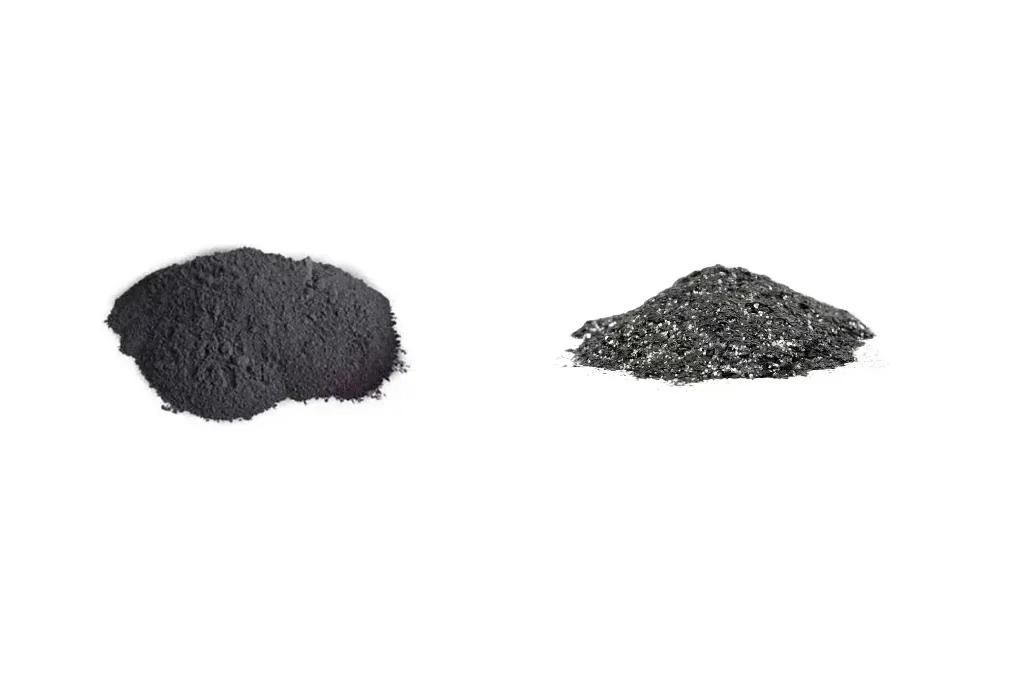
Natural graphite powder and synthetic graphite powder can both provide carbon, lubricity, electrical functionality, thermal behavior, or a solid filler phase, yet they are not interchangeable simply because the certificate shows a similar fixed-carbon value. Feedstock route, particle shape, particle-size distribution, ash and trace chemistry, bulk behavior, surface condition, and lot consistency can all change the way a powder behaves in a formulation.
The useful comparison therefore starts with the formulation job. A conductive coating needs a measurable electrical result after dispersion and curing. A friction material needs stable tribological behavior through the qualified compound and test cycle. A lubricant or polymer compound may care about film formation, rheology, wear, processing, or cleanliness. The graphite label narrows the candidate set; the formulation test decides whether the candidate works.
Chinese standards also treat graphite products by defined material and application scope rather than one universal “graphite powder” specification. GB/T 3518-2023 covers flake graphite, while the current industry standard JC/T 2508-2019 covers synthetic graphite for friction materials. Those separate scopes are a reminder that the right specification depends on product type and end use.
Define the Formulation Job Before Comparing Graphite Types
The formulation job defines which differences between natural and synthetic graphite are worth measuring and which differences can be ignored. Without that definition, a comparison becomes a list of generic properties that may have little connection to the product being developed.
Write the graphite’s function in one sentence. Examples include “provide a conductive carbon phase without causing unacceptable viscosity,” “modify friction and wear while keeping the compound processable,” “provide solid lubrication in a specified binder,” or “add a graphite filler while controlling ash and particle size.” The sentence should contain a function and a constraint.
Then identify the matrix and process. A powder dispersed in a low-viscosity coating experiences different wetting and settling conditions from powder mixed into a rubber, resin, powder-metallurgy blend, brake formulation, grease, or refractory system. Addition sequence, mixing energy, temperature, solvent or liquid phase, curing route, compaction, molding, and later heat treatment can all change the way the graphite contributes to the finished material.
| Formulation question | Property to measure | System-level verification |
|---|---|---|
| Must the graphite create or support an electrical path? | PSD, morphology, powder chemistry, bulk/tap behavior; electrical data where applicable | Resistivity/conductivity of the qualified formulation or coated specimen |
| Is lubricity or friction behavior the main job? | PSD, morphology, fixed carbon, ash/chemistry, consistency | Friction, wear, noise, temperature or other project tribology test |
| Is the powder difficult to feed or dose? | Bulk density, tap density where useful, PSD, fines, moisture | Feeder repeatability, batch mass/volume, mixing consistency |
| Is surface appearance or coating quality important? | PSD tails, agglomerates, morphology, dispersion behavior | Film appearance, roughness or project-specific visual/functional test |
| Are chemistry or contamination limits critical? | Fixed carbon, ash, moisture, sulfur and specified trace elements | Compatibility, corrosion, contamination or customer acceptance test |
This framework changes the sourcing question from “Which route is better?” to “Which candidate reproduces the required formulation result with the least uncontrolled variation?” Natural and synthetic graphite should therefore enter the shortlist as material families or options, not as automatic quality rankings. The purchase decision is made only after the route has been translated into measurable powder properties and then into a system-level result.
How Feedstock and Processing Route Change the Material You Receive
Natural and synthetic graphite powders arrive through different feedstock and processing routes, and those routes influence the particle and chemistry profile that the formulator receives. The differences are real, but they are not simple quality rankings.
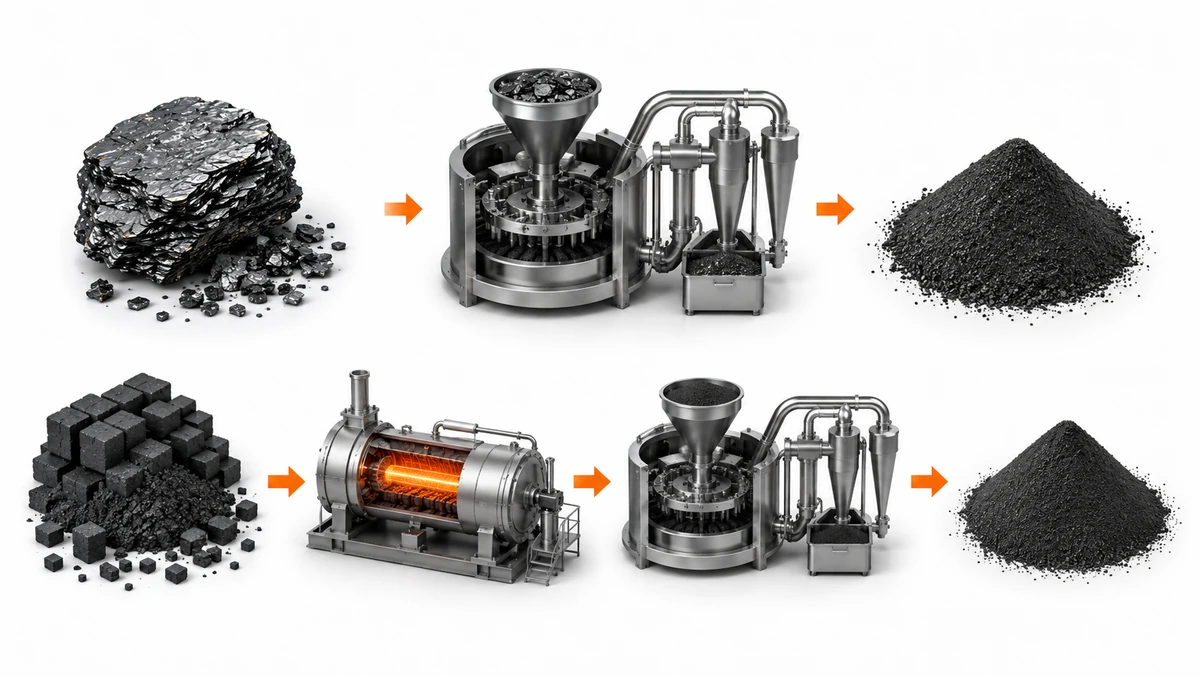
Natural graphite begins with mined graphite-bearing material. Beneficiation separates graphite from associated minerals, and the concentrate may then be classified, milled, purified, shaped, or otherwise processed for the target grade. Preserving flake structure can be important in some products, while other applications intentionally reduce particle size. The current natural flake graphite processing guide follows that route from ore through flotation, sizing, purification, and application-ready selection.
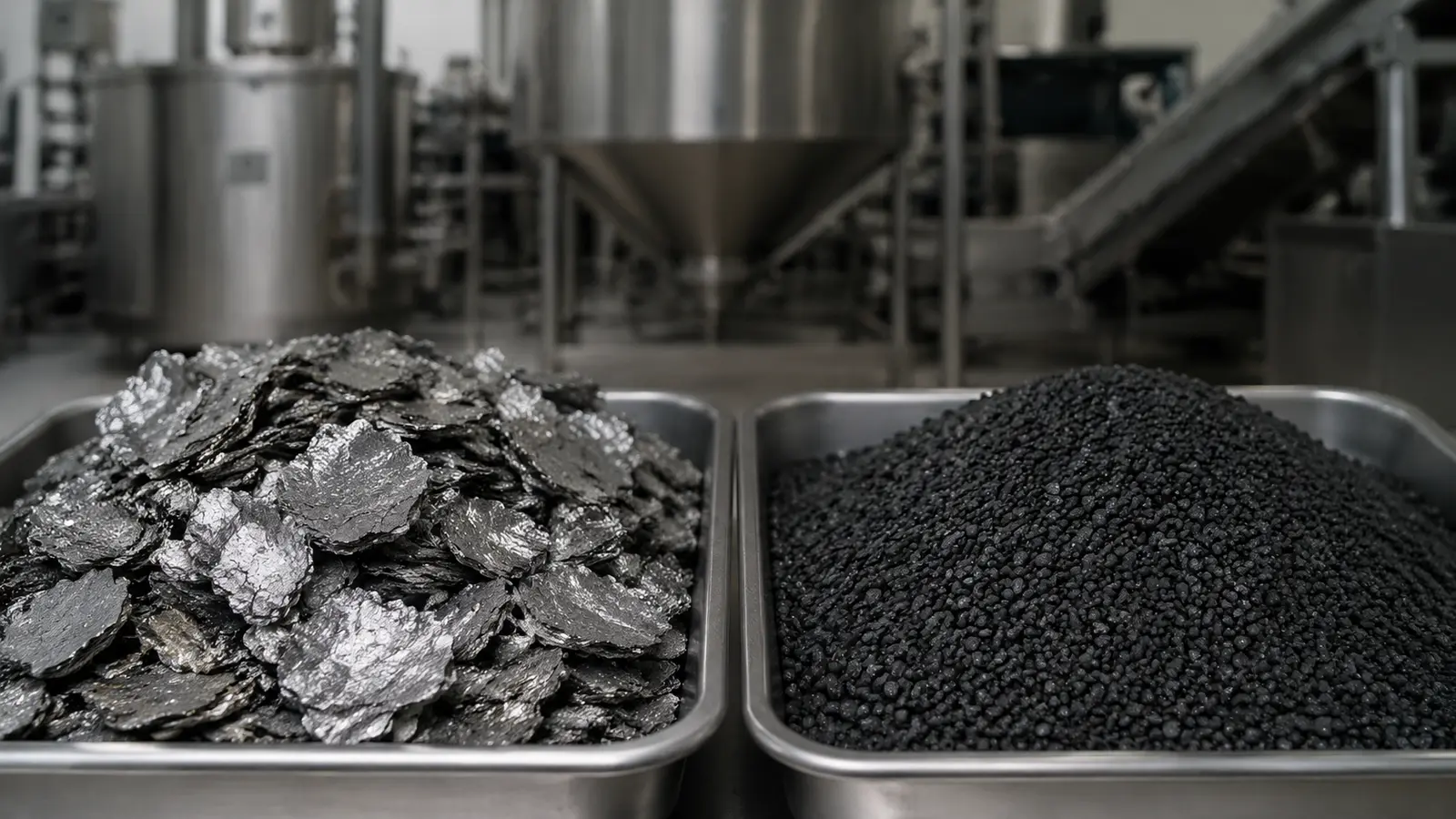
Because the starting material is geological, natural graphite can carry mineral-derived ash and trace elements unless beneficiation or purification removes them. Deposit mineralogy and process history therefore matter. A high fixed-carbon result does not describe particle morphology, size distribution, ash composition, surface condition, or lot consistency by itself.
Synthetic graphite is produced from carbonaceous feedstocks through controlled thermal processing that develops graphitic structure, followed by crushing, milling, classification, and any required finishing steps. The exact precursor and heat-treatment route vary by product. A synthetic label therefore does not guarantee one morphology, one purity, one density, or one performance level.
The industrial evidence in China reflects that application specificity. JC/T 2508-2019 is a current recommended industry standard specifically for synthetic graphite used in friction materials. For that application, the document covers both material requirements and the controls used to test, inspect, identify, package, and deliver the product. The standard’s existence does not mean every synthetic graphite powder is a friction grade; it shows why application-specific specification matters.
When comparing the two routes for a formulation, ask what changed in the finished powder rather than stopping at the feedstock story. The measurable questions are particle-size distribution, particle shape, ash and trace chemistry, fixed carbon, moisture, bulk behavior, surface properties where relevant, and consistency across lots.
Compare the Properties That Actually Need Measurement
The properties worth comparing are the ones that can change formulation processing or finished-system performance, so the test list should be built from the application rather than copied from two supplier data sheets. More data is not automatically better data.
Particle-size distribution usually belongs near the top of the list. D50 alone is not enough when oversize causes surface defects or when fines change rheology, dusting, packing, or dispersion. Record the measurement method and the distribution tails that matter to the process. China’s current GB/T 3520-2024, Test method for fineness of graphite, provides a current national test reference for graphite fineness where applicable.
Particle morphology can be just as important as size. Natural flake-derived powders often retain platelet-like features to some degree, but milling and shaping can change that morphology substantially. Synthetic powders can be angular, granular, flake-like, or shaped depending on precursor and processing. The purchase specification should describe or measure the morphology needed for the application rather than assume it from the word “natural” or “synthetic.”
Bulk and tap behavior affect feeding, packaging, volumetric dosing, and the apparent solids volume entering a batch. Two powders added at the same mass can occupy different volumes and move differently through a hopper. These are handling properties, not substitutes for true density or graphite crystallographic density.
Moisture matters when the formulation or feeding system is water-sensitive, when powder flow changes with humidity, or when the buyer needs a consistent dry-mass basis. A moisture value should be connected to the conditioning and test method rather than treated as a universal constant.
Surface area and oil/vehicle demand may matter in some coatings, polymer systems, or other formulations because they influence wetting and the amount of liquid phase required to incorporate the powder. They are not mandatory fields for every industrial graphite powder. If surface area is measured, record the method and sample preparation so that results can be compared.
Electrical or thermal performance should normally be verified in the relevant compact, coating, composite, or finished specimen when the formulation relies on that function. A powder property can help screen candidates, but inter-particle contact, binder fraction, orientation, pressure, porosity, cure, and specimen geometry can dominate the system result.
The related technical articles on micronized graphite, conductive coatings, bulk density and flowability, friction materials, and COA interpretation go deeper into those individual variables. This comparison page keeps the decision at the material-family level.
Purity, Ash, Particle Shape, and Consistency: What to Verify
Purity, ash, particle shape, and lot consistency should be verified separately because none of them can be inferred reliably from the natural-versus-synthetic label. A fixed-carbon number is useful, but it does not replace the rest of the powder definition.
For natural graphite, ash often reflects residual mineral matter from the ore and beneficiation route. Purification can reduce the impurity burden, but the remaining element profile depends on the deposit and process. For synthetic graphite, ash and trace elements can come from precursor, additives, furnace environment, handling, milling, or other process inputs. Either route can therefore require a chemistry limit when the application is sensitive.
China’s current GB/T 3521-2023, Methods for chemical analysis of graphite, provides a current national chemical-analysis reference. The purchase order should still state which results are contractual. Fixed carbon, ash, moisture, sulfur, or individual trace elements should not be added to the COA simply because they are measurable.
The Jixi municipal government’s graphite testing-center method list shows the same application-specific pattern. For friction-material synthetic graphite, its method package reaches beyond basic carbon and ash data to volatile content, sulfur, packing-related density, pH, silicon carbide, and lattice-related measurements. The important point is the method scope, not copying every field into an unrelated formulation specification. Those fields make sense in that product context; they should not be copied wholesale into a conductive-coating or lubricant RFQ.
Particle shape needs its own evidence. Microscopy can show platelets, rounded particles, angular fragments, agglomerates, and surface texture, but image selection must be representative. One attractive micrograph does not define the lot. Where morphology is critical, agree on the sample preparation, magnification or measurement approach, and the feature that is actually being controlled.
Consistency is the final layer. A candidate powder that gives excellent results in one trial is not automatically the best production choice if its lot-to-lot variation is high. During qualification, retain lot identity and compare more than one lot when the cost of formulation failure justifies it. Trend PSD, chemistry, bulk behavior, and the system-level result that matters to the product.
The graphite purification methods comparison explains why a purity result has to remain connected to purification route, impurity profile, residues, test method, and order specification rather than functioning as a stand-alone quality score.
Screen a Replacement Grade Before the Full Formulation Trial
When the practical task is replacing an incumbent graphite powder, use a two-stage screen before a full production trial. First compare the incoming material definition; then test only candidates that are close enough to justify formulation work. This avoids wasting plant trials on powders that already differ in a field known to control the process.
| Replacement-screen field | Compare on the same basis | Reason to stop before trial |
|---|---|---|
| Material family and modification | Natural/synthetic route plus any purification, milling, shaping or surface treatment that defines the supplied grade | Candidate is not the material family the project intends to qualify. |
| PSD and coarse/fine tails | Same or bridged method, including the tail that caused historical process sensitivity | Candidate falls outside a known feeder, coating, surface or dispersion window. |
| Chemistry | Fixed carbon, ash and only the trace fields tied to the application | A contractual contamination or compatibility requirement is missed. |
| Bulk/handling state | Method-defined bulk or tap behavior where dosing and feeding are sensitive | Commercial handling would require a different production setup. |
| Lot evidence | Actual lot result, method, sample identity and change-control information | The candidate cannot be traced or compared on a repeat-supply basis. |
Passing this screen does not prove equivalence. It means the candidate is technically plausible enough to enter the controlled formulation trial. Failing it does not mean the material is poor; it means the replacement project would be changing more than the buyer intended.
Build a Trial Matrix Instead of Choosing by Label
A controlled trial matrix should compare candidate powders under the same formulation and process before any decision is made from the words “natural” or “synthetic.” The objective is to identify which measurable powder differences actually change the finished product.
Start with a baseline formulation and freeze all non-graphite variables that can reasonably be held constant. Use the same binder or matrix lots, addition sequence, mixing equipment, mix time, temperature, specimen preparation, cure or molding cycle, and test method. Record the actual graphite addition on a mass basis. If bulk volume or solids volume affects processing, record that too rather than assuming equal mass creates equal process conditions.
The first trial can compare one natural candidate and one synthetic candidate only if they are reasonably aligned on the parameters already known to control the formulation. If one candidate has a materially different PSD, morphology, chemistry package, or bulk state, record that difference before the trial rather than treating the route label as the only variable. If the formulation results diverge, the next experiment should isolate the measured property most plausibly connected to the failure.
| Trial stage | Keep fixed | Compare | Decision output |
|---|---|---|---|
| Material-family screen | Formulation, process, addition basis, specimen, test | One natural vs one synthetic candidate | Does either route show a clear process or performance advantage? |
| PSD confirmation | Material family and chemistry as close as practical | Defined size distributions | Is the first difference actually a size-distribution effect? |
| Chemistry confirmation | PSD and process | Ash / impurity profile or purification level | Does chemistry affect compatibility or finished performance? |
| Handling confirmation | Qualified formulation | Bulk/tap behavior, feeding and dosing | Can the candidate be run consistently at production scale? |
| Repeat-lot check | Approved formulation and process | Additional lots of the preferred candidate | Is the performance repeatable enough for purchase control? |
Do not change several graphite variables at once and then attribute the result to material origin. A natural powder with a much coarser distribution and a synthetic powder with a finer distribution are testing origin plus PSD simultaneously. If the finer powder performs better, the trial has not proven that synthetic graphite is the cause.
Measure the outputs that define the product. A conductive formulation needs its qualified electrical result and processability. A friction compound needs the agreed friction/wear or dynamometer evidence. A lubricant needs the relevant friction, wear, film, or durability measure. A coating needs dispersion, application quality, cured-film condition, and whatever electrical, thermal, or mechanical function the graphite is supposed to support.
Keep failed trials and connect each failure to the material lot and observed mechanism. “Synthetic candidate failed” is weak evidence; “candidate B increased coating viscosity while its fine fraction and surface-area data also shifted” creates a testable hypothesis for the next comparison. The same discipline applies to natural candidates. Record the failed process signal, the powder fields that differed, and what was held constant.
Turn Trial Results into a Grade-Selection Scorecard
A grade-selection scorecard converts the successful formulation evidence into a repeatable purchase decision without pretending that one graphite type wins every category. The weighting should reflect the actual product risk.
| Scorecard area | Evidence | Example weighting logic |
|---|---|---|
| Finished-system performance | Conductivity, friction/wear, lubrication, mechanical or other application test | Highest weight when this is the reason graphite is present. |
| Processing stability | Dispersion, viscosity, feeding, mixing, molding/coating behavior | High weight when process failure causes scrap or downtime. |
| Particle definition | PSD, oversize/fines, morphology | Weight according to sensitivity demonstrated in trials. |
| Chemistry | Fixed carbon, ash, sulfur, specified trace elements, moisture | High only when linked to compatibility, contamination, or customer limits. |
| Lot consistency | Repeat-lot data and supplier change control | High for continuous production and tight formulations. |
| Commercial fit | Approved delivered form, packaging, order quantity, supply continuity | Consider only after technical candidates meet the required function. |
The scorecard should not contain unverified statements such as “natural graphite is always cheaper” or “synthetic graphite is always purer.” Cost depends on grade, purification, particle processing, quantity, packaging, market conditions, and qualification burden. Purity depends on the actual material and process. Both statements can be true in a particular comparison and false in another.
The final RFQ should describe the selected grade by the properties that survived the trial: material family, particle-size distribution, morphology requirement if necessary, fixed carbon and chemistry fields that have a real application basis, moisture, bulk/tap behavior where process-relevant, lot documentation, packaging, and change notification. The finished-system test remains the evidence that the powder actually performs the intended job.
A buyer who has not yet chosen between natural and synthetic powder should send the formulation function, matrix or binder type, processing route, current powder if there is one, target PSD or known size constraint, chemistry limits, dosing method, sample quantity, and the test used to rank candidates. That information produces a more useful material comparison than a request for “the highest-purity graphite powder.”
References and Sources
- National Standard Information Public Service Platform — GB/T 3518-2023, Flake graphite. Current Chinese national product standard for flake graphite.
- National Standard Information Public Service Platform — GB/T 3520-2024, Test method for fineness of graphite. Current Chinese national test reference for graphite fineness.
- National Standard Information Public Service Platform — GB/T 3521-2023, Methods for chemical analysis of graphite. Current Chinese national chemical-analysis reference.
- National Standard Information Public Service Platform — JC/T 2508-2019, Synthetic graphite for friction materials. Current Chinese industry standard with an application-specific scope.