A purchasing email that says “please quote 100 mesh natural flake graphite” appears precise, but it still leaves the supplier with several decisions to make. Does 100 mesh mean that essentially all material must pass one sieve, that a certain proportion should remain on it, or that the buyer simply wants a nominal commercial size? Is the sieve series defined? Are oversize flakes unacceptable because they block a screen or change a coating surface, or are excessive fines the real problem because they alter packing, dusting, or formulation behavior? The phrase does not answer any of those questions.
For an RFQ, mesh should be treated as a sieve description, not as a complete particle specification. China’s current national reference GB/T 3520-2024, Test method for fineness of graphite, confirms that graphite fineness is a test-method question rather than a free-standing grade label. The practical purchasing task is to define the method, the fraction that matters, the allowed tails, the sampling basis, and the application reason for each control.
Caution: Do not convert a familiar mesh term into a false precision. If the supplier and buyer use different sieve bases, different shaking conditions, or different definitions of “pass,” the same commercial phrase can describe non-equivalent material.
The broader natural flake graphite processing guide explains how ore becomes an application-ready graphite grade. This article starts later, at the point where the buyer has already decided to source natural flake graphite and needs to write a purchase line that receiving inspection can actually verify.
Mesh Size Is a Sieve Description, Not a Complete Particle Specification
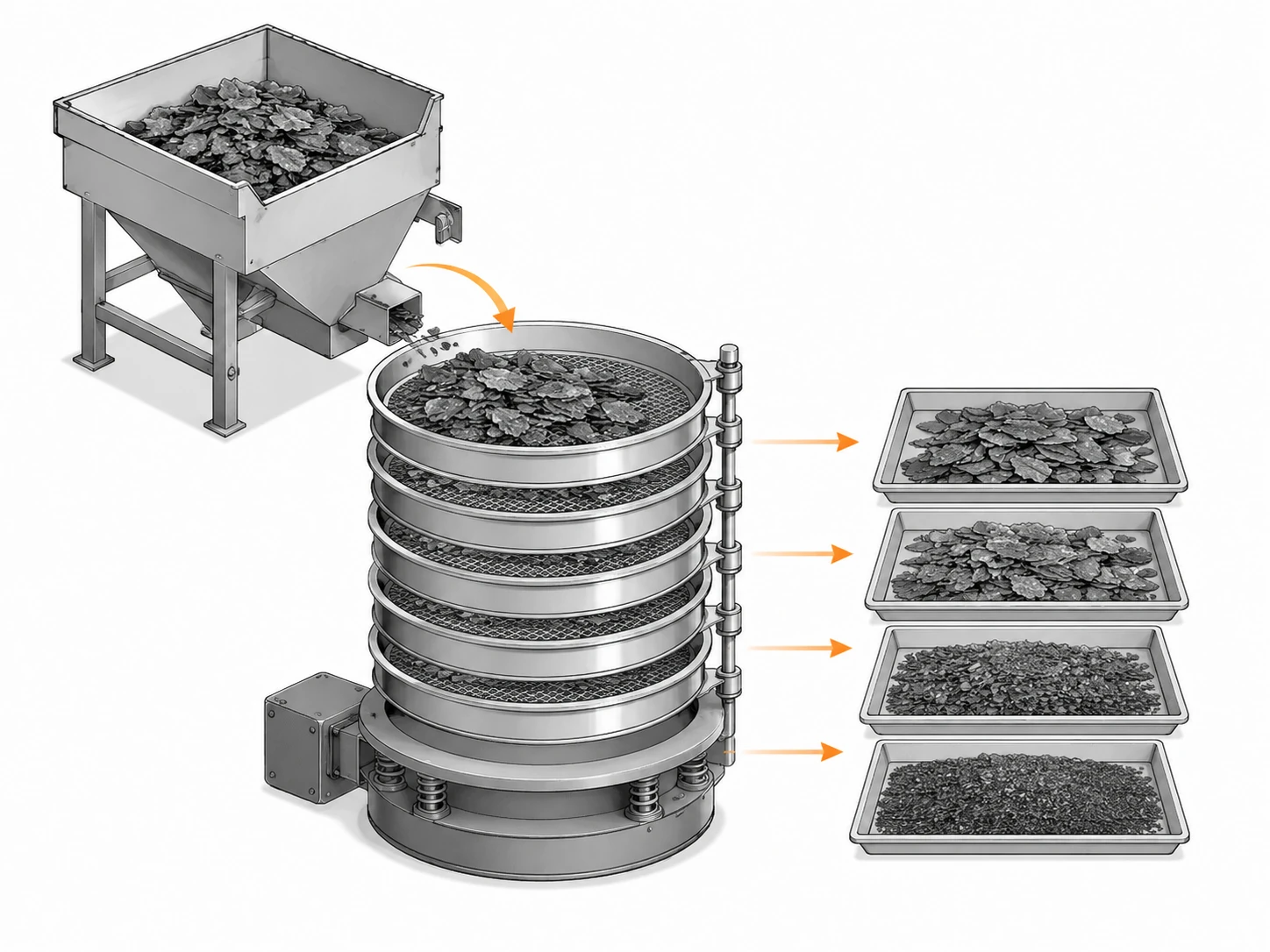
A mesh number identifies a sieve opening system, but it does not by itself define the full particle-size distribution of a natural flake graphite lot. Two lots can both be marketed with the same nominal mesh description while containing different proportions of coarse flakes, target fraction, and fines.
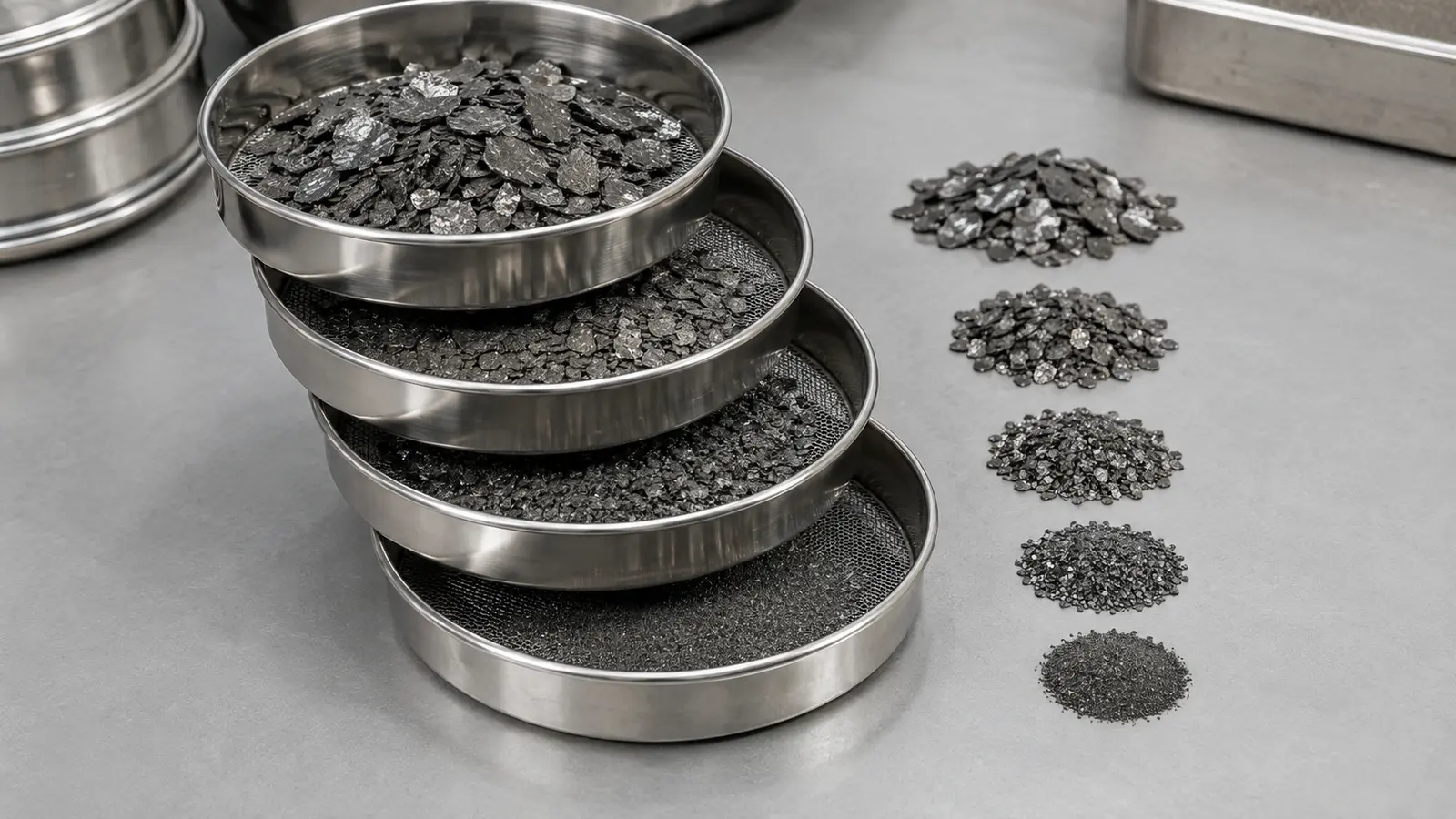
That distinction matters because natural flake graphite is not a collection of ideal spheres. Particles are plate-like to varying degrees, and their orientation as they approach a sieve opening affects whether they pass. A flake may present its broad face, rotate, or approach edge-on. The result is useful for classification, but it should not be interpreted as a three-dimensional particle diameter in the same way an instrumental particle-size metric might be interpreted.
The first RFQ question is therefore: What decision does the mesh requirement need to protect? A buyer may need to prevent coarse particles from entering a coating line, preserve a visible or functional flake fraction, control the amount of fines in a dry blend, maintain feeding behavior, or match an already qualified formulation. Those are different objectives, and they lead to different acceptance fields.
A nominal line such as “100 mesh” should be expanded into at least three elements: the test basis, the required fraction, and the acceptance rule. The test basis identifies the agreed sieve method. The required fraction explains which portion must pass, remain, or fall between defined sieves. The acceptance rule states how much variation is allowed and how the result will be sampled and reported.
If an instrumental PSD is also important, keep it as a separate field. Laser diffraction and sieve analysis do not answer exactly the same question, especially for non-spherical particles. A buyer can use both, but the RFQ should not silently treat one as a substitute for the other.
Define the Sieve Basis and the Required Size Fraction
A usable sieve requirement begins by naming the method or agreed sieve basis and then defining which fraction of the lot the buyer intends to control. Without that step, “mesh” remains commercial shorthand rather than a reproducible acceptance condition.
Start by deciding whether the purchase requirement is an upper-size control, a lower-size control, or a banded fraction. An upper-size control is useful when oversized flakes create a process risk. A lower-size control is useful when too many fines change dusting, packing, surface area, or formulation behavior. A banded fraction is useful when the application depends on maintaining a meaningful population between two sieve limits rather than merely eliminating one tail.
Then specify how the result will be expressed. Examples include percentage passing a defined sieve, percentage retained on a defined sieve, or percentage located between two sieves. The exact acceptance values should come from the buyer’s qualified material, process trial, customer specification, or another documented basis—not from a generic internet table.
The sample condition also matters. Moisture, agglomeration, handling, and sample reduction can change the apparent result. If the production lot is large, one convenient scoop from the top of a bag may not represent it. State whether the supplier reports a production-lot result, a composite sample, or another defined sampling basis.
Note: If the application was qualified using a supplier’s historical sieve method, preserving method continuity can be more valuable than replacing it with a “more advanced” method that produces a different numerical scale.
For new projects, ask the supplier to state the method used on the COA or test report. That allows the buyer to compare repeat lots on the same basis and avoids a later dispute in which both parties have technically correct but non-equivalent results.
Control Oversize and Undersize Instead of Quoting One Mesh Number
Oversize and undersize limits turn a nominal mesh request into a distribution control because they define what the buyer is trying to exclude from both ends of the particle population. For many industrial applications, these tails are more actionable than a single central label.
Oversize material can create visible surface defects, blockage, uneven mixing, local thickness variation, poor filling into a narrow geometry, or inconsistent screen passage depending on the process. The correct control is not “smaller is always better.” It is “coarse material above the qualified limit must remain low enough that the process runs consistently.”
Undersize or fine material creates a different set of questions. More fines can increase dust, alter apparent bulk behavior, change wetting and binder demand, affect compaction, or shift the effective surface presented to a formulation. In some applications fines are useful; in others they are the main source of instability. Again, the RFQ should protect the process rather than chase a generic size ranking.
| RFQ field | Question it answers | Why it is stronger than one mesh label |
|---|---|---|
| Agreed sieve / method | How is the result measured? | Makes supplier and buyer results comparable. |
| Oversize control | How much material may remain above the intended upper limit? | Protects equipment, surface, and coarse-particle risks. |
| Target fraction | Which size band represents the useful commercial grade? | Defines the population the application actually uses. |
| Undersize control | How much fine material is acceptable? | Protects mixing, dusting, packing, and formulation behavior where relevant. |
| Sampling basis | Which part of the production lot does the result represent? | Connects the laboratory number to delivered material. |
Do not add all five fields mechanically to every order. A proven application may only need two of them as release limits and keep the others as monitoring data. The point is to identify which tail causes risk and control that tail explicitly.
Preserve Flake Information That Mesh Alone Cannot Describe
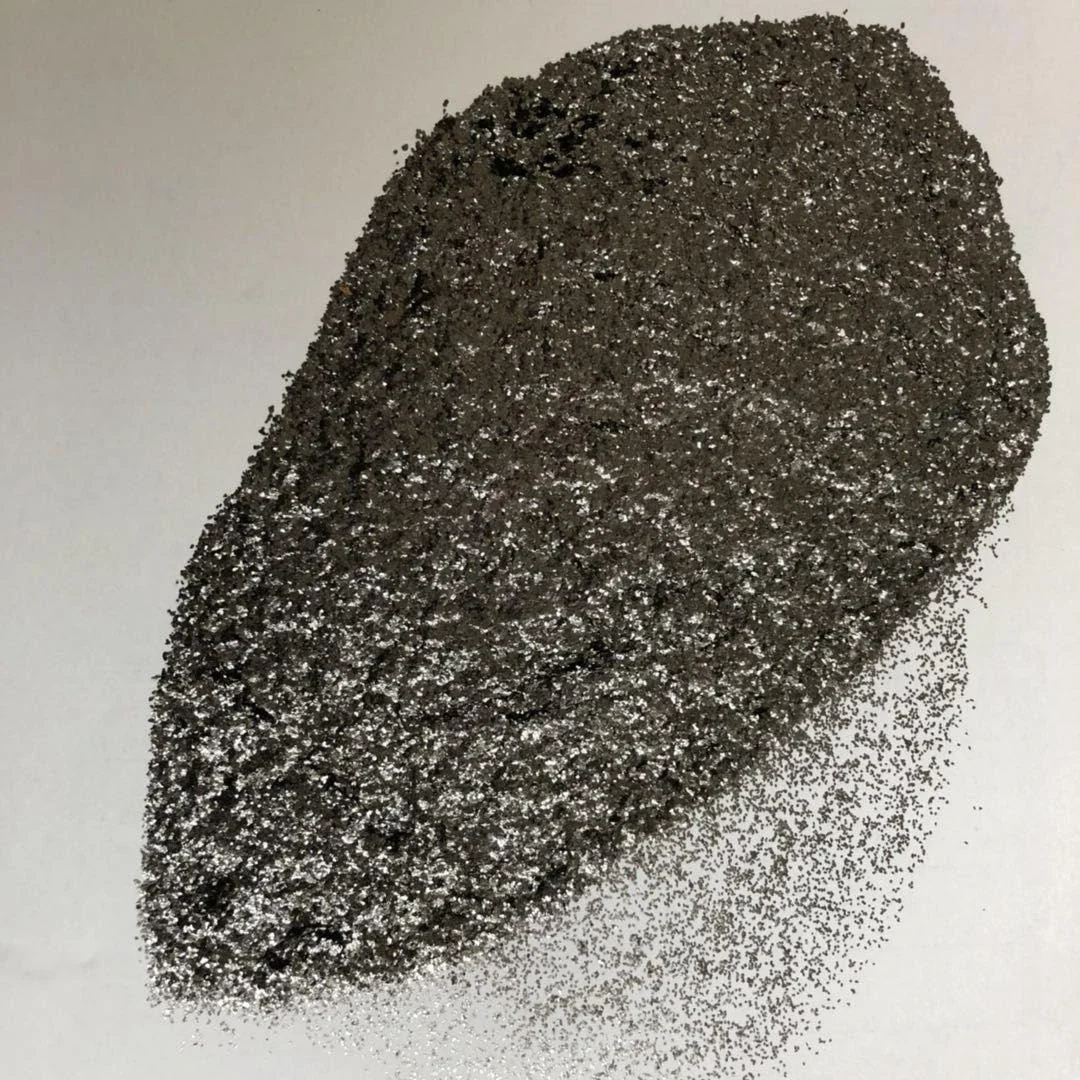
Natural flake graphite should retain a material-identity description beyond mesh because sieve behavior cannot fully describe flake morphology, thickness, aspect, surface condition, or the visual difference between a plate-like flake population and a heavily milled powder.
This is especially important when the buyer is replacing an established grade. A new supplier can meet a broad sieve result while presenting a visibly different particle population. That difference may come from feedstock, milling intensity, classification route, purification, handling, or another production step. If the end use is sensitive to particle architecture, the incoming specification should preserve the relevant evidence.
Useful evidence can include a retained approved sample, agreed microscopy images, a morphology description, an instrumental PSD used as supporting data, or another observation linked to the application. These fields do not all need to become hard COA limits. Some work better as qualification references or change-control triggers.
A retained sample is often underrated. When a new lot arrives, a side-by-side comparison of appearance, flake character, sieve result, and application behavior can reveal a shift faster than debating whether a single reported mesh line still “passes.” For repeat supply, the reference sample should be tied to the approved grade and lot record.
Also separate purity from size. Fixed carbon, ash, moisture, and selected chemistry can matter, but a high fixed-carbon value does not prove the correct flake distribution, and the correct sieve result does not prove the required chemistry. The next article in this series, how to read a graphite powder COA, shows how those data fields should be compared without mixing unlike methods.
Match the Particle Requirement to the End Use
The particle requirement should be justified by the end use because the same natural flake graphite size distribution can be acceptable in one process and troublesome in another. The RFQ becomes stronger when each size control can be traced to a production or product decision.
For a coating or slurry, the buyer may care about the relationship between coarse particles, film build, filtration, dispersion, and surface finish. For a dry blend, dusting, segregation, feeder consistency, and mixing may be more important. For a thermal or electrically functional composite, flake architecture and contact structure can matter alongside size. For expandable-graphite feedstock or another downstream transformation, the relevant incoming particle requirement may be defined by the later process rather than by final-use appearance.
Do not assume that tighter size distribution always improves performance. Tighter control can increase processing cost and reduce supplier flexibility. A narrow limit is justified when the process has shown sensitivity to that variable. If several accepted lots operate normally across a broader range, the broader qualified window may be the more robust purchase specification.
The application trial should therefore record the lot, sieve data, supporting PSD if used, morphology observations, key chemistry fields, process settings, and finished result. Once the buyer identifies which variation actually changes the result, those fields can move from “information only” to release control.
When supplier equivalency is the objective, compare candidates on the same method and the same application trial. Do not select a replacement simply because its nominal mesh name matches the incumbent. The equivalency question is whether the delivered distribution and flake character reproduce the qualified process.
Write a Complete RFQ Line Item for Natural Flake Graphite
A complete RFQ line should identify the material, method, particle window, chemistry fields, evidence, packaging, and qualification basis in a form that both purchasing and receiving inspection can use. It does not need to be long, but every field should have a reason.
Example: Instead of writing “100 mesh natural flake graphite,” write the line as a structured request: natural flake graphite; agreed graphite fineness/sieve method; defined target fraction; oversize and/or fines control based on the qualified process; fixed-carbon/ash/moisture fields as required; lot-specific COA; retained sample or agreed qualification reference; packaging suitable for the handling process. Insert numerical acceptance values only from your approved material data or trial record.
The RFQ should also ask the supplier to identify any production change that could affect the controlled fields. Feedstock source, milling, classification, purification, blending, or another major process change can alter the delivered particle population even if the product name remains the same.
For first supply, request enough sample for both laboratory characterization and the actual application trial. A small laboratory jar may be enough to measure a sieve result but not enough to expose segregation, feeder behavior, or production-scale mixing differences. Qualification quantity should follow the process being qualified.
The final purchase line can be checked with this list:
- Material identity: natural flake graphite, not a generic “graphite powder” label.
- Agreed sieve or fineness method.
- Target fraction and the specific tail or tails that require control.
- Sampling and lot identity.
- Application-relevant fixed carbon, ash, moisture, or chemistry fields.
- Retained sample, approved sample, or other qualification reference where useful.
- COA fields and method references required for repeat-lot comparison.
- Packaging and moisture/segregation controls only where the process needs them.
- Supplier change-notification requirements.
That structure converts “mesh size” from a loose commercial label into a purchase specification. The buyer no longer asks the supplier to guess what 100 mesh is supposed to mean; both sides know which fraction, method, evidence, and application risk the requirement is protecting.
Before issuing the order, purchasing should also confirm the reporting format. If the supplier reports only a commercial grade name while receiving inspection records percentages by sieve, the two records will be difficult to reconcile later. Put the expected result format in the RFQ so the quotation, sample approval, COA, and incoming inspection all speak the same language.
One more RFQ problem appears when the buyer mixes supplier terminology with internal inspection terminology. A supplier may call a material “+100 mesh,” “-100 mesh,” or use a commercial grade name that was created around a historical sieve convention. Receiving inspection may record percentage retained or percentage passing instead. Before the first order, convert both descriptions into one agreed reporting format. That prevents a later situation in which the delivered lot follows the supplier’s grade definition but appears to fail the buyer’s spreadsheet simply because the two teams use opposite descriptions of the same sieve cut.
It is also useful to separate qualification tolerance from production tolerance. During development, the buyer may intentionally test several size windows to learn which one the process can tolerate. Once the working window is understood, the production RFQ can be narrower than the exploration range without pretending that only one exact mesh value works. Keeping the development data allows future sourcing teams to know how much room actually exists if a supplier change or capacity issue requires a second source.
Sieve condition is part of method control. Damaged mesh, contamination, incorrect stacking, or inconsistent cleaning can change a result even when the graphite lot has not changed. For routine acceptance, identify the sieve set or method reference used by the laboratory and maintain it under the lab’s normal equipment-control procedure. When buyer and supplier results disagree, check sieve identity and test execution before assuming that the delivered particle distribution is different.
References and Sources
- National Standard Information Public Service Platform — GB/T 3520-2024, Test method for fineness of graphite. Current Chinese national graphite-fineness test reference.