The first sign of a bulk-density or flowability problem is often a feeder that suddenly surges, a hopper that stops emptying cleanly, or a package whose powder state no longer matches the qualified lot. The graphite can still meet its particle-size and chemistry requirements. What changed is the way the powder occupies volume and moves through storage, transfer, dosing, mixing, or packaging. Those handling differences are not described by fixed carbon or D50 alone.
Bulk density and flowability should therefore be treated as process properties. They are influenced by particle-size distribution, morphology, surface condition, moisture, agglomeration, packing history, vibration, storage, and the geometry of the handling system. The useful specification is not “highest density” or “best flow.” It is a repeatable handling window that allows the qualified storage, feeding, mixing, dosing, and packaging process to run consistently.
GB/T 31057.1-2014, Granular materials—The physical properties—Part 1: Determination of apparent density, provides a general granular-material method reference. It defines a measurement basis, not a universal graphite-powder acceptance limit, so the purchase specification still needs the powder state and process context that make the result meaningful.
Bulk Density Is Not the Same as True Density
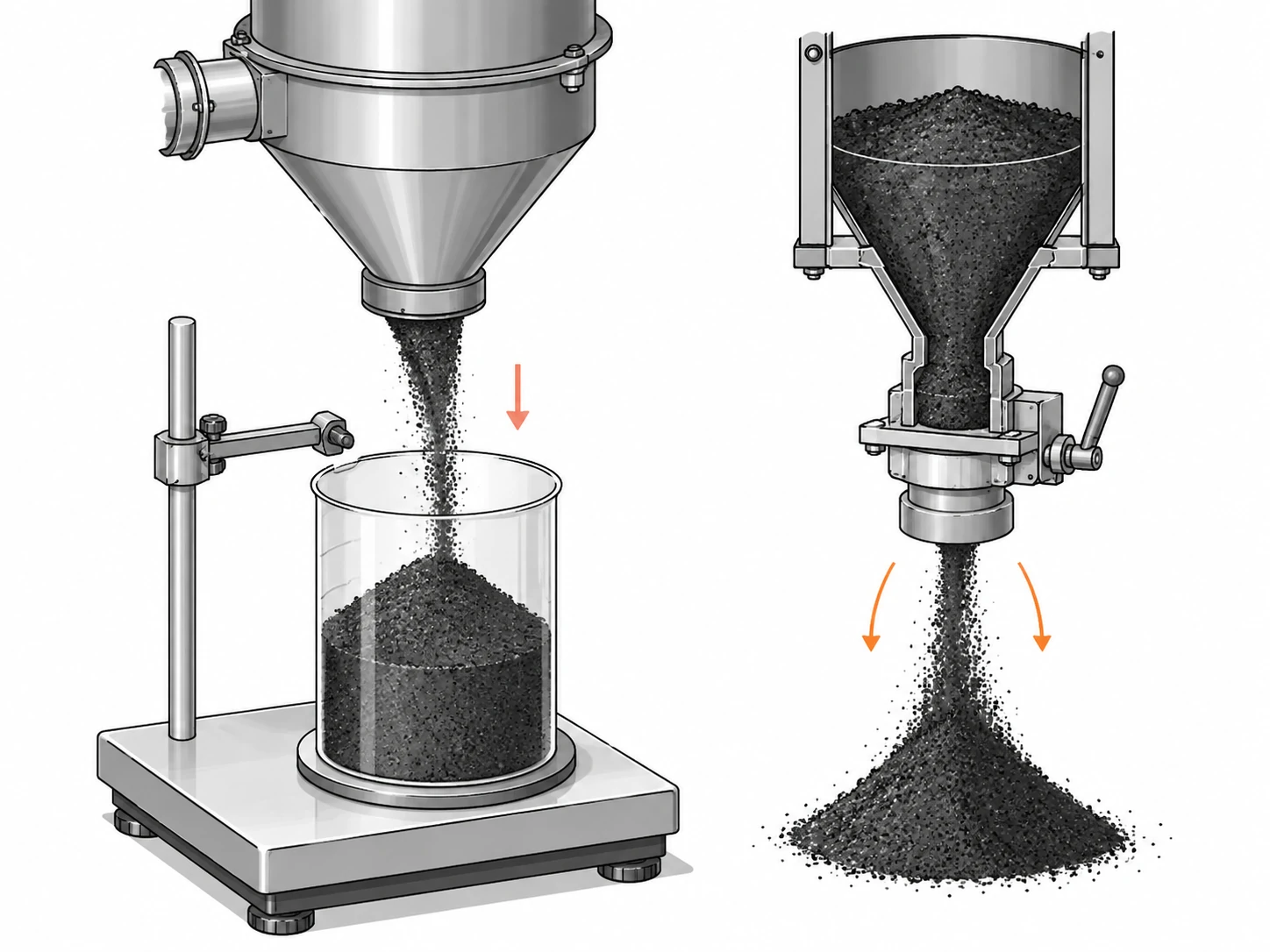
Bulk density describes the mass of powder occupying a defined bulk volume under stated handling conditions, while true density describes the density of the solid material itself without the inter-particle void space. The two values answer different questions and should not be substituted for one another.
Bulk powder contains voids between particles. The amount of void space depends on particle size, distribution width, morphology, agglomeration, surface friction, and how the material was poured, vibrated, tapped, compressed, or transferred. Two graphite powders made from the same broad material family can therefore have different bulk densities even though their solid graphite structure is similar.
This difference matters to production because factories handle containers and volumes, not isolated particles. A bag, hopper, screw pocket, feeder chamber, or mixer has a finite volume. If the same graphite mass occupies more volume, the powder may reach a different fill level, interact differently with a feeder, or change the working volume available for the rest of the formulation. If a process doses by volume, a density shift can change the delivered mass directly.
Do not confuse loose bulk density with a value measured after tapping or vibration. Tapping allows particles to rearrange into a more compact state. The relationship between loose and tapped states can be useful for understanding packing sensitivity, but it depends on the method. The purchase specification should name the state and method that correspond to the production risk.
The natural versus synthetic graphite powder comparison treats bulk behavior as one material attribute among PSD, morphology, chemistry, and formulation performance. A natural or synthetic label does not predict the handling state by itself.
Why Feeding Systems Expose Flowability Problems First
Feeding systems expose flowability problems quickly because they repeatedly ask the powder to move through a defined opening under a controlled mechanical or gravitational condition. A small change in cohesion, packing, or aeration can become a large change in feeder output.

Common symptoms include inconsistent screw fill, surging, intermittent discharge, bridging over the outlet, rat-holing through the center of a hopper, flooding after a compacted mass breaks loose, or increasing variation as the hopper level changes. These symptoms are system results, not single powder properties. Hopper angle, wall material, outlet size, screw geometry, vibration, aeration, feeder speed, and upstream compaction all interact with the powder.
Particle-size distribution is one important contributor. More fines can increase cohesive behavior in some powders, while coarse particles and broad distributions can change segregation and packing. The micronized graphite PSD guide explains why D50 should be read with the tails and method. In a feeder investigation, use that PSD information to explain the observed discharge pattern rather than assuming one size value controls flowability.
Moisture and storage history also matter. A powder can absorb or lose moisture, compact under its own weight, settle during transport, or become aerated during transfer. A sample tested immediately after laboratory preparation may not represent a bag that has experienced vibration and storage. If the production complaint appears after transport or long storage, reproduce that handling state during investigation.
When a feeder becomes unstable, first compare the new lot with a retained qualified lot under the same equipment and settings. If both behave poorly, investigate equipment and process conditions before changing the powder specification. If only the new lot shows the failure, compare bulk density, PSD, moisture, and other handling observations to identify the material difference.
Mixing and Dosing: When Volume Becomes a Process Variable
Volume becomes a process variable when graphite is metered volumetrically, when mixer fill level affects dispersion, or when different powder volumes change the way ingredients enter and circulate through the batch. A mass-equivalent substitution can therefore create a different mixing condition.
Mass-based dosing protects formulation ratio better than volume-based dosing, but it does not remove every volume effect. A lower-bulk-density powder occupies more space before it is incorporated. It can enter a mixer over a longer period, contact a different area of the liquid or dry blend, entrain more air, or reach the working-volume limit of the vessel sooner.
Volumetric feeders add another layer. If a feeder pocket or screw volume remains fixed, a change in bulk density can change delivered mass. The operator may compensate by changing speed, but that can alter residence time, pulsation, or downstream mixing. For a qualified production line, it is better to understand whether the incoming powder state changed before repeatedly tuning equipment around each lot.
Mixing behavior should be recorded during grade qualification. Note the graphite mass, occupied volume where useful, addition sequence, feeder or manual-addition method, mixer loading, time, temperature, visible dusting, incorporation time, and any torque, power, viscosity, or other process signal available from the equipment. The purpose is not to collect data for its own sake; it is to identify which handling characteristics predict a stable batch.
| Process step | Handling variable | Typical symptom to investigate | Material data to compare |
|---|---|---|---|
| Storage hopper | Packing, cohesion, wall interaction | Bridge, rat-hole, incomplete discharge | Loose/tapped bulk state, PSD, moisture, storage history |
| Feeder | Fill consistency and discharge | Mass-rate variation, surging, flooding | Bulk density, PSD tails, flow test, aeration state |
| Mixer charging | Occupied volume and addition rate | Dust, long incorporation time, local concentration | Bulk density, fines, agglomeration, moisture |
| Batch mixing | Distribution through the formulation | Nonuniform product or process signal | PSD, morphology, dosing accuracy, lot identity |
| Packaging | Settling and compaction | Bag volume change, segregation, discharge difference | Packing history, bulk/tap behavior, PSD |
Packaging and Shipping Can Change the Handling State
Packaging and shipping can change the handling state of graphite powder because vibration, settling, pressure, moisture exposure, and repeated transfer can rearrange the particles before the material reaches the production line.
A bag filled with a loose powder may occupy less volume after transport because the particles settle and pack more efficiently. The material can still be chemically identical and retain the same broad PSD while discharging differently. Conversely, transfer through a pneumatic or high-shear handling step can aerate the powder or break weak agglomerates, creating a temporary lower-density state.
Segregation is another risk in broad distributions. Vibration and handling can move coarse and fine fractions differently. A sample taken only from the top of a container may not represent the material near the bottom. If the process is sensitive to the tails of the PSD, define sampling across the delivered package rather than assuming one scoop represents the lot.
Packaging material can also matter when moisture or contamination is important. A liner that provides adequate protection for one industrial powder may not meet the needs of a moisture-sensitive or high-purity grade. The requirement should follow the application. Do not apply clean packaging rules merely as a visual quality signal.
During scale-up, test the actual commercial package. A laboratory jar avoids many of the consolidation, lifting, opening, emptying, and residual-material issues that appear with bags, drums, or other transport containers. If a packaging change alters feeder behavior, record it as part of the material change investigation.
Measure Bulk Density and Flowability with Repeatable Conditions
Bulk density and flowability measurements are useful only when the sample condition and test procedure are repeatable enough to distinguish a material change from normal test variation. The method should reproduce the handling state relevant to the process.
For bulk density, define whether the powder is measured loose, settled, tapped, or under another stated condition. Record the container or apparatus, filling procedure, conditioning, and whether vibration is applied. A result without those conditions is difficult to compare across laboratories or over time.
For flowability, choose a method that produces information correlated with the production problem. A simple funnel or flow-time method can be useful for a freely flowing powder but may fail to produce a result for a cohesive powder. That “no flow” observation can itself be informative, but it does not quantify how the material will behave in every hopper or screw feeder.
Other practical tests can examine angle or pile behavior, tapped packing, compressibility-related response, shear behavior, or equipment-specific discharge. The test selected for routine incoming control should be the simplest method that reliably predicts the production issue. A complex test adds little value if it does not improve the accept/reject decision.
Use each test reference within its stated scope. GB/T 31057.1-2014 covers apparent density for granular materials, while GB/T 31057.3-2018 provides a fluidity-index method. Neither standard by itself defines the acceptable handling window for a specific graphite production line; that window has to be qualified against the actual feeder, mixer, packaging, or dosing problem.
Do not treat a single laboratory flow result as a direct prediction of every production line. A powder that passes a funnel test can still bridge in a shallow hopper with an unfavorable outlet, and a cohesive powder that does not flow through a simple funnel may still be metered successfully by a properly designed forced feeder. The routine test earns its place in the specification only after the buyer has shown that it separates acceptable production lots from problematic ones.
For troubleshooting, keep the order of evidence clear. First confirm whether the equipment changed. Then confirm whether the package, storage time, or sampling state changed. Only after those checks should a difference in bulk density or flowability be treated as a raw-material cause. This discipline reduces unnecessary supplier claims and prevents a machine problem from being hidden by repeated material adjustments.
Set Practical Acceptance Criteria for Production Lots
Practical acceptance criteria should be built from lots that run successfully in the qualified production process and should control only the handling properties that predict a real production risk. The narrowest possible bulk-density range is not automatically the best specification.
Collect data from more than one accepted lot where possible. Record loose or tapped density as applicable, the chosen flowability observation or test, PSD, moisture, packaging state, and feeder or mixing result. This establishes the normal variation of material that already works.
Separate release limits from monitoring fields. A release limit should have a clear connection to feeder stability, dosing accuracy, mixer capacity, packaging, or another production constraint. A monitoring field can be trended without rejecting a lot until enough evidence exists to define the operating window.
When a new lot falls outside a trend, repeat the test on a representative sample before escalating. Check whether sampling location, conditioning, transport compaction, or laboratory technique changed. Then compare the lot in the production or pilot handling test that originally established the specification.
| Acceptance field | What to state | Use |
|---|---|---|
| Material and lot identity | Approved grade/family and traceable lot | Connects handling data to the delivered material |
| Bulk-density state | Loose, tapped, or other qualified condition with method | Prevents non-equivalent density values from being compared |
| Flowability check | Qualified method or equipment-specific check | Controls the failure mode that matters to production |
| PSD support | Relevant central, coarse, and fine controls | Helps explain handling changes |
| Moisture / conditioning | Only where process-sensitive, with test basis | Controls a common source of handling variation |
| Packaging | Qualified package/liner and handling condition where relevant | Protects the delivered powder state |
| Change notification | Material or process changes requiring review | Prevents silent shifts after qualification |
If a production line develops feeder variation, investigate in this order: confirm equipment condition and settings; compare the new lot with a retained control; check the delivered package and storage history; measure the qualified bulk-density and flowability fields; review PSD, moisture, and agglomeration; then run a controlled feeding or mixing comparison. This sequence avoids blaming the powder for an equipment problem or adjusting the equipment around an uncontrolled raw-material change.
Where the same powder feeds more than one production line, qualify the handling window against the most sensitive feeder rather than averaging unlike equipment. Keep equipment-specific settings in the plant control plan, while the purchase specification retains only the material characteristics that repeatedly explain acceptable or unacceptable handling.
When requesting graphite powder from QDZRT Graphite for a process with handling constraints, provide the application, current powder, dosing basis, hopper/feeder type at a descriptive level, batch size or throughput context where useful, known PSD, bulk-density or flow concerns, packaging format, storage condition, and the production symptom being solved. The supplier does not need every machine setting to understand the request, but it does need enough context to avoid treating bulk density as an isolated catalogue number.
For material that arrives compacted after transport, compare an as-received sample with the qualified conditioning procedure before deciding that the powder itself has changed. Record whether the production line normally breaks up, aerates, or settles the material before dosing. If the feeder receives the powder in a different state from the laboratory test, add a simple conditioning step to the test plan or a plant-side handling check. This aligns the measurement with the state that actually reaches the process.
References and Sources
- National Standard Information Public Service Platform — GB/T 31057.1-2014, Granular materials—The physical properties—Part 1: Determination of apparent density. Current Chinese general granular-material apparent-density reference; cited for method context, not as a universal graphite-powder specification.
- National Standard Information Public Service Platform — GB/T 31057.3-2018, Granular materials—Physical properties—Part 3: Fluidity index. Current Chinese method standard for fluidity index; useful when a contractual flowability field is based on this method.
- National Standard Information Public Service Platform — GB/T 19077-2024, Particle size analysis—Laser diffraction methods. Current Chinese national laser-diffraction reference supporting PSD investigation where the method is applicable.