A gasket converter can buy the same flexible graphite family in rolls or cut sheets and still experience very different production economics. The difference does not start with temperature resistance or graphite chemistry. It starts at the cutting table: how many parts fit on the available width, how much offcut can be reused, how material is moved between operations, how flat it remains, and how many lots must be stored and identified.
That makes roll versus sheet an operating decision rather than a simple material comparison. A roll can reduce transverse joints in long cutting plans and give the nesting process more length to work with, but it can also add handling equipment, curl or set concerns, and larger losses if a roll is damaged. Sheets can be easier to count, isolate, and move in smaller batches, but fixed sheet dimensions can create recurring edge scrap when part geometry does not fit the format efficiently.
The flexible graphite itself should still be controlled by the applicable material specification. JB/T 7758.2-2005 remains a current Chinese industry reference for technical conditions of flexible graphite sheet, while GB/T 33920-2025 is the current national test-method reference for flexible graphite sheets. Those references help control material identity and testing; they do not decide which supply form produces the lowest conversion cost in a particular plant.
Start from the Converter’s Cutting and Nesting Process
The best supply form is the one that fits the converter’s actual cutting and nesting process with the least uncontrolled handling and waste. Start with part geometry and order mix before comparing roll and sheet prices.

A converter producing many small gaskets from repeating dimensions may be able to nest parts efficiently on a standard sheet. The operator knows the usable area, can stage one sheet at a time, and can separate orders or lots without handling a long roll. If the sheet size aligns with the die layout or CNC cutting bed, the apparent simplicity can translate directly into predictable cycle time.
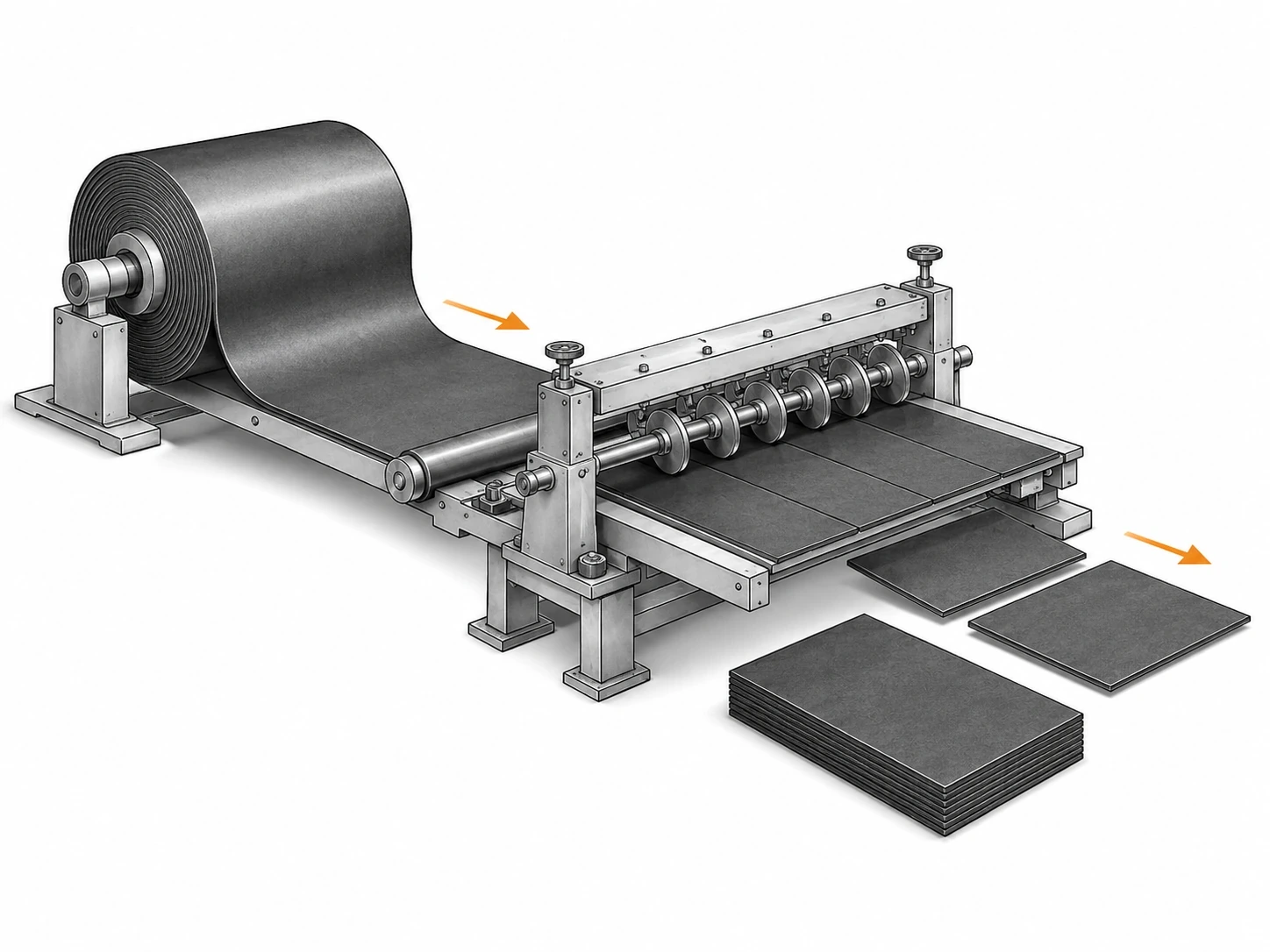
A roll becomes more attractive when the cutting plan benefits from continuous length. Large rings, long strips, multiple-row nesting, or variable order combinations can use the roll length to avoid the artificial boundary created by the end of every sheet. The gain is not automatic, however. The usable width still limits nesting, and the converter may need unwinding, support, tension control, or a staging table that prevents damage as material enters the cutting process.
Machine format is another constraint. A cutting table that only accepts a certain maximum length cannot exploit unlimited roll length unless the converter feeds and indexes the material. A die-cutting operation may prefer discrete sheets because the press and handling system were designed around fixed blanks. Before changing supply form, map the material from storage to final cut rather than evaluating only the cutting pattern on a screen.
The existing graphite paper conversion guide shows why slitting, lamination, die cutting, and handling form one connected process. For gasket converters, the same principle applies: supply form should be evaluated against the operations that physically touch the material.
Yield and Scrap: When Roll Length Helps—and When It Does Not
Roll length improves yield only when the nesting plan can use that extra length to reduce otherwise unavoidable sheet-boundary waste. A longer format does not solve scrap caused by width mismatch, part spacing, damaged edges, or quality restrictions.
Consider a converter cutting large rings. The center discs may be reusable for smaller parts, or they may become scrap depending on the order mix and quality requirements. A roll gives the planner more freedom to pair different sizes along the machine direction, but if all orders use nearly the same ring diameter, the dominant loss may still be the unused material inside and between rings.
With sheets, each blank creates a hard boundary. A part that nearly fills the sheet can be efficient, while a part that leaves an awkward strip at the edge can create the same waste on every piece. If those strips cannot be consumed by another regular product, the theoretical simplicity of sheet handling carries a permanent material penalty.
Rolls introduce a different type of loss. The leading and trailing portions may be less useful depending on packaging, clamping, tension, or edge condition. If a roll is telescoped, crushed, contaminated, or creased, a long section may need to be quarantined. The loss from one damaged roll can therefore be larger than the loss from one damaged sheet pack even if average nesting yield is better.
The right calculation uses accepted output divided by issued material, not only CAD nesting percentage. Include unusable edges, setup pieces, damaged material, remnants too small to inventory, and rework caused by handling. A roll that looks five percent better on a software nesting screen can still be more expensive if production loses time flattening, aligning, or removing damaged sections. Conversely, a sheet format with easy handling can still be wasteful if the same offcut accumulates every day.
| Yield question | Roll supply | Sheet supply |
|---|---|---|
| Length flexibility | Continuous length can combine jobs and reduce sheet-end boundaries. | Each sheet fixes a maximum nesting area. |
| Width mismatch | Still creates edge scrap if roll width does not fit the part family. | Can be optimized by ordering a sheet width/length matched to common parts. |
| Damage exposure | One local handling problem can affect a long continuous section. | Damage may be isolated to individual sheets or a smaller pack. |
| Remnant control | Long remnants can be reusable if they are identified and protected. | Offcuts are easier to count but may be too small for routine reuse. |
Handling and Flatness During Production
Rolls require a controlled unwind and support path, while sheets require controlled lifting, stacking, and transfer. Neither form is automatically easier; the converter should choose the handling method that preserves flatness and prevents surface or edge damage through the actual production route.
Flexible graphite can be mechanically vulnerable to creasing, edge impacts, abrasion, and local compression. A heavy or wide roll may need a core support, cradle, shaft, or lifting method that avoids crushing the circumference. Pulling material directly from an unsupported roll can create uneven tension or local folds before it reaches the cutting table.
Sheets avoid the unwind step but create repeated lifting events. Operators may slide sheets across one another, grip unsupported corners, or stack them against an uneven surface. Thin or large sheets can sag during manual transfer. A pack that is easy to move with a forklift may still need a different method once individual sheets are taken to the cutting station.
Flatness should be considered as a process condition, not merely an incoming visual criterion. Material that has taken a roll set may still process normally if the converter’s feed system controls it, while a crease or local buckle may interfere with die alignment or CNC cutting. Sheets can arrive flat but become damaged when stored on a warped pallet or partially unsupported rack.
The converter should record where handling defects first appear. If incoming material is acceptable but defects increase after internal transfer, changing the supplier’s packaging alone may not solve the problem. If rolls repeatedly arrive with crushed edges or sheets show corner damage before unpacking, packaging and transport become part of the supply-form decision.
Storage, Identification, and Lot Control
Sheet supply is often easier to subdivide physically, while roll supply can reduce the number of individual pieces that must be tracked. The better lot-control system depends on how the converter receives, samples, releases, stages, and returns material to inventory.
A roll can carry one clear lot identity and remain intact until production begins. That can simplify traceability when one roll is consumed against one large order. Problems arise when partial rolls are returned to storage without durable identification or when remnants from different lots are placed on the same rack. The core, outer wrap, and remnant label must preserve identity after the original shipping package is removed.
Sheets can be split into multiple job quantities while keeping each pack labeled. This is useful when the converter serves many small orders or maintains quarantine and released stock in separate locations. Yet individual sheets are easier to separate from their label. Once a stack is divided, the lot identity must move with every sub-pack.
First-in/first-out rules should not be applied blindly if engineering qualification, customer approval, or lot segregation requires a different allocation. A new approved lot may need to be kept separate from older stock even when both meet the same basic material specification. The inventory system should support that distinction rather than treating all graphite sheets of the same thickness as interchangeable.
Storage hardware also affects economics. Rolls consume rack positions and may require horizontal or vertical storage rules depending on packaging design. Sheets need flat supported areas and protection from edge impact or heavy items placed on top. Calculate warehouse density with the actual protected package, not the bare graphite dimensions.
Packaging and Transport Damage Risk
Roll and sheet shipments fail in different ways, so transport protection should be matched to the supply form rather than copied from a generic graphite packing instruction. The older export packaging guide for graphite rolls and sheets provides detailed damage-pattern background.
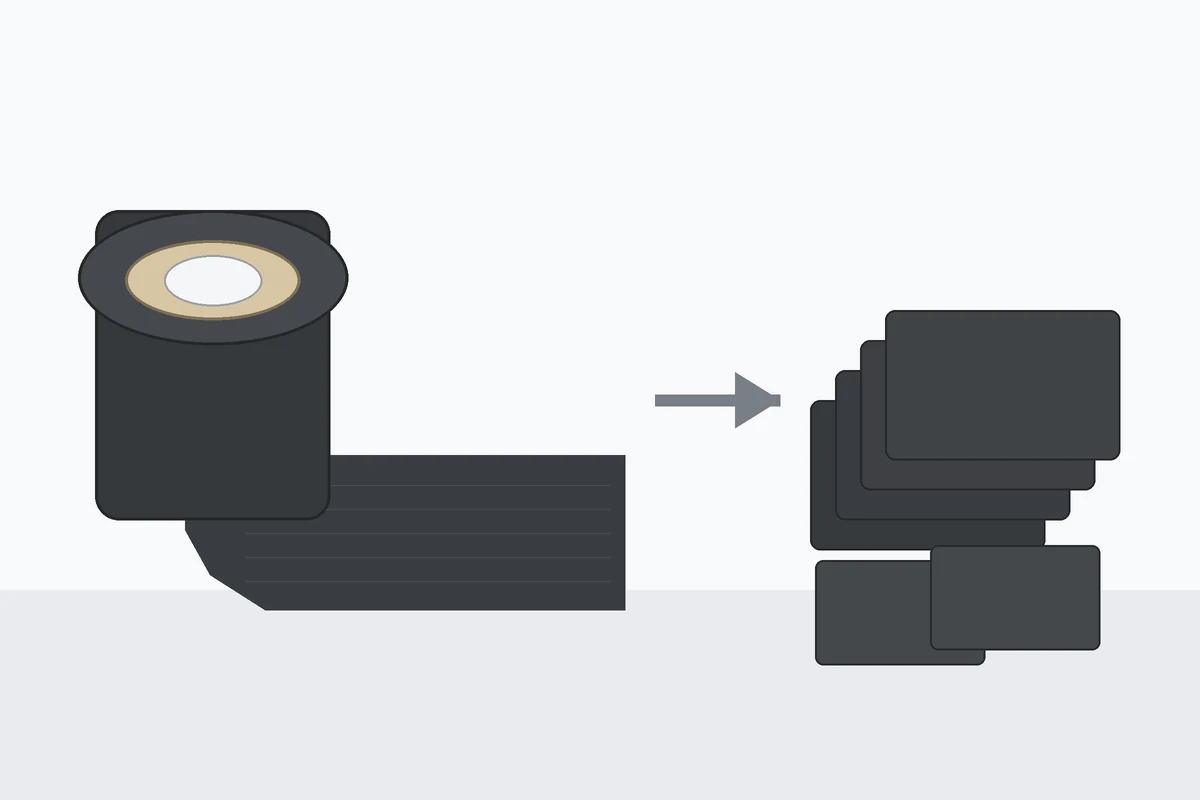
For rolls, common risks include edge crushing, telescoping, core deformation, movement inside the crate, abrasion of the outer layers, and moisture or contamination reaching damaged wrapping. A roll package should prevent movement while avoiding support points that concentrate load into the graphite. The converter should also check whether the lifting method used at receiving matches the way the roll was packed.
For sheets, the main risks shift toward corner and edge damage, bending of the entire pack, local compression from straps or stacking, sliding abrasion, and inadequate support under large formats. Sheet packs that survive container transport can still be damaged in the final warehouse move if forks do not fully support the pallet.
Damage cost should be measured by usable-material loss and production disruption. A small edge defect on a sheet may be irrelevant if the nesting plan trims that edge away; the same defect can be critical if a large gasket must use nearly the full sheet. A damaged roll edge can create recurring scrap along many meters. Incoming inspection should therefore connect the observed defect to the converter’s usable cutting zone.
MOQ, Changeover, and Inventory Flexibility
The supply form that minimizes material cost on one order can increase working capital and changeover cost across the full order mix. MOQ, width or sheet-size combinations, lot sizes, and production scheduling belong in the decision.
Custom roll widths can improve yield, but every width added to inventory creates another stock item and may increase minimum order requirements. If demand is volatile, the converter can end up with a highly efficient roll width that sits unused for months. Standard sheets may have slightly worse nesting yield but better flexibility when the same format serves several gasket families.
Changeover also includes warehouse and machine setup. Switching from one roll width to another can require a lifting or unwind change. Switching sheet sizes can require different pallets, cutting programs, or die layouts. Count the actual setup work rather than assuming the physical material change is instantaneous.
For low-volume custom jobs, sheets can limit the amount of material committed to one specification. For stable high-volume families, a dedicated roll width can reduce repeated cutting waste. The decision should be revisited when the product mix changes; a supply form chosen for last year’s demand pattern may no longer be economical after a major customer, die layout, or machine changes.
When comparing supplier quotations, normalize the commercial unit before deciding which form is cheaper. A roll may be quoted by mass, area, or roll; sheets may be quoted by piece, pack, area, or mass. Convert both to an expected cost per accepted part using the converter’s own yield data. Freight and packaging should be included when one format needs heavier crates, longer pallets, special core protection, or additional warehouse handling. Otherwise the purchasing comparison can favor the lower unit price while hiding the cost that production actually experiences.
Choose Supply Form by Total Conversion Cost
Total conversion cost combines purchase price, usable yield, handling labor, machine setup, damage loss, warehouse space, inventory carrying cost, traceability work, and the cost of production interruption. Roll versus sheet should be decided on that combined record.
A simple decision sheet can track the following for each supply form:
- Issued material: kilograms or area released to the job.
- Accepted finished parts: parts or accepted area after conversion.
- Reusable remnant: material returned to controlled inventory.
- True scrap: nesting loss, damaged material, setup loss, and unusable remnants.
- Handling time: receiving, staging, loading, unloading, and internal transfer.
- Changeover time: machine or die setup attributable to the material format.
- Damage events: transport, warehouse, and production handling separated by origin.
- Inventory days: how long each specialized width or size remains in stock.
Use several representative jobs rather than one favorable nesting example. A roll may win for a large production family and lose for short custom orders. A sheet may be operationally convenient but create recurring width scrap on the converter’s highest-volume part. The purchasing strategy can also use both forms: rolls for stable high-volume programs and sheets for lower-volume, prototype, or variable geometry work.
The RFQ should state the supply form, width and length basis, thickness and material requirements, quantity tolerance where applicable, core or pallet expectations, labeling, lot traceability, and packaging needed for the converter’s handling system. Material tests and acceptance fields should remain consistent between roll and sheet if the converter expects the two forms to represent the same qualified flexible graphite material.
That is the main distinction. Roll and sheet are not different graphite technologies; they are different ways to deliver material into a conversion process. The better choice is the one that gives the converter the lowest controlled cost per accepted part while preserving material identity and handling quality.