“High purity” becomes a useful graphite-powder specification only after the buyer identifies what must actually be low. One application may be concerned mainly with metallic contamination. Another may care about sulfur, halides, ash-forming minerals, or species that interfere with a binder, high-temperature process, electrical function, or customer contamination limit. A single headline purity value collapses those different risks into one number.
The purchasing task is not to find the highest purity number. Identify which impurities can cause failure, confirm how they are measured, decide which results belong on the COA, and keep repeat lots comparable. Sensitive applications may need tight targeted limits; others do not benefit from a large analytical panel.
China’s current national reference GB/T 3521-2023, Methods for chemical analysis of graphite, provides a current graphite chemical-analysis framework. The Jixi municipal government’s graphite product quality inspection method catalogue also shows that different graphite product categories are associated with different analytical fields. Those sources support a basic purchasing principle: chemical control has to be connected to product and application context.
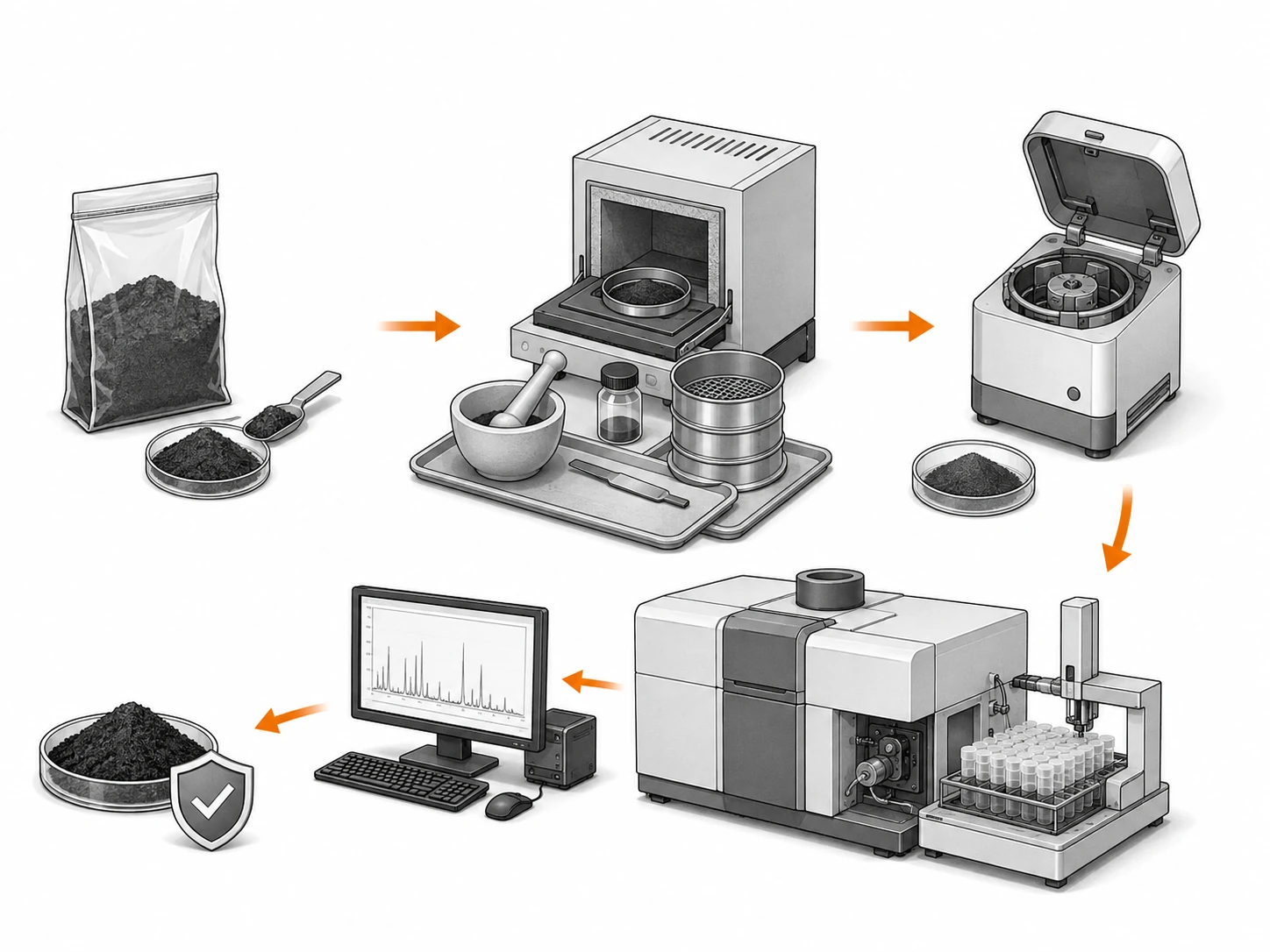
Start with the Application, Not a Generic Purity Percentage
The application determines which impurities deserve contractual control. Until the relevant fields and limits are written down, “high purity” is only a material-family description.
Begin by listing the failure mechanisms that contamination can create. In a contamination-sensitive thermal process, a metallic impurity may migrate, react, volatilize, or contaminate another material. In an electrochemical or electronics-related use, selected metallic elements or ions may interfere with the controlled material system. In a corrosion-sensitive assembly, sulfur or halide-related chemistry may deserve attention. In a friction formulation, mineral residue, sulfur, pH, or other fields can be relevant for reasons that are entirely different from those in an electronics process.
The material route also matters, but it does not replace analysis. Natural graphite begins with a geological feedstock and can carry mineral-derived impurities unless beneficiation and purification remove them. Synthetic graphite begins with carbonaceous feedstocks and controlled thermal processing, yet precursor, furnace, additives, handling, milling, and finishing can still influence the trace profile. The natural versus synthetic graphite powder guide explains those route differences without treating either material family as automatically purer.
Write the application requirement in operational language before choosing limits. Examples include “control metallic contamination for a qualified thermal process,” “control sulfur-related chemistry for a corrosion-sensitive customer requirement,” or “control ash and selected trace elements because the binder or downstream product has demonstrated sensitivity.” This wording forces the team to identify a mechanism instead of selecting an impressive purity figure first.
Group Impurities by the Failure They Can Cause
Impurities are easier to specify when they are grouped by the failure they can cause rather than by a long laboratory element list. The groups can overlap, but the structure helps the buyer decide which results deserve routine control.
| Impurity / chemistry group | Possible application concern | Evidence needed before making it contractual |
|---|---|---|
| Ash-forming mineral residue | Non-carbon residue, refractory/mineral contamination, process deposits, formulation variation | Application trial, customer specification, or lot-correlation evidence |
| Selected metallic elements | Contamination, electrical/electrochemical sensitivity, catalytic or high-temperature interaction | Defined sensitive element list and analytical basis |
| Sulfur-related chemistry | Corrosion, gas/thermal behavior, customer chemistry restriction | Defined sulfur result, method, and application reason |
| Halide / ionic species where relevant | Corrosion, electrochemical sensitivity, contamination control | Specific application requirement and agreed analytical method |
| Moisture and volatile-related fields | Handling, formulation compatibility, dry-mass basis, thermal processing | Process sensitivity and conditioning/test basis |
| Other application-specific species | Binder compatibility, downstream reaction, customer restricted substance | Documented mechanism or customer requirement |
This grouping prevents two opposite errors. The first is under-specification: asking only for total purity while ignoring a trace element that the application cannot tolerate. The second is over-specification: imposing a large list of ultra-low limits because another industry uses them, even though the current product has no demonstrated sensitivity.
Total ash and fixed carbon remain useful broad indicators. They can reveal whether the overall non-carbon fraction or carbon grade changed. They do not identify the composition of the residue. A low ash result can coexist with one application-relevant element at a level that still matters, while a higher ash result can be acceptable in an application that has no sensitivity to the mineral species present.
Separate broad composition fields from targeted impurity limits: the first help track lot consistency; the second protect a specific failure mechanism.
Different Applications Need Different Impurity Priorities
Different applications need different impurity priorities because the graphite interacts with different materials, temperatures, electrical environments, and contamination budgets. A single “semiconductor grade,” “battery grade,” “friction grade,” or “high-temperature grade” label is not enough unless the underlying requirements are defined.
The Jixi graphite testing-center method catalogue illustrates this application specificity. Its listed coverage for lithium-ion battery graphite materials includes particle distribution, moisture, fixed carbon, surface area, density-related fields, several metallic elements, multiple anions, sulfur, magnetic matter, and other product-specific tests. Its friction-material synthetic-graphite section expands the test package beyond basic carbon and ash data to sulfur, packing behavior, pH, silicon carbide, and lattice-related characteristics. That wider scope illustrates why an application-specific impurity package is more useful than a generic “purity” label. These are examples of different test menus, not universal requirements for all graphite powders.
A high-temperature industrial process may care about ash, selected metals, sulfur, or other residues because contamination can transfer to the processed material or equipment. A conductive coating may care about chemistry only where it changes dispersion, binder compatibility, corrosion, or electrical stability. A friction material can have another priority set. The same impurity field should not receive the same limit simply because each application uses graphite.
If the buyer serves several applications, maintain separate approved specifications rather than one “best grade” that carries the tightest requirement from every customer. Combining all limits can create a grade that is expensive to make, difficult to source, and unnecessarily restrictive for most orders.
This is also where the existing graphite purification methods comparison should remain separate. That article explains purification routes, residues, test context, and order specification. The current article does not rank purification methods. It starts after purification and asks which remaining impurities matter to the buyer’s actual application.
Confirm Which Test Method the Supplier Used—Not Which Method Is “Best”
The buyer should confirm which test method produced the supplier’s impurity result and whether that result is comparable with the qualification basis. The objective is method consistency and decision traceability, not a generic argument about which analytical technique is superior.

A number on a COA is incomplete if the measured property is ambiguous. “Sulfur,” “ash,” “metal impurities,” or “purity” can represent different preparation and measurement procedures. The purchase order should identify the agreed property and method reference used for release, especially when the limit is tight enough that normal method differences can change the pass/fail decision.
GB/T 3521-2023 is a current Chinese national chemical-analysis reference for graphite. Where that standard or another agreed method applies, record it with the result. If a supplier uses an internal method, the buyer should determine whether it was correlated with the qualification method before comparing the values directly.
Do not require a supplier to change methods merely because another laboratory reports more decimal places or a lower detection capability. More analytical sensitivity is only useful when it supports an application decision. A method that is repeatable, appropriate for the material, and correlated with the accepted specification can be more valuable for routine lot release than an analytically impressive result that cannot be compared with historical qualification data.
During supplier changes or laboratory changes, run an overlap study where practical. Test retained or split samples on the old and new basis, document the relationship, and update the purchase specification only after the team understands whether the numerical scale changed.
Packaging and handling belong in the impurity discussion when the material is sensitive enough that post-production contamination can erase the benefit of purification. Clean liners, closed containers, compatible sampling tools, protected transfer, and controlled storage can matter more than adding another decimal place to the supplier’s purity claim. If contamination control is a real requirement, write the packaging and handling condition into the order and verify it during qualification.
Trend results only on a consistent method and sampling basis. A gradual move toward the edge of the qualified window can justify investigation even before a lot fails, especially when the cost of contamination is high.
Do not combine unrelated impurity limits into a single “total metals” requirement unless the application truly responds to the combined quantity. A process may be sensitive to one particular element while tolerating others at higher levels, and a total value can hide that distinction. Conversely, a long list of individual elements adds little value when the application evidence shows that total ash is the only chemistry field correlated with performance. The specification should follow the mechanism, not the length of the laboratory report.
Lot Sampling and COA Evidence: What the Buyer Actually Needs
Lot sampling and COA evidence determine whether an impurity result represents the delivered graphite rather than one convenient laboratory portion. A tight chemistry limit is weak control if the sampling plan is undefined.
Define what constitutes a lot, how the sample is drawn, whether multiple containers or locations are represented, how the sample is combined or reduced, how contamination during sampling is prevented, and whether a retained sample is kept. High-purity materials can be especially sensitive to contamination introduced by tools, containers, dust, packaging, or laboratory preparation.
The COA should identify the lot and the contractual chemistry fields, together with the method where necessary. It should not become a dump of every result the laboratory can produce. Routine COA fields should be selected because they support release, trend analysis, or a documented customer requirement.
| Evidence item | Minimum question to answer | Why it matters |
|---|---|---|
| Lot identity | Which production lot does this certificate represent? | Connects the result to delivered material |
| Sampling basis | How was the laboratory sample selected and reduced? | Determines representativeness |
| Method reference | How was each contractual result measured? | Makes repeat results comparable |
| Release fields | Which impurity or chemistry results determine acceptance? | Separates contractual control from information-only data |
| Retained sample | Can the lot be rechecked after a customer or process issue? | Supports investigations |
| Change notification | Which supplier/process/laboratory changes require review? | Protects the qualification basis |
The graphite powder COA guide addresses certificate reading in more detail. For high-purity powder, the important rule is simpler: every critical impurity result must remain connected to a lot, a sample, a method, and an application reason.
Write an Application-Specific Impurity Specification
An application-specific impurity specification should contain only the chemistry controls needed to preserve a qualified process or customer requirement, while clearly separating those controls from broad material descriptors such as fixed carbon or total ash.
Start with material identity and use. State the graphite powder family, approved grade or qualification reference, intended application, and any customer specification that governs chemistry. Then list broad fields such as fixed carbon, ash, or moisture only where they are part of the approved material definition.
Next list the targeted impurity fields. For each one, record the reason, limit or qualified range, test method, sampling basis, and COA requirement. If the limit comes from a customer specification, preserve the customer reference. If it comes from an internal application trial, retain the trial record that supports it.
Avoid words such as “ultra-high purity,” “semiconductor grade,” or “low impurity” as contractual acceptance criteria unless they are followed by measurable requirements. These labels can be useful commercial shorthand, but they do not tell receiving inspection what to test or purchasing what constitutes a nonconforming lot.
Use qualification and routine control differently. The initial qualification can analyze a broader impurity panel to understand the material. Once the application-sensitive fields have been identified, routine COA and incoming control can focus on those fields while less critical data are monitored periodically or after a change.
When requesting high-purity graphite powder from QDZRT Graphite, provide the application, current powder if available, required graphite form and PSD, broad purity/fixed-carbon expectation, the specific impurity fields that matter, their source or application reason, the required analytical basis, lot/COA expectations, packaging or contamination-control needs, and the sample quantity needed for qualification. If a requested threshold has no documented basis, identify it as a trial target rather than presenting it as a universal graphite-industry rule.
If several programs buy the same powder family, keep the material identity common but separate application-specific chemistry requirements so one program’s tightest limit does not become universal by default.
Each critical impurity should be tied to an application risk, an agreed analytical result, a representative lot sample, and a release or monitoring decision. That turns “high purity” from marketing shorthand into a repeatable purchase specification.
At very low impurity limits, sampling can become part of the result. Use clean tools and containers when handling contamination could be comparable to the material limit, and add blanks or controls only where the application sensitivity justifies them.
References and Sources
- National Standard Information Public Service Platform — GB/T 3521-2023, Methods for chemical analysis of graphite. Current Chinese national graphite chemical-analysis reference.
- National Standard Information Public Service Platform — JC/T 2508-2019, Synthetic graphite for friction materials. Used as an example of an application-specific graphite product standard rather than a universal high-purity specification.