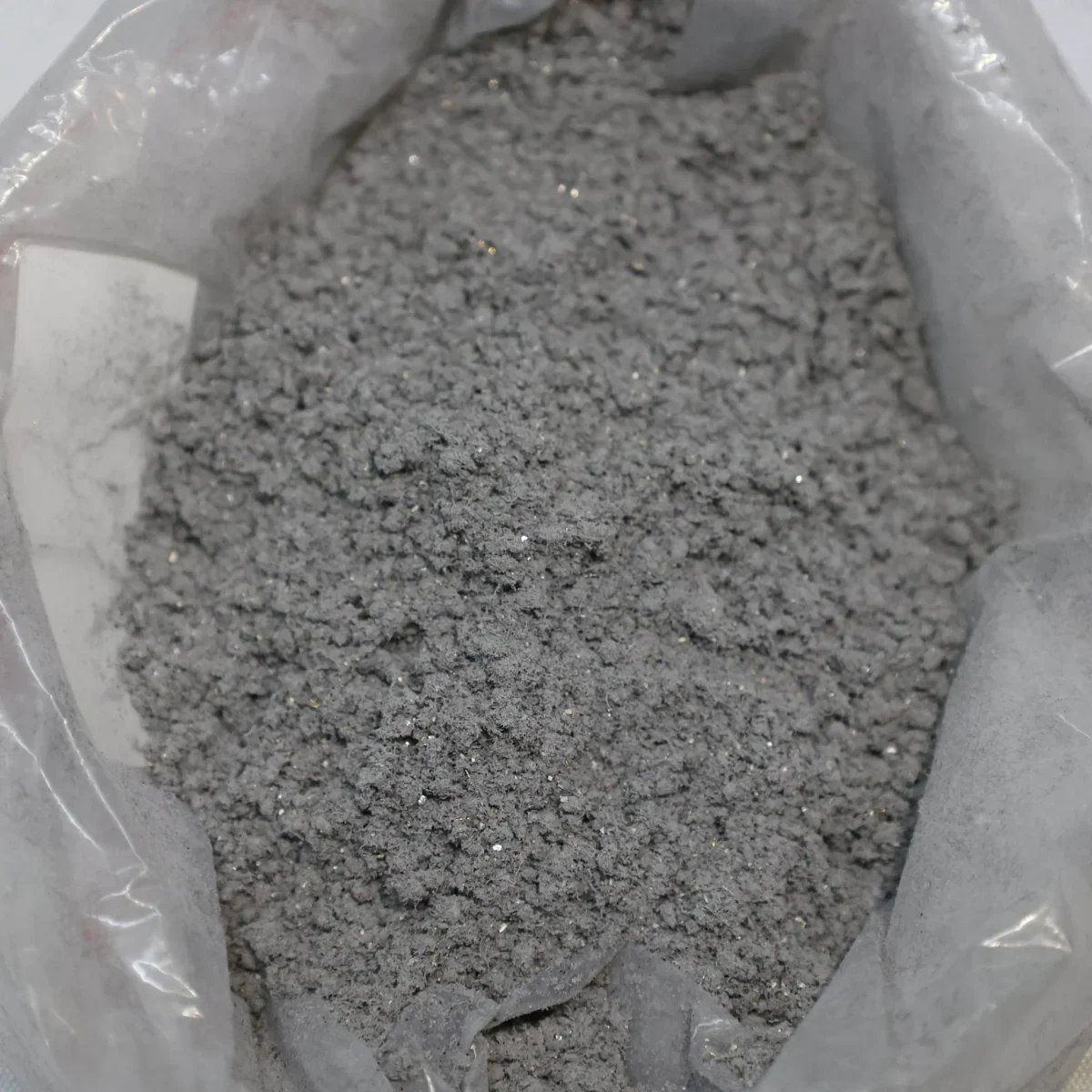
Fixed carbon is often the first number purchasing checks on a friction-grade graphite powder, but it is a poor endpoint for qualification. Friction formulations are multi-component systems in which graphite works beside binder, fibers, abrasives, fillers, metals, lubricants, and other friction modifiers. Particle-size distribution, morphology, ash composition, trace chemistry, moisture, bulk behavior, dispersion through the compound, and lot consistency can all change the way the graphite participates in processing and at the contact surface.
“Fixed carbon: pass” is only an entry condition. A friction formulation can still fail because of coarse particles, excess fines, mineral residue, morphology, or a lot-to-lot material shift. None of those effects can be read from one carbon percentage.
China has an application-specific industry standard for this material category. The National Standard Information Public Service Platform lists JC/T 2508-2019, Synthetic graphite for friction materials, as a current recommended industry standard covering requirements, test methods, inspection, marking, packaging, transport, and storage for synthetic graphite used in friction materials. The existence of a dedicated scope is important: friction-material graphite should be specified as an application material, not as generic “high-carbon graphite powder.”
Fixed Carbon Is Only the First Screening Number
Fixed carbon is useful for screening graphite powder, but it cannot describe the particle or impurity features that determine how the powder behaves in a friction compound. A buyer should treat it as one field inside a broader material definition.
Fixed-carbon methods typically separate the carbon fraction from moisture, volatile matter, and ash by an agreed analytical procedure. The result is valuable because it shows whether a material is broadly consistent with the expected carbon grade. It does not identify the mineral or elemental composition of the ash, the size of the graphite particles, their shape, their bulk handling behavior, or their interaction with the binder and other friction modifiers.
Two powders with similar fixed carbon can therefore produce different formulation results. One may contain a different coarse fraction. Another may be more finely milled. Their ash totals can be similar while the ash composition differs. One may flow and meter consistently while the other segregates or dusts. A supplier change can alter morphology or PSD while leaving the fixed-carbon line almost unchanged.
The natural versus synthetic graphite powder comparison provides the broader material-family framework. For friction materials, the next step is to identify which properties are connected to the qualified compound and its failure modes.
Do not respond to uncertainty by requesting the highest possible fixed carbon. Tighten the carbon limit only when formulation evidence, contamination sensitivity, or a customer requirement shows that it matters.
Particle Size and Morphology Need Their Own Controls
Particle size and morphology need separate controls because they influence mixing, distribution, contact behavior, and surface interaction independently of fixed carbon. The relevant control is the one that keeps the qualified friction formula reproducible.
Particle-size distribution should be read as a whole. D50 can describe the central population when an instrumental method is used, but the coarse tail and fines can matter more to a friction formulation. Coarse particles can distribute differently through the compound and may contribute to local surface variation. Fines can change dusting, mixing behavior, binder demand, packing, and the apparent volume of the dry blend.
For the measurement logic behind D50, D90, and distribution tails, use the micronized graphite PSD guide. This article uses those data only when they explain mixing, packing, molding, or friction-test behavior in the qualified formulation.
Morphology is equally important. Platelet-like, angular, granular, rounded, or irregular particles can occupy the compound differently and present different contact geometry after the friction surface is developed. Natural origin does not guarantee one morphology, and synthetic origin does not guarantee another. Milling, classification, shaping, and handling can substantially alter the final particle form.
Where morphology is process-sensitive, define how it will be assessed. Microscopy can support comparison, but one attractive image is not a lot specification. Sample preparation, field selection, magnification, and the feature being judged should be consistent. If morphology is only a diagnostic field during qualification, keep it as monitoring data rather than inventing an overly subjective acceptance limit.
Ash and Trace Components: Link Limits to the Formulation
Ash and trace-component limits should be linked to the friction formulation and its performance risks rather than copied from an unrelated high-purity graphite specification. Total ash tells the buyer how much non-carbon residue remains under the agreed method, but it does not identify what that residue contains.
Different mineral or elemental components can behave differently during mixing, molding, curing, and friction testing. The relevant chemistry may depend on the binder, other fillers, metallic ingredients, operating temperature, corrosion concerns, customer restrictions, or the required stability of the friction surface. A single low ash number therefore cannot prove that every chemically important component is controlled.
For friction grades, the chemistry method named on the COA matters more than the size of the analysis panel. GB/T 3521-2023, Methods for chemical analysis of graphite, is one current national reference; use it as method context, then make only formulation-relevant chemistry fields contractual.
The Jixi municipal government’s graphite testing-center method catalogue is useful evidence of application-specific practice. Its section for synthetic graphite used in friction materials lists fields including moisture, ash, volatile matter, fixed carbon, sulfur, tap density, pH, silicon carbide content, and lattice parameters under referenced methods. That list should not be copied into every RFQ. It demonstrates that a friction-grade definition can require several independent characteristics beyond fixed carbon.
Impurity selection is handled separately in the high-purity graphite powder guide. Here, a chemistry field belongs in release control only when the formulation, customer specification, or a demonstrated friction-material failure mechanism gives it a specific purpose.
Consistency Between Lots Matters More Than a Perfect One-Off Sample
Repeat-lot consistency matters more than one exceptional development sample. Qualification should show that the preferred graphite stays inside a material window that reproduces the same compounding and friction behavior over multiple batches.
Keep the graphite lot identity tied to every formulation trial. When an apparently identical material is received again, compare the new lot with the qualified lot for the fields that matter: PSD, fixed carbon, ash or chemistry, moisture, bulk or tap behavior where relevant, and any morphology observation used during development.
Trend the process result as well. A stable COA does not guarantee that every compounding step remained unchanged. Mixer loading, sequence, time, temperature, binder lot, fiber distribution, pressing or molding condition, cure, machining, and specimen preparation can all change the final friction result. The retained control lot is useful because it gives the laboratory a way to separate material change from process change.
| Consistency check | What to record | Why it matters |
|---|---|---|
| Incoming powder | Lot, PSD, carbon/ash fields, moisture, selected chemistry, bulk/tap behavior where relevant | Shows whether the delivered graphite changed |
| Compounding | Ingredient lots, addition sequence, mixer, batch mass, time, temperature | Separates powder variation from mixing variation |
| Forming/cure | Pressing or molding route, cure cycle, specimen preparation | Controls the structure entering the friction test |
| Friction test | Agreed test method, specimen identity, failure mode and result | Connects the material lot to actual application evidence |
| Retained sample | Reference graphite and, where practical, reference compound/specimen | Provides a control for investigations |
A supplier specification should include change notification for material or process changes that can affect the qualified fields. The buyer does not need access to every internal production detail, but silent changes to feedstock, milling, classification, purification, or another critical step can invalidate a formulation comparison if they shift the delivered powder.
Design the Friction-Material Trial Around Failure Modes
The friction-material trial should be organized around specific failure modes so that a powder difference can be connected to a measurable formulation consequence. Do not change several graphite variables and several formulation variables at the same time.
Start with the existing failure or target. Is the compound difficult to mix? Does the graphite segregate? Is the molded part inconsistent? Is the friction response unstable? Is wear unacceptable? Is the surface noisy or rough? Is there excessive dust, cracking, or another failure? The graphite trial should measure the outputs that answer that question.
Use the same base formulation, ingredient lots where practical, graphite addition basis, mixer, sequence, batch size, forming conditions, cure, specimen geometry, conditioning, and friction-test procedure. Replace only the candidate graphite in the first comparison. If the result changes, use powder data to decide which variable deserves a second trial.
Do not use universal friction-coefficient or wear thresholds in a graphite-powder specification unless the finished friction product and test conditions are defined. Those values belong to the qualified friction system, not to a generic powder. The graphite specification should preserve the material characteristics that were proven to support that system.
A practical trial sequence can move from broad to narrow. First compare candidate material families. Then isolate PSD if the results suggest a size effect. Next compare chemistry or ash profile if compatibility is suspected. Finally test additional lots of the preferred grade to make sure the result is repeatable.
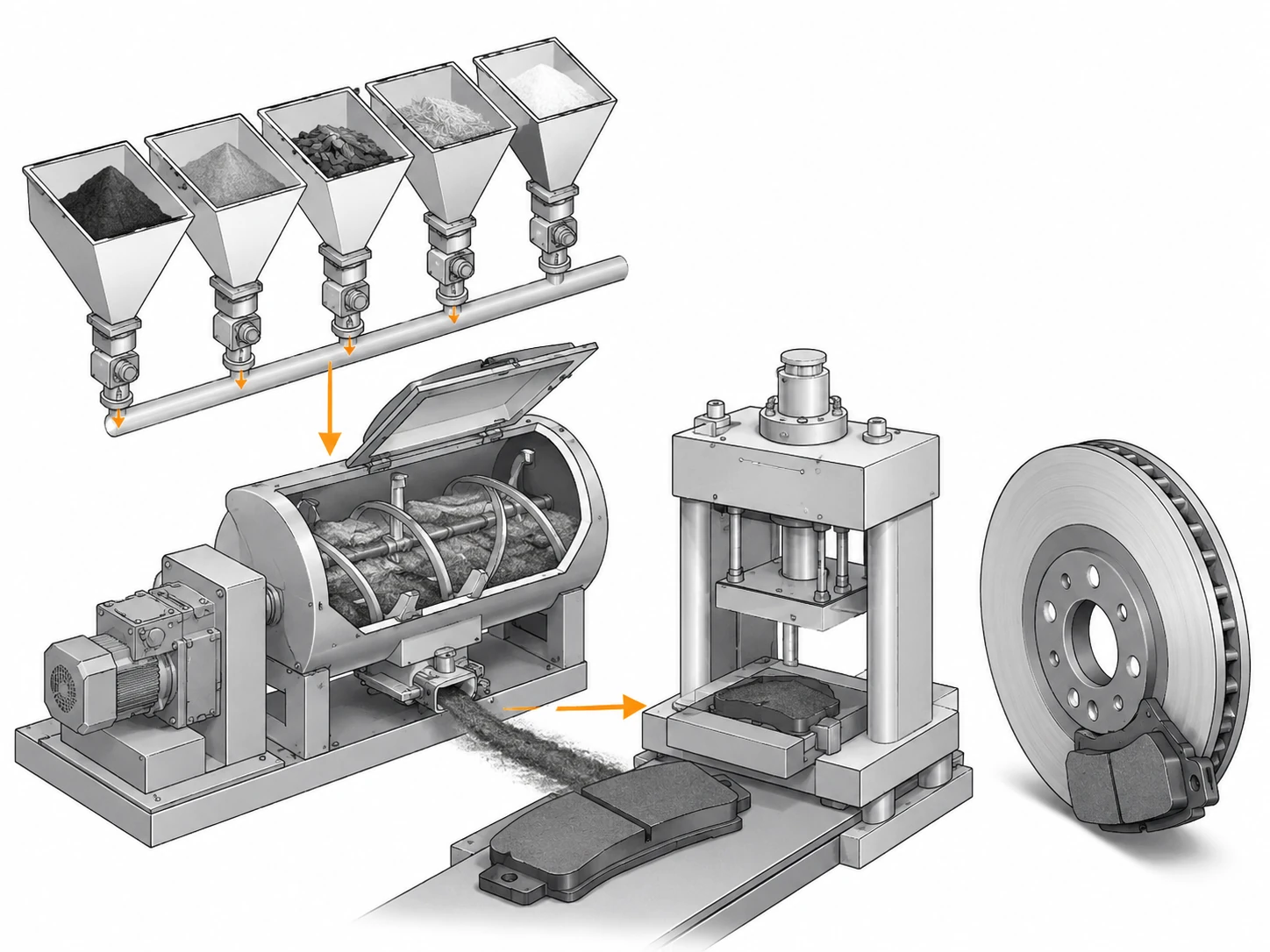
Pay attention to the relationship between mass dosing and occupied volume during qualification. Two graphite powders added at the same mass can occupy different apparent volumes in a dry blend, and that difference can change how the powder enters a mixer, how quickly it wets into the binder, and how uniformly it is distributed before forming. If the production process uses volumetric feeding, the effect can be larger because a fixed feeder volume may not deliver the same graphite mass after a bulk-density change. Record whether the development trial used mass-based or volume-based addition and do not assume those two approaches are interchangeable.
For handling-sensitive programs, include the commercial package in scale-up. Transport vibration, moisture pickup, and repeated transfer can change segregation, dusting, or agglomeration compared with a laboratory jar.
If a problem appears only after storage or a packaging change, check handling before blaming graphite chemistry. Keep enough lot and production history to identify which powder was used and which retained sample represents it.
Build a Supplier Specification from the Qualified Formula
The supplier specification should be written from the formula that passed the controlled trial, using only the graphite properties needed to protect that result. This produces a more durable purchase standard than copying every line from a supplier data sheet.
| RFQ / specification field | What to define | Reason |
|---|---|---|
| Application | Friction-material use and relevant product/process context | Prevents a generic powder from being treated as automatically equivalent |
| Graphite family | Natural or synthetic route / approved grade reference as qualified | Preserves the material family used in development |
| Particle definition | PSD fields, oversize/fines, or graphite fineness method as proven necessary | Controls the size features linked to compounding or friction behavior |
| Carbon and ash | Qualified range and agreed method | Controls broad composition without pretending it defines all impurities |
| Selected chemistry | Only sulfur, trace elements, pH, moisture, or other fields with an application basis | Avoids both uncontrolled risk and unnecessary testing |
| Handling fields | Bulk/tap behavior or packaging requirements only when process-sensitive | Protects feeding, dosing, storage, and mixing repeatability |
| Lot documentation | Lot identity, COA fields, sampling and retained-sample rule | Connects delivered powder to qualification evidence |
| Change control | Changes requiring notification or requalification | Protects the qualified formula from silent raw-material shifts |
Keep finished friction performance outside the powder COA. The supplier can certify agreed powder characteristics. The friction-material manufacturer must verify the compound and finished component under the qualified process and test. Mixing those responsibilities creates false confidence when a powder “passes” its certificate but the formulation has changed.
When requesting a new graphite powder for a friction-material program, send QDZRT Graphite the material function, current graphite if available, natural/synthetic preference if already qualified, particle-size information, fixed-carbon and chemistry requirements with their basis, mixing and forming route, sample quantity, and the friction or process failure being investigated. The more clearly the failure mode is defined, the easier it is to select candidate powder properties without over-specifying the order.
For repeat lots, confirm material identity, particle controls, carbon/ash and relevant chemistry, any handling change that can affect compounding, and the finished friction result where the qualification plan requires it. Keep those checks tied to the approved formulation revision.
Mixing sequence is another useful qualification variable. The same graphite can behave differently when it is added before or after resin, fibers, metal powders, or other friction ingredients because the sequence changes dispersion and local concentration. Record the addition order and representative mixing condition during candidate trials. If a later lot appears to change friction performance, rerun the retained reference graphite through the same sequence before assigning the cause to the new powder.
References and Sources
- National Standard Information Public Service Platform — JC/T 2508-2019, Synthetic graphite for friction materials. Current Chinese recommended industry standard specifically scoped to synthetic graphite used in friction materials.
- National Standard Information Public Service Platform — GB/T 3521-2023, Methods for chemical analysis of graphite. Current Chinese national graphite chemical-analysis reference.